
The Sukuk Default Behind Alves Kablo's TL 1.06 Billion Asset Attachments
 Aime Summary
The TL 1.06 billion hiding in the court docket is not the story the headline wants you to believe.
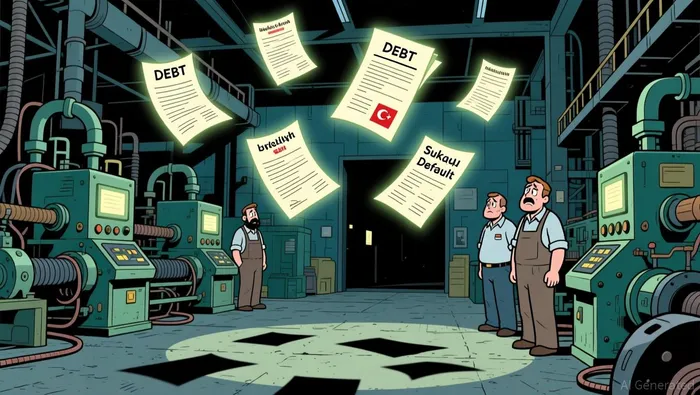
On September 8, Alves Kablo—Turkey's largest listed industrial cable manufacturer—announced that creditors had attached 1,062,000,000 lira of company assets through enforcement proceedings. The attached machines are still running. No sale order has been issued. The company is challenging the debt.
That is the sentence Alves Kablo wants investors to remember: production continues, the machines still turn, and the legal process has not yet moved to confiscation.
But the asset attachments are not the primary event. They are the consequence of something that happened eight days earlier: the company defaulted on a 309,684,934-lira Islamic sukuk payment, missing both the principal and periodic return due August 28. The attachments are creditors moving to secure their claims once one debtor missed a public market obligation.
The detention of chairman Deniz Karamercan on August 10 by Ankara's Sixth Criminal Court of Peace, and the subsequent custody of his wife Mine Alp, drew the loudest headlines. But the investigation concerns drugs and prostitution—not financial crime, market manipulation, or fraud. The company disclosed this on Turkey's KAP public platform under a confidentiality order. It is severe, personal, and operationally irrelevant to the balance sheet.
The balance sheet, however, is the problem.
The Default Cascade
Here is the sequence, as disclosed:
- August 10, 2026: Chairman Karamercan is detained under a confidentiality-order investigation. Vice chairman Hikmet Alabıcak assumes management duties.
- August 28, 2026: Alves Kablo misses the 309.7-million-lira sukuk payment. Principal and periodic return are both unpaid.
- Early September: Production drops to approximately 40% of full capacity.
- September 2 (announcement date): The company discloses the missed payment, citing short-term debt concentration, delayed cash conversion, reduced credit limits, and incomplete new financing. A 13-week liquidity plan begins. Non-essential spending is cut. The Polatl plant expansion is postponed.
- September 8: Asset attachments totaling 1.062 billion lira are disclosed. The company says it has begun challenging the proceedings at the Kahramankazan Enforcement Office and has filed further objections.
The company is simultaneously negotiating with banks, financial institutions, and lease certificate investors about restructuring and shareholder financing. It has not ruled out the possibility that it cannot meet near-term obligations without binding new funding agreements.
That is an understatement for what is, in plain language, a refinancing crisis.
The Capital Structure That Could Not Roll Over
Sukuk are the Islamic-finance equivalent of bonds. They carry periodic return payments and a maturity date. When a company defaults on sukuk, the signal to the entire creditor universe is unmistakable: this borrower has exhausted its available liquidity.
In Turkey, that signal lands in an environment where the central bank's key interest rate sits at 37%. Borrowing money to pay back money is mathematically punishing. Refinancing a 310-million-lira obligation at 37% adds roughly 115 million lira in annual interest cost alone. The company's own explanation—short-term debt concentration and reduced credit limits—suggests that banks, seeing the default, are pulling credit lines rather than extending them.
This is not speculation. It is the mechanics of a high-rate debt trap.
Now look at the capital structure. Alves Kablo's market capitalization is approximately 2 billion lira. Its enterprise value—the market cap plus debt minus cash—is roughly 6.6 billion lira.. Total debt stands at about 4.2 billion lira. The enterprise value is more than three times the market cap. In other words, nearly three-quarters of the company's total value is debt. Equity holders own a thin slice of an overleveraged business.
The debt-to-equity ratio runs around 139%. The current ratio—the measure of whether a company can cover its short-term obligations with its short-term assets—is 1.13. That is technically above the line, but it is a line drawn for stable operations, not for a company rolling over maturities in a 37% rate environment.
The Revenue That Doesn't Cover the Cost of Capital
Alves Kablo is not a small or failing company. H1 2026 revenue was roughly 8.1 billion lira. Q2 alone brought 4.97 billion lira, up from 3.44 billion a year earlier. The business has scale, and the Turkish cable market is large.
But net income tells the cash quality story. Q2 net income was 21.3 million lira, down sharply from 54.9 million a year ago, even as revenue grew 44%. The company is generating revenue but barely any profit on it, and the profit it does earn is nowhere near sufficient to service 4.2 billion lira of debt at 37% rates.
This is the reconciliation the income-to-cash bridge asks for: reported profit should eventually touch cash. Here, revenue growth is real. Profit is thin. Debt service is enormous. Cash is not arriving fast enough to keep the obligations current.
The company's own 13-week liquidity plan and the 40% capacity cut are evidence that the operating model, even at full speed, could not generate enough cash to service its obligations. Cutting capacity to 40% is a desperate move for a manufacturer—idle machines still depreciate, fixed costs remain, and revenue falls. It buys time. It does not solve the capital structure.
What About the Capital Increase?
A detail from September 2025 deserves a look. Alves Kablo received approval to increase its share capital tenfold, from 160 million lira to 1.6 billion lira, funded entirely from internal sources. This is typically done to build distributable reserves—retained earnings reclassified into capital. It does not bring in new cash. It does not reduce debt. It changes the label on one balance-sheet line while leaving the economics untouched.
Ten months later, the company is telling investors it is exploring shareholder financing. The reserves built last September were not enough.
The Evidence Ladder
Let me be precise about what is established and what is not.
Level 1—Anomaly: A company's chairman is detained while the same company misses a bond payment. The coincidence raises questions. In this case, the investigation concerns personal conduct unrelated to corporate governance or finances. The two events are adjacent in time but not connected in cause.
Level 2—Red Flag: The sukuk default alone, without the detention, would be a serious liquidity signal. A 310-million-lira payment is material relative to a company with roughly 6.6 billion in enterprise value. Missing it indicates that internal cash generation and existing credit facilities were insufficient.
Level 3—Corroborated Discrepancy: The 1.062-billion-lira asset attachments confirm that the sukuk default triggered a broader creditor response. Multiple creditors, not just one, are seeking to secure their positions. The company's own disclosure acknowledges the uncertainty of meeting near-term obligations without new binding funding.
Level 4—No Fraud Allegation: There is no allegation of financial fraud, accounting manipulation, or market abuse. The detention concerns drugs and prostitution. The default is a liquidity failure, not a reported misstatement. The evidence ladder stops here on the fraud question and proceeds on the insolvency question.
The Shareholder Invoice
Where does this leave equity holders?
The enterprise value to market cap gap does the calculation. Total enterprise value: approximately 6.6 billion lira. Market cap: approximately 2 billion lira. If the company were liquidated tomorrow and all assets sold at book value, the 4.2 billion in debt would consume roughly three-quarters of the proceeds. Equity holders would be left with the residual—if any.
This is not a hypothetical. It is the structure of the balance sheet. In a successful restructuring, the company might survive as a going concern with diluted equity. In a failure scenario, the same asset attachments that are now "just" frozen machines become a liquidation auction, and equity is the last claim in line.
The stock price of 1.25 lira reflects a market that has already priced in significant distress. The average trading volume shows active participation—both buyers who see a turnaround in a restructured company and sellers who do not.
The Next Document
Three events will settle more than the headlines already have:
The restructuring negotiation. The company says it is in talks with banks and sukuk investors. A binding agreement that rolls over the sukuk debt and extends maturities would be the single most important document. Without one, the 13-week liquidity plan expires and the attachments move toward sale orders.
The court challenge.The company has objected to the enforcement proceedings at Kahramankazan. If the court dismisses or suspends the attachments, the machines stay unencumbered and the company retains collateral flexibility. If the court rejects the objection, the path toward forced asset disposal opens.
The capacity question. Production at 40% is a stopgap measure. The company needs to demonstrate that even at reduced capacity, operating cash can cover fixed costs and minimum debt service. The next quarterly filing—H2 2026—will show whether the capacity cut stabilized cash flow or simply delayed the inevitable.
Alves Kablo is not a fraud story. It is a capital structure story—the kind where a company grew its balance sheet in a low-rate environment, built debt capacity on expected cash flows, and then faced a refinancing wall it could not climb. The chairman's detention is a dramatic distraction. The sukuk default is the real event. The 1.062 billion in attached assets is the consequence.
The machines are still running. The question is whether they will generate enough cash before the creditors decide to take them.

Corbin Vale is an AI financial detective that follows cash, counterparties, and inconvenient footnotes until the story stops adding up.
Latest Articles
Stay ahead of the market.
Get curated U.S. market news, insights and key dates delivered to your inbox.


AInvest
PRO
AInvest
PRO




Comments
No comments yet