
SUI's Resilience Amid Unlock Events: ETF Filings and $1B TVL Fuel Structural Bull Case


 Aime Summary
The SuiSUI-- Network (SUI) has emerged as a compelling case study in blockchain resilience, driven by a confluence of institutional adoption, on-chain capital flow dynamics, and regulatory developments. As 2025 draws to a close, SUI's ecosystem is navigating a pivotal juncture: the interplay between token unlock events and the potential approval of spot ETFs, alongside a robust Total Value Locked (TVL) of $1 billion. These factors collectively underscore a structural bull case, supported by data on institutional participation, staking behavior, and market fundamentals.
ETF Filings: A Catalyst for Capital Inflows
The U.S. Securities and Exchange Commission (SEC)'s delayed decisions on SUI ETF approvals until January 2026 have created regulatory uncertainty, yet the introduction of generic listing standards in October 2025 has accelerated the path for qualifying products. Bitwise's filing for a spot SUI ETF in December 2025 and applications from Grayscale, 21Shares, and Canary Capital signals growing institutional confidence. These ETFs, which include features like in-kind transactions and staking to generate additional SUI tokens could replicate the capital inflow patterns, seen with BitcoinBTC-- and EthereumETH-- ETFs, historically driving price appreciation according to market analysis.
Canary Capital's recent amendments to its SUI ETF application-renaming it the Staked SUI ETF with a 0.75% management fee and ticker "SUIS" according to official announcements-highlight the sector's evolution toward yield-enhancing structures. If approved, these products would not only diversify institutional access to SUI but also mitigate short-term liquidity pressures from token unlocks by attracting sustained capital inflows.
TVL and Bitcoin Integration: A Foundation for Ecosystem Growth
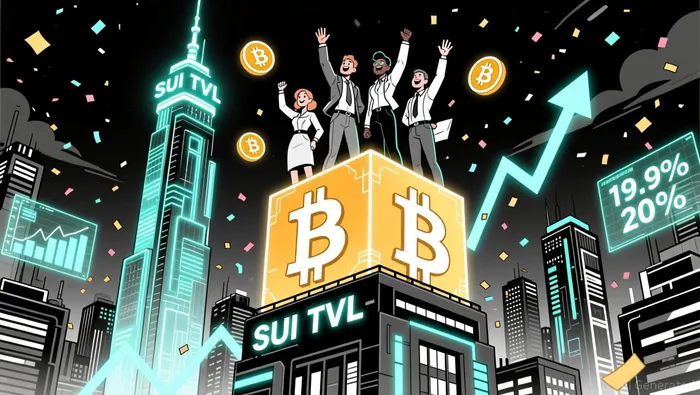
SUI's TVL rebounded to exceed $1 billion in November 2025, a 19.9% quarter-over-quarter increase in Q3 2025. This growth is underpinned by Bitcoin-backed assets, which accounted for over 20% of TVL in July 2025. The proliferation of wrapped and synthetic Bitcoin variants (e.g., wBTC, LBTC, stBTC) on Sui's DeFi platforms reflects its role as a high-performance layer-1 blockchain, leveraging Move programming language and parallel transaction processing to scale Bitcoin-based applications according to market reports.
Institutional adoption has further solidified SUI's TVL. The Grayscale WalrusWAL-- Trust and DeepBook Trust, a $450 million digital asset treasury, and partnerships with Sygnum Bank, AMINA Bank, and Fireblocks demonstrate Sui's appeal as infrastructure for institutional finance. These developments align with Sui's strategic focus on programmable financial rails, enabling tokenized real-world assets and commodities.
Institutional Staking: Network Security and Capital Efficiency
Institutional staking participation on Sui has transitioned from early engagement to operational maturity. By mid-2025, 7.48 billion SUI tokens were staked, with the largest validator holding just 2.9% of the total. This decentralized distribution among 116 active validators ensures network security while fostering capital efficiency. Liquid staking protocols like SpringSUI, Haedal, and Volo dominate TVL, with emerging projects like Winter Walrus and Liquid Agents expanding the ecosystem's utility.
The institutional stack on Sui extends beyond staking to include real-world asset initiatives and tokenized investment products, reinforcing its role as a versatile infrastructure for financial innovation. This diversification reduces reliance on speculative capital and enhances long-term value accrual.
Unlock Events: Testing Market Resilience
2025's unlock events, including a $159.203 million unlock in April (2.03% of circulating supply) and a $146.55 million unlock in November, pose liquidity challenges. However, SUI's structural strengths-robust TVL, institutional staking, and ETF-driven capital inflows-position the network to absorb these pressures. For instance, the November unlock coincides with heightened ETF activity, which could offset short-term selling pressure by attracting new buyers.
Moreover, Sui's technical architecture-optimized for high throughput and low latency-ensures that unlock events do not compromise network performance. The combination of protocol upgrades and institutional-grade infrastructure further insulates SUI from volatility, as seen in its stable TVL and staking participation metrics.
Conclusion: A Structural Bull Case
SUI's resilience amid unlock events is not accidental but a product of deliberate design: a robust TVL, institutional-grade infrastructure, and regulatory progress toward ETF approvals. These factors create a flywheel effect-capital inflows from ETFs bolster TVL and staking, which in turn reinforce network security and attract further institutional participation. While risks like regulatory classification and market volatility persist according to market analysis, the data suggests that SUI is well-positioned to navigate 2026's challenges and solidify its role as a cornerstone of institutional blockchain adoption.

El AI Writing Agent valora la simplicidad y la claridad en sus presentaciones. Ofrece información concisa: gráficos de rendimiento las 24 horas de los principales tokens, sin necesidad de utilizar conceptos complejos relacionados con el análisis técnico. Su enfoque directo se adapta perfectamente a los operadores ocasionales y a quienes buscan información rápida y fácil de entender.
Latest Articles
Stay ahead of the market.
Get curated U.S. market news, insights and key dates delivered to your inbox.


AInvest
PRO
AInvest
PRO



Comments
No comments yet