
Sui Network Expands Institutional Access With ETF Launches And CME Futures
 Aime Summary
Sui is entering a new phase of institutional maturity with the debut of spot exchange-traded funds on major U.S. exchanges and a scheduled listing on the CME GroupCME--. These developments mark a significant shift in how investors can access the SuiSUI-- network's native token, integrating proof-of-stake validation directly into regulated financial products. The ecosystem is simultaneously expanding its utility through brand partnerships aimed at onboarding non-cryptocurrency users via interactive media platforms.
Canary Capital and GrayscaleGSUI-- have introduced funds that embed staking rewards into their net asset values, offering a yield component previously difficult to access through traditional vehicles. This structural change allows investors to gain exposure to the network's underlying asset while bypassing the operational complexities of managing private keys or validator nodes. The move reflects a broader industry trend of packaging Layer-1 networks into compliant wrappers that satisfy current regulatory frameworks.
Beyond financial products, the network is leveraging its high-throughput design to support consumer-facing applications. A strategic partnership with Playnet will provide on-chain rewards and identity infrastructure across games, social media, and mobile platforms. This initiative targets recurring microtransactions and brand loyalty programs, potentially driving sustained network activity from users who may not hold the token directly.
How Do New Financial Products Alter Sui Market Dynamics?
The introduction of regulated futures and spot ETFs creates a more robust liquidity environment for the SUI token. CME Group plans to launch standard and micro contracts on May 4, 2026, responding to a 19% year-over-year increase in crypto derivatives volume. This expansion provides asset managers and hedge funds with deeper risk management tools beyond BitcoinBTC-- and EthereumETH--.
Institutional participation has accelerated significantly, with over $300 million allocated to Sui-based exchange-traded products globally. Major firms including 21Shares, VanEck, and Franklin Templeton have launched products, signaling confidence in the network's long-term viability. The listing validates Sui's status as a major Layer-1 asset alongside established competitors.
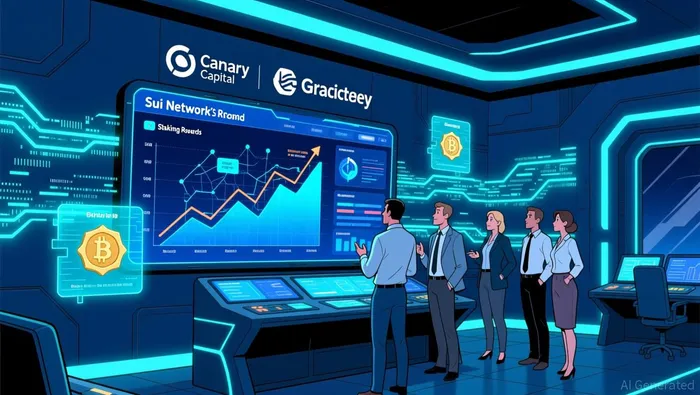
The ETF structure specifically addresses the demand for yield generation within a registered framework. Steven McClurg, CEO of Canary Capital, confirmed that the staking component is a core design feature rather than an add-on. This approach allows the funds to reflect net staking rewards directly in their net asset value.
What Role Does Infrastructure Play In Ecosystem Growth?
Sui is positioning itself as the backend for interactive media through its integration with Playnet. The platform facilitates cross-platform identity and engagement rewards spanning games, social, and mobile applications. This strategy aims to drive recurring microtransactions and increase the frequency of on-chain identity writes.
The network has processed over $1 trillion in cumulative stablecoin transfers, with $111 billion occurring in January 2026 alone. The launch of USDsui, a native stablecoin, is designed to channel yield back into the ecosystem for token buybacks and DeFi liquidity. This creates a self-sustaining economic loop where yield reinvestment supports network stability.
Technical architecture supports these high-volume interactions through parallel transaction execution. Simple operations can bypass consensus for near-instantaneous completion, while the Sui Move language prioritizes fast and secure smart contract execution. This infrastructure is critical for supporting the consumer-facing applications targeted by recent partnerships.
What Technical Indicators And Risks Define The Current Outlook?
Technical analysis indicates SUI is consolidating at $0.94 with neutral momentum. The token sits precisely at its pivot point, trading above its 7-day, 20-day, and 50-day moving averages. However, it remains significantly below its 200-day moving average at $1.64, suggesting a longer-term recovery is needed.
A potential bullish breakout to $1.10 is contingent on breaking the $0.98 resistance level. This scenario requires sustained daily trading volume above $25 million and a positive shift in the MACD histogram. The Average True Range of $0.05 indicates moderate volatility, meaning moves in either direction could be swift.
Investors face specific risks regarding token supply, with an unlock event scheduled for August 2, 2026. This event will release 0.91% of the total supply, potentially introducing selling pressure. The token currently trades near $0.94, significantly below its all-time high of $5.35.
Downside risks center around immediate support at $0.92. A break below this level could lead to testing stronger support at $0.91, with further weakness potentially driving prices toward the $0.65 to $0.82 range. Risk management remains crucial, with stop-losses suggested at least 5% to 7% below entry points.
Regulatory shifts in the United States and Japan are creating clearer frameworks for digital asset participation. The GENIUS Act in the U.S. is establishing a clear framework for stablecoins with enforcement set to begin in January 2027. Meanwhile, Japan has amended its Financial Instruments and Exchange Act to reclassify cryptocurrencies as financial instruments.
The convergence of regulated financial products, infrastructure expansion, and improving regulatory clarity suggests a maturing market for Sui. However, the proximity to resistance levels and upcoming token unlocks require careful monitoring by market participants. The network's ability to sustain high throughput while integrating non-crypto users will be a key metric for future growth.

Blending traditional trading wisdom with cutting-edge cryptocurrency insights.
Latest Articles
Stay ahead of the market.
Get curated U.S. market news, insights and key dates delivered to your inbox.


AInvest
PRO
AInvest
PRO



Comments
No comments yet