
Sui Futures Launch CME Group May 2026 And Native Stablecoin USDsui
 Aime Summary
CME Group has announced plans to launch standard and micro futures contracts for SuiSUI-- (SUI) and AvalancheAVAX-- (AVAX) on May 4, 2026, pending regulatory approval. This expansion introduces a dual contract structure to enhance capital efficiency for both institutional and smaller market participants. Sui contracts will cover 50,000 SUI in standard sizes, with micro versions set at 5,000 SUI.
The move aligns derivatives markets closer to the 24/7 nature of crypto spot trading, with CMECME-- planning to begin 24-hour trading for its crypto suite starting May 29. This structural shift follows recent additions of CardanoADA--, ChainlinkLINK--, and Stellar futures, signaling a systematic approach to altcoin inclusion.
Concurrently, the Sui blockchain has officially launched its native stablecoin, USDsui, issued by Bridge, a Stripe company. The digital dollar is designed for scalable finance and global payments, generating yield that Mysten Labs intends to channel back into the Sui ecosystem.
How Does The CME Sui Futures Launch Impact Institutional Access?
The introduction of SUI futures addresses a critical gap in risk management tools for Layer 1 blockchain assets within the traditional financial framework. Giovanni Vicioso, CME Group's Global Head of Cryptocurrency Products, noted that average daily trading volume in the crypto suite rose 19% year-over-year in March.
The new contracts offer standard and micro-sized options to serve diverse market participants, mirroring the logic behind equity Micro E-mini products. This structure enables precise risk management for smaller portfolios while maintaining capital efficiency for larger institutional clients.
Industry leaders support the expansion, with Justin Young of Volatility Shares stating that a deeper marketplace benefits all participants. The listing validates Sui as a viable subject for institutional hedging, ensuring compliance with established market standards.
What Are The Implications Of The USDsui Stablecoin Launch?
USDsui is backed by bonds and liquid reserves, with a yield mechanism designed to return value to the Sui ecosystem through token repurchases or DeFi liquidity support. This structural innovation contrasts with traditional stablecoin models where reserve income often remains external to the underlying network.
The asset is already active across major Sui applications including Turbos, Cetus, Suilend, Bluefin, NAVI, and Scallop. Zach Abrams, CEO of Bridge, highlighted that the Open Issuance platform eliminates the complexity and extended timelines typically associated with stablecoin deployment.
Adeniyi Abiodun of Mysten Labs stated that the launch marks the beginning of Sui's payments journey. The network has already processed over $1 trillion in cumulative stablecoin transfers, with $111 billion recorded in January 2026 alone.
What Are The Technical Trajectories And Valuation Risks For Sui?
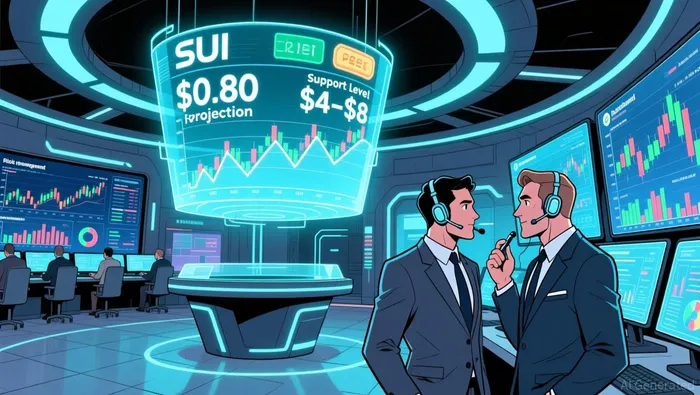
Analysts project Sui's price trajectory based on network growth, total value locked (TVL), and developer activity, with 2026 projections suggesting a range between $4 and $8. Sui is currently in a corrective phase, testing the $0.80 support level with a risk of dropping to $0.50 if support fails.
Key resistance levels to watch include $1.05, $1.60, and $2.00, with a breakout above $3.50 required to confirm a trend reversal. The object-centric architecture is positioned favorably for use cases like digital identity and supply chain management, though critical risks include technological vulnerabilities and competitive pressures.
Competitors like Solana operate on a monolithic architecture processing 2,000–4,000 transactions per second, while Sui leverages the Move language for gaming and high-speed consumer apps. The analysis highlights that the L1 landscape has shifted from generic competition to specialization, where user choice depends on specific use cases.
Long-term projections to 2030 consider technological evolution and regulatory landscapes, with Sui's growth potentially aligning with late 2020s market cycles. Investors are advised to monitor daily active addresses, transaction volume, TVL, and developer activity to assess fundamental health.

Blending traditional trading wisdom with cutting-edge cryptocurrency insights.
Latest Articles
Stay ahead of the market.
Get curated U.S. market news, insights and key dates delivered to your inbox.


AInvest
PRO
AInvest
PRO



Comments
No comments yet