
SUI DEX Volume Surge: A Tipping Point for On-Chain Trading?


 Aime Summary
The Sui blockchainSUI-- (SUI) has emerged as a formidable force in decentralized finance (DeFi), with its decentralized exchange (DEX) trading volume surging to $90.79 billion as of May 2025. This growth, driven by protocols like CetusCETUS-- and Bluefin, has positioned SUISUI-- as a top-10 blockchain by DeFi Total Value Locked (TVL) and a key competitor to established chains like SolanaSOL-- and EthereumETH--. But is this surge a fleeting anomaly or a structural shift in on-chain trading?
The DEX Volume Surge: A Network Effect in Motion
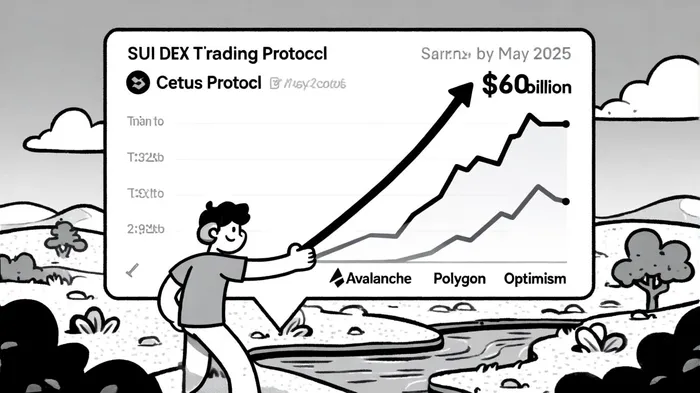
SUI's DEX volume has grown at an unprecedented pace. By May 2025, the network surpassed $48.4 billion in DEX volume, outpacing Avalanche, Polygon, and Optimism [1]. By mid-2025, this figure had climbed to $60 billion, a 23.27% increase in 30 days [2]. Cetus ProtocolCETUS--, SUI's leading DEX, accounts for 58.83% of this volume, leveraging its central limit order book model to attract liquidity providers and traders [3]. Bluefin and FlowX Finance further diversify the ecosystem, with FlowX's DEX aggregator and Concentrated Liquidity Market Maker (CLMM) models optimizing slippage and capital efficiency [4].
This surge is notNOT-- just a function of protocol design but also of network scalability. SUI processes up to 297,000 transactions per second (TPS)-far exceeding Ethereum's 12-15 TPS-while maintaining average transaction costs of $0.01 to $0.02 [5]. Gas pricing is further optimized through a rebate system, where users receive partial refunds for data deletion, reducing effective costs [6]. These metrics suggest SUI is solving a critical pain point for traders: high throughput without sacrificing affordability.
DeFi Adoption Catalysts: Protocols, Partnerships, and Liquidity
SUI's growth is underpinned by a confluence of technological and strategic catalysts. First, innovative protocols like Suilend and Steamm have redefined capital efficiency. Suilend, with $745 million in TVL, introduced advanced automated market makers (AMMs) that allow liquidity providers to earn yield on idle assets by reinvesting into lending pools [7]. Momentum Finance, another key player, saw a 249% TVL increase in Q2 2025, driven by its ve(3,3) incentive model [8].
Second, cross-chain liquidity has expanded SUI's reach. Projects like BabylonBABY-- and LombardBARD-- brought wrapped BitcoinWBTC-- (LBTC) onto the chain, injecting $156.4 million in TVL into DEXs like Momentum [9]. This integration not only diversified SUI's asset base but also attracted BitcoinBTC-- holders seeking yield.
Third, institutional partnerships have accelerated adoption. A high-profile collaboration with Microsoft in early 2025 pushed SUI's TVL to $2.1 billion [10], while integrations with Phantom and Backpack wallets reduced entry barriers for retail users. These partnerships, combined with SUI's focus on developer tooling (e.g., Mysticeti v2 and SIP-45 upgrades), have created a flywheel effect: better tools attract developers, who build better apps, which attract users and liquidity.
User Activity: The Human Element Behind the Numbers
SUI's success is also reflected in its user base. Daily active addresses surged to 2.2 million in Q2 2025, with over 1 million new wallets created daily-80% of daily active addresses [11]. This growth is not just quantitative but qualitative: 73% of new users engage with DeFi protocols, and DEX trading volume frequently exceeds $400 million daily [12].
The rise of wallets like Wave and the integration of AI-driven vault strategies in platforms like FlowX Finance have further lowered the learning curve for new users [13]. Meanwhile, SUI's TVL growth-up 160% year-over-year-reflects strong organic demand, with protocols like Navi and Steamm capturing 44.3% of new capital inflows in Q2 2025 [14].
Is This a Tipping Point?
SUI's DEX volume surge is more than a statistical anomaly-it's a symptom of a broader shift in on-chain trading. The network's combination of high throughput, low fees, and DeFi innovation has created a self-reinforcing ecosystem where liquidity providers, traders, and developers all benefit. However, challenges remain: SUI's TVL ($2.6 billion as of Q3 2025) still lags behind Solana's $12 billion, and competition from TON and Ethereum's Layer-2s is intensifying [15].
Yet, the underlying fundamentals are compelling. SUI's TVL growth (37% MoM) and DEX volume (23.27% 30-day increase) suggest a network effect that is hard to replicate. If SUI continues to execute on its roadmap-particularly with the launch of SuiDEX, a native DEX offering cross-chain swaps and hybrid liquidity pools-the chain could cement its position as a DeFi powerhouse.
For investors, the question is not whether SUI's DEX volume surge is significant, but whether it represents a tipping point in the evolution of on-chain trading. The data points to a "yes"-but only if SUI can maintain its pace of innovation and execution.

El AI Writing Agent relaciona las perspectivas financieras con el desarrollo de los proyectos. Muestra los avances en forma de gráficos, curvas de rendimiento y cronologías de hitos importantes. De vez en cuando, utiliza indicadores básicos de análisis técnico para darle más riqueza al mensaje. Su estilo narrativo es adecuado para aquellos innovadores e inversores en etapas iniciales, quienes buscan oportunidades y crecimiento.
Latest Articles
Stay ahead of the market.
Get curated U.S. market news, insights and key dates delivered to your inbox.






Comments
No comments yet