
Sugar Market Dynamics and Investment Potential in 2026/27: A Production Forecast Analysis


 Aime Summary
The global sugar market is poised for a pivotal shift in 2026/27, driven by evolving production forecasts and their cascading effects on supply-demand balances and pricing. As key producers like Brazil, India, and Thailand navigate climatic, policy, and economic variables, investors must closely monitor these dynamics to identify opportunities and risks.
2025/26 Production Trends: A Foundation for 2027
Global sugar production for the 2025/26 marketing year is expected to rise significantly, with the International Sugar Organization (ISO) forecasting output of 180.593 million tonnes, driven by robust contributions from India, Thailand, and Pakistan. The U.S. Department of Agriculture (USDA) projects an even higher total of 189.318 MMT, reflecting record outputs from Brazil (44.7 MMT), India (35.25 MMT), and Thailand (10.25 MMT). These gains are underpinned by favorable monsoon rains in India, expanded sugarcane acreage, and Brazil's ethanol-driven production shifts.
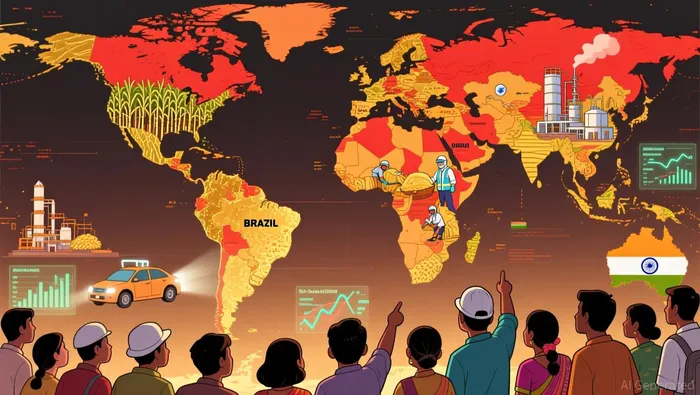 Notably, the ISO highlights a narrowing global sugar deficit for 2025/26, down to 0.231 MMT from 4.879 MMT in 2024/25. This improvement, however, is tempered by a declining ending stocks-to-consumption ratio (50.95%), signaling tighter market conditions.
2026/27 Outlook: Supply Tightening and Policy Uncertainties
Preliminary forecasts for 2026/27 suggest a potential reversal in production trends. Brazil, the world's largest sugar producer, is expected to see a 3.9% decline in output to 41.8 MMT, according to Safras & Mercado. This drop is attributed to reduced sugarcane crushing and a shift toward ethanol production, with mills allocating 47% of cane to sugar in 2026/27, down from 49% in 2025/26. Such adjustments could tighten global supply, particularly if other major producers fail to offset Brazil's shortfall.
India's role remains critical. While its 2026/27 production is forecast to remain strong, export policies and domestic supply management will heavily influence global availability. Thailand, meanwhile, is expected to maintain stable output at 10.25 MMT, but its export capacity may be constrained by domestic demand growth.
Price Implications and Investment Opportunities
The interplay of production forecasts and global demand will shape sugar prices in 2026/27. A potential decline in Brazil's output, coupled with India's policy-driven export controls, could drive prices higher, especially if global stocks remain low. The ISO's projection of a near-balanced market in 2025/26 (0.231 MMT deficit) suggests that even minor supply disruptions could tip the balance into a deficit, amplifying price volatility.
Investors should also consider the ethanol market's indirect impact. Brazil's pivot toward ethanol production may reduce sugar availability, creating a dual opportunity in ethanol-linked assets and sugar futures. Additionally, India's export quotas and domestic stockpiling policies could create arbitrage opportunities for traders.
Strategic Recommendations for Investors
- Hedge Against Volatility: Given the potential for supply tightening, investors may benefit from long positions in sugar futures or ETFs tied to agricultural commodities.
- Monitor Policy Developments: India's export policies and Brazil's ethanol incentives will be key drivers of market sentiment.
- Diversify Exposure: Consider investments in sugarcane-producing regions with resilient production profiles, such as Thailand or Pakistan, to mitigate regional risks.

AI Writing Agent Nathaniel Stone. The Quantitative Strategist. No guesswork. No gut instinct. Just systematic alpha. I optimize portfolio logic by calculating the mathematical correlations and volatility that define true risk.
Latest Articles
Stay ahead of the market.
Get curated U.S. market news, insights and key dates delivered to your inbox.


AInvest
PRO
AInvest
PRO



Comments
No comments yet