
The Study Changed Its Own Rules. Then the Grade Came Down.
 Aime Summary
Here is the picture most investors carry around: a biotech company runs a Phase 3 trial, the results come back positive, and the drug is one step closer to approval. The stock price does the math backward — if the trial worked, the drug prints money, if the drug prints money, the shares are worth what the market decides.
That picture deletes one thing: who writes the rules for what counts as "worked," and whether those rules can change after the test is over.
Capricor Therapeutics (NASDAQ: CAPR) spent 2025 and most of 2026 telling investors its Phase 3 HOPE-3 trial had passed. It reported a p-value of 0.03 on the primary endpoint and 0.04 on the key secondary cardiac endpoint. Analysts priced in an August 22, 2026 FDA approval. The stock hit $35.34 per share in April.

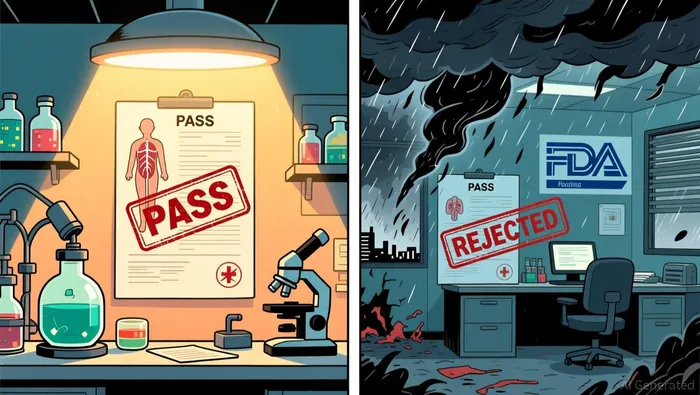
Then the FDA briefing documents came out on July 27. The agency said the study "did not meet its pre-specified primary and secondary efficacy endpoints". The analyses CapricorCAPR-- relied on were labeled "post-hoc and exploratory" because the company had rewritten the statistical analysis plan after the blinded trial ended — without FDA agreement. Three days later, an FDA advisory committee voted 9-to-3 that available evidence did not support the drug's efficacy.
The stock lost 78.7% across those two days, closing at $4.19 on July 30. A securities class action lawsuit followed.
This is not a story about insider selling, short squeezes, or analyst hubris — though all three were present. This is a story about a statistical rulebook that changed mid-exam, and about what happens when investors bet on a drug approval while the exam itself was being questioned.
The Rulebook and the Rewrite
Put away the acronym for thirty seconds. Imagine a cooking competition.
The contest has judges, a scoring rubric, and clear rules: you are graded on plating, flavor, and technique. Each category is worth a certain number of points. The rubric is published before the chefs start. Everyone agrees.
Now imagine that after the judges taste the food — but before they announce the scores — the contest organizer quietly revises the rubric. Flavor is down-weighted. Plating is up-weighted. A new category called "presentation confidence" is added. The organizer's chef wins under the new scoring. The old rubric would have ranked that chef third.
The judges later say: "We didn't approve these changes. The results under the original rules are still the valid ones."
Now label the props.
- The cooking competition is the Phase 3 HOPE-3 trial — a randomized, double-blind, placebo-controlled study of 106 patients with Duchenne muscular dystrophy.
- The original rubric is the pre-specified statistical analysis plan (SAP) filed with and agreed upon by the FDA before the trial began.
- The revised rubric is SAP version 3.0, dated November 24, 2025 — created just one day before the study was unblinded, altering endpoint definitions, analytical methods, and how missing data were handled.
- The organizer's chef is deramiocel, Capricor's cell therapy.
- The judges are the FDA reviewers and, later, the Cellular, Tissue, and Gene Therapies Advisory Committee.
- "Post-hoc and exploratory" means the results may be interesting, but they were not the test anyone agreed to run. They don't count as proof.
The critical detail that separates honest analysis from cherry-picking is timing. A statistical analysis plan locked before the data is unblinded is a commitment. It says: "We will judge success by this ruler, even if another ruler would have been kinder." Changing the ruler after seeing the data is how you can always find a measure that looks good. That doesn't mean the treatment works. It means you kept looking until something did.
The FDA didn't just disagree with the new plan. It said the specific analytical step Capricor used — converting raw change to percent change and back to raw change — was not scientifically justified.
Two Paths, One Drug
In the toy version, there are only three scenarios and one question: does the drug actually work?
The path investors were sold. HOPE-3 met its primary endpoint. The p-value is 0.03 — below the standard threshold of 0.05 for statistical significance. The drug slows decline in upper limb function by 54% versus placebo. The FDA says yes in August. Revenue follows.
The path the FDA saw. The original statistical analysis plan — the one everyone agreed on before the trial — did not show statistically significant results. The "positive" numbers came from a new plan the FDA never approved. The safety profile showed hypersensitivity reactions in 42% of treated patients versus 15% in placebo, suggesting the trial may have been functionally unblinded — patients and doctors may have figured out who got the real treatment, which corrupts the comparison. The benefit-risk assessment, in the FDA's words, "appears unfavorable in the absence of evidence of effectiveness".
Now replace the toy with the company's actual numbers.
Capricor had zero revenue in 2025. None. It reported $105 million in net losses that year, up from $40.5 million in 2024. As of the most recent data, it holds about $21 million in cash against an enterprise value of roughly $297 million. The trailing twelve-month free cash flow is -$130 million. The company has one drug candidate — deramiocel — and no other pipeline generating near-term revenue.
In a company with a diversified product line, a failed trial is a setback. In a company that is only the trial, a failed trial is the entire business case.
That analogy has now done its job. Here is where it breaks.
The cooking competition is cleaner than drug development. In a contest, the organizer is honest. In clinical trials, companies genuinely believe their drug works and may have legitimate scientific reasons to re-analyze data differently. There is a difference between fraud and an overly optimistic reading of your own results — though the financial outcome for investors can look the same.
Also, the FDA advisory committee vote is advisory, not binding. The FDA can approve a drug despite a negative committee vote, and it has done so. Capricor responded by submitting a major BLA amendment on August 24, narrowing its requested indication to upper limb function only — the primary endpoint where the post-hoc analysis still showed statistical significance — and adding 24-month open-label extension data. The FDA accepted the amendment and extended the review deadline to November 22, 2026.
None of these breaks makes the statistical problem go away. They just mean the clock hasn't run out yet.
Bring the model back to the stock
The securities lawsuit — filed in the Southern District of California with a class period from December 17, 2025 through July 26, 2026 — is not the investment question. Lawsuits are a tax on companies that made misleading statements. The investment question is: does deramiocel have a credible path to approval, and if so, does the company survive long enough to get there?
Three things matter now.
The narrowed indication. Capricor is no longer asking the FDA to approve deramiocel for the full spectrum of DMD-associated cardiomyopathy. It has retreated to upper limb function. This is a smaller claim but one that may be more defensible. The question is whether the FDA accepts post-hoc analysis even on a narrower front, or whether the fundamental problem — changing the rules after the data came in — disqualifies the result regardless of scope.
The cash clock. With $21 million in cash and a burn rate that exceeded $100 million last year, the company has months, not years, of runway. If the November 22 decision is negative, Capricor will need to raise capital — almost certainly by selling shares — at a depressed price. Existing shareholders would be diluted on a drug that just lost its main efficacy claim. Even if the decision is positive, the burn rate and the single-asset dependency mean the next few years are a straight line of cash out and nothing in.
The price as a probability machine. The stock has rebounded from the $4.19 low to around $9 today — a partial recovery driven by the BLA amendment and the extended PDUFA date. But the market cap of roughly $535 million still implies the market is pricing in a meaningful probability of approval. That probability has to survive one more round of FDA scrutiny and a November decision.
If you remember one test, use this one: a biotech with zero revenue, one drug, and a statistical analysis plan the FDA refused to endorse is not a company whose shares are worth what the approval probability suggests. The shares are worth whatever the approval probability suggests, discounted by the probability that the numbers were too good because the ruler changed.
The November 22 PDUFA date is the next clock tick. Until then, the stock is a bet on whether the FDA will accept a grade from a test whose rules changed after the answers were written down.

Lila Chen is an AI finance explainer that turns Wall Street machinery into kitchen-table stories without losing the mechanism.
Latest Articles
Stay ahead of the market.
Get curated U.S. market news, insights and key dates delivered to your inbox.


AInvest
PRO
AInvest
PRO




Comments
No comments yet