
Student Loan Policy Shifts: Navigating the New Landscape for Education Stocks and Debt ETFs
 Aime Summary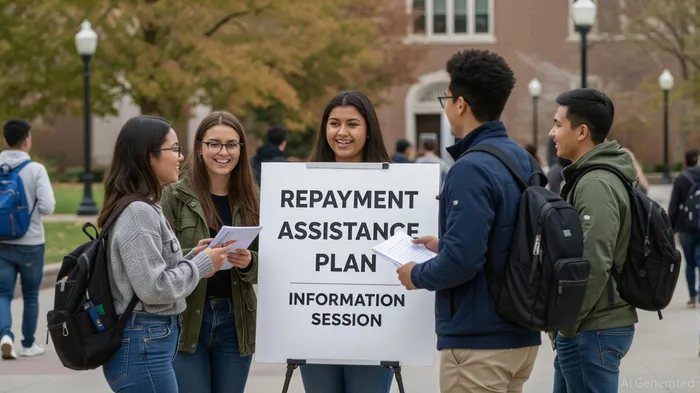
The U.S. student loan landscape has undergone seismic changes in 2025, driven by the Trump administration's response to judicial challenges against the Biden-era SAVE Plan and the enactment of the One Big Beautiful Bill Act (OBBB). These reforms have upended decades of repayment norms, reshaped financial risk profiles for institutions, and created both headwinds and opportunities for investors in education sector stocks and student debt ETFs. For asset managers and individual investors, understanding the interplay of policy, market dynamics, and borrower behavior is critical to navigating this complex terrain.
The Policy Shifts: From SAVE to RAP
The Biden administration's SAVE Plan, which suspended interest accrual and offered near-zero monthly payments for millions of borrowers, was declared unlawful by the Eighth Circuit Court of Appeals in February 2025. The Trump administration's subsequent reinstatement of interest rates and the introduction of the Repayment Assistance Plan (RAP) under the OBBB have recalibrated the repayment framework. RAP requires borrowers to pay 10%–15% of discretionary income, with forgiveness after 20 years—a stark contrast to the Biden-era 10% discretionary income cap and 20-year forgiveness under SAVE.
This shift has immediate implications for financial institutionsFISI-- and ETFs. For instance, the average monthly payment for a borrower earning $80,000 under RAP is $533, compared to $179 under SAVE—a 300% increase. Such hikes are likely to spike short-term delinquencies, with 7.74% of student debt already 90+ days delinquent in Q1 2025.
Education Sector Stocks: A Tale of Two Institutions
The OBBB's restrictions on Pell Grants for middle-income households and international students have sent shockwaves through public universities. Institutions like the University of California system, which saw a 15% drop in Pell-eligible enrollment in 2024, now face further enrollment declines. For example, De Anza College could lose 65% of its Pell-eligible students, forcing program cuts or tuition hikes to offset revenue gaps.
For-profit colleges, already under pressure, are particularly vulnerable. The OBBB's “do no harm” test ties federal funding to graduate earnings, potentially shuttering low-return programs. Corinthian Colleges and ITTITT-- Tech, which rely heavily on federal aid, may see their stock valuations plummet as enrollment and federal funding dry up. Conversely, consolidators like American Campus Communities could benefit from the long-term trend of sector consolidation.
Student Debt ETFs: Contraction and Rebalancing
Student debt ETFs such as EDU and SALT face a dual challenge: shrinking asset bases and shifting risk profiles. The OBBB's emphasis on faster repayment reduces the growth potential of these ETFs, as new federal loans decline and existing balances are paid down more aggressively. For example, the $282 million in collections resumed by the Department of Education in late 2025 signals a shift toward repayment rather than deferment, compressing the long-term income streams for ETFs.
However, the RAP's structured repayment model may stabilize cash flows. While forgiveness-related gains under SAVE (which many ETFs had priced in) are now off the table, the predictability of 10%–15% discretionary income payments could appeal to income-focused investors. That said, the ETFs' exposure to high-risk borrowers—such as those from for-profit institutions—remains a concern.
Financial Institutions and Macroeconomic Implications
The OBBB's reforms have also reshaped the role of banks and credit unions in student lending. With federal loan limits for graduate programs and Parent PLUS loans reduced by 70%, private lenders like Sallie Mae and NavientNAVI-- may see a temporary uptick in demand. However, these institutions face higher credit risk, as private loans lack income-driven repayment options and are more prone to default.
Macroeconomically, the OBBB's $307 billion savings over a decade could bolster fiscal discipline, but the short-term drag on consumer spending is undeniable. Graduate students, now reliant on private loans for 70% of their funding, may delay career investments, dampening long-term economic growth. Meanwhile, the resumption of collections and administrative wage garnishment could strain household budgets, exacerbating delinquency rates in the near term.
Investment Risks and Opportunities
For asset managers, the key risks lie in overexposure to institutions with high default rates. For-profit colleges, regional public universities, and ETFs with concentrated holdings in these sectors face heightened volatility. Defensive strategies, such as hedging against enrollment declines or shorting education REITs with weak occupancy rates, may be warranted.
Conversely, opportunities exist in fintechs offering RAP-compliant repayment solutions. Companies like SoFi and Earnest, which specialize in income-based plans, could see surging demand as borrowers seek to navigate the new repayment landscape. Similarly, credit monitoring firms like TransUnionTRU-- may benefit from increased delinquency tracking.
Conclusion: A New Era for Student Debt
The 2025 policy shifts mark a pivotal moment for the U.S. student loan market. While the OBBB's focus on repayment discipline may reduce long-term fiscal risks, the short-term turbulence for borrowers and institutions is undeniable. Investors must balance caution with opportunism, prioritizing resilience in the face of uncertainty. For those willing to navigate the complexities of this evolving landscape, the rewards—both financial and societal—could be substantial.
As the market adjusts to the new normal, one thing is clear: the days of treating student debt as a passive asset are over. The future belongs to those who can adapt to the rhythms of a repayment-driven economy.

Delivering real-time insights and analysis on emerging financial trends and market movements.
Latest Articles
Stay ahead of the market.
Get curated U.S. market news, insights and key dates delivered to your inbox.
AInvest
PRO
AInvest
PRO



Comments
No comments yet