
Student Loan Overhaul: Navigating the Economic and Market Shifts Ahead
The U.S. Senate's recent passage of sweeping student loan legislation marks a pivotal moment for one of the nation's most pressing economic issues. With over $1.8 trillion in outstanding federal student debt, the law's provisions—ranging from repayment plan overhauls to borrowing caps—will reshape consumer behavior, financial sector dynamics, and investment landscapes for years to come.
Consumer Spending: A Tightrope Between Relief and Constraint
The legislation's phaseout of income-driven repayment (IDR) plans like PAYE and SAVE, effective July 2026, could force millions of borrowers into higher monthly payments under the new Repayment Assistance Plan (RAP). While RAP offers 30-year forgiveness—longer than current options—its rigid terms (e.g., minimum payments even with no income) risk straining budgets.
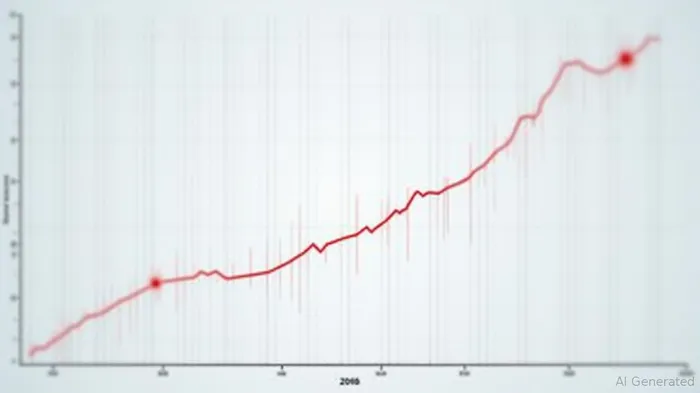
For lower-income borrowers, this could reduce discretionary spending on housing, travel, or retail goods. Conversely, those transitioning to RAP with manageable payments might see modest relief. The net effect, however, leans toward caution: a already shows a steady climb. The bill's caps on graduate and professional loans—capping Stafford loans at $20,500/year and eliminating Graduate PLUS loans—may deter enrollment in costly programs, indirectly curbing demand for education-related services.
Investors should monitor sectors tied to consumer discretionary spending. A slowdown in housing or autos could hit stocks like Home DepotHD-- (HD) or Ford (F), while education platforms like CourseraCOUR-- (COUR) or 2U (TWOU) might benefit from demand for shorter, cheaper programs.
Financial Institutions: Between Opportunity and Risk
The legislation's impact on banks and lenders is a double-edged sword. Caps on federal loans could push borrowers toward private lenders, favoring institutions like SLM CorporationSLM-- (SLM), which specializes in private student loans. A might reveal growth potential—if defaults stay manageable.
However, the bill's stricter terms for forbearance and deferments (e.g., limiting unemployment deferments) could spike delinquencies. The already hovers near 10%; without IDR safety nets, this could rise sharply. Banks exposed to student debt, such as regional lenders or portfolios held by institutions like JPMorganJPM-- (JPM), may face higher loan loss provisions.
The preservation of the Public Service Loan Forgiveness (PSLF) program is a bright spot. Sectors reliant on PSLF participants—healthcare, education, and nonprofits—could see stabilized workforce costs, benefiting firms like CVS HealthCVS-- (CVS) or HCA HealthcareHCA-- (HCA).
Policy-Driven Investment Opportunities
The legislation opens avenues for investors to capitalize on structural shifts:
Alternative Education Financing: With federal loans constrained, income-sharing agreements (ISAs) and vocational training platforms may surge. Companies like StrideLRN-- (LRN) or Guild Education (GLD) could attract capital as they offer cost-effective pathways to employment.
Debt Relief Services: Firms specializing in student loan consolidation or debt management, such as SoFiSOFI-- (sofi), might see increased demand as borrowers navigate the new system.
Sector-Specific Plays: Sectors benefiting from PSLF retention—such as renewable energy (NextEra Energy, NEE) or public infrastructure—could attract socially conscious investors.
Regulatory Arbitrage: Monitor bipartisan proposals to amend the bill, such as lowering interest rates (H.R. 2003). If passed, this could reduce refinancing costs for borrowers, easing pressure on consumer spending.
Conclusion: Positioning for Volatility
The student loan overhaul is a catalyst for both economic stress and innovation. While the legislation's long-term effects remain uncertain—especially if delayed provisions like school-based discharges are reinstated—investors must balance risk and reward.
Short-term strategy: Avoid overexposure to consumer discretionary stocks and banks with significant student loan exposure. Instead, explore alternative education providers and PSLF-linked sectors.
Long-term outlook: The bill's emphasis on private lending and vocational training points to a future where education finance diversifies. Investors should favor agility, monitoring policy changes and default trends closely.
The road ahead is fraught with uncertainty, but for those attuned to the shifts, it offers a chance to capitalize on the evolving landscape of education and debt.
Data queries and visuals are placeholders for interactive elements. Actual implementation would require real-time data feeds.

Stay ahead of the market.
Get curated U.S. market news, insights and key dates delivered to your inbox.
AInvest
PRO
AInvest
PRO



Comments
No comments yet