
The Student Loan Delinquency Surge: Navigating Risks and Opportunities in a Shifting Credit Landscape


 Aime Summary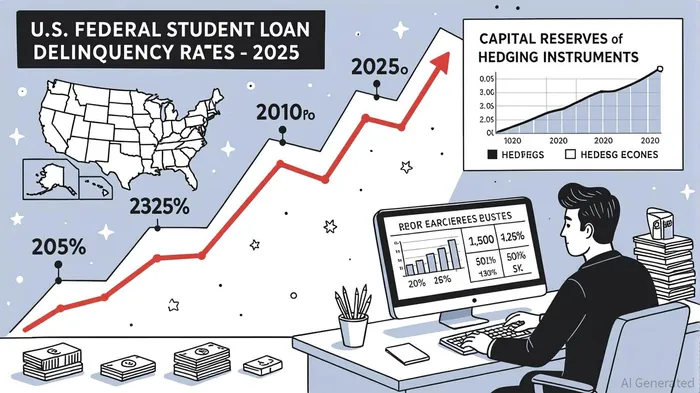
The end of pandemic-era payment pauses for U.S. federal student loans has triggered a seismic shift in the credit landscape. As of August 2025, delinquency rates have surged to 11.3%, with 34.4% of borrowers more than 30 days behind on payments. This crisis, fueled by the expiration of the SAVE Plan forbearance and the resumption of interest accrual, has created a perfect storm for financial institutionsFISI-- and consumer credit markets. For investors, the implications are twofold: a reevaluation of risk exposure in traditional banking portfolios and an emerging opportunity in alternative lenders and hedging instruments.
Macroeconomic Implications: A Credit Crisis in the Making
The resumption of student loan payments has exposed vulnerabilities in both borrower behavior and institutional preparedness. Older borrowers (ages 50+) now account for 18% of serious delinquencies, a stark increase from 10% in 2019. This demographic, often nearing retirement, faces compounding pressures from rising inflation, stagnant wages, and the resumption of high monthly payments. Meanwhile, younger borrowers, though less delinquent, are grappling with a $300 average monthly payment increase post-SAVE Plan expiration, according to the Student Borrower Protection Center.
For banks, the fallout is twofold. First, asset quality is deteriorating. The Federal Reserve Bank of New York reports that 23.7% of borrowers with scheduled payments are delinquent, a 200% increase from pre-pandemic levels. Second, interest income is under threat. With 8 million borrowers exiting forbearance, the resumption of interest accrual has inflated loan balances, reducing the likelihood of timely repayment. TransUnionTRU-- data reveals that 25% of defaulting borrowers were previously classified as “prime” (credit scores above 620), a shift that challenges traditional risk models.
Borrower Behavior and Policy Uncertainty: A Volatile Mix
The behavioral shift among borrowers is equally concerning. Many, particularly younger prime borrowers, lack repayment experience and are now facing the reality of debt management. The Federal Reserve's analysis highlights a “behaviorally unprepared” cohort: individuals with the financial means to repay but no prior engagement with repayment systems. This group's delinquencies are not driven by income insufficiency but by a lack of financial literacy or prioritization.
Policy uncertainty compounds the issue. The Trump administration's resumption of wage garnishment and the potential reinstatement of Social Security garnishments create a regulatory environment rife with volatility. Meanwhile, the Biden administration's pivot to the Repayment Assistance Plan (RAP)—which mandates minimum payments of $10/month even for zero-income borrowers—has further strained budgets. For investors, this regulatory tug-of-war introduces unpredictable risks for institutions reliant on stable repayment assumptions.
Financial Institutions: Adapting to a New Normal
Banks and credit unions are recalibrating their strategies to mitigate exposure. Capital reserves are being optimized through share buybacks and credit risk transfers (CRTs), a tactic highlighted in the Basel III Endgame re-proposal. Larger banks are leveraging CRTs and forward-flow arrangements to offload risk while retaining customer relationships. For example, JPMorgan ChaseJPM-- and Bank of AmericaBAC-- have expanded CRT programs to reduce risk-weighted assets, freeing capital for other ventures.
AI-driven risk modeling is another frontier. Institutions like Wells FargoWFC-- and Citibank are deploying predictive analytics to identify early signs of delinquency, using behavioral data (e.g., spending patterns, debt-to-income ratios) to refine credit scoring. This shift is critical: TransUnion estimates that 35.9% of newly delinquent borrowers had credit scores in the 620–719 range, a segment traditionally considered low-risk.
Investment Opportunities: Hedging and Alternative Lenders
The crisis has created fertile ground for alternative lenders and hedging instruments. Private credit firms, such as ApolloAPO-- Global Management and BlackstoneBX--, are capitalizing on the gapGAP-- left by traditional banks. These firms offer flexible repayment terms and tailored solutions for borrowers in late-stage delinquency, positioning themselves as intermediaries in the student loan ecosystem. Apollo's recent $5 billion expansion into consumer credit underscores this trend.
Hedging instruments, including CRTs and credit default swaps (CDS), are also gaining traction. For instance, the iShares Credit Risk Transfer ETF (CRTX) has seen a 15% inflow in 2025 as investors seek to offset potential losses in student loan portfolios. Similarly, forward-flow arrangements with private credit firms allow banks to transfer interest payments and credit risk, as seen in partnerships between regional banks and entities like KKRKKR--.
Strategic Recommendations for Investors
- Hedge Exposure with CRTs and CDS: Investors in traditional banks should consider allocating a portion of their portfolios to hedging instruments. CRTX and similar ETFs offer diversification and downside protection as delinquency rates climb.
- Target Alternative Lenders: Private credit firms with expertise in distressed debt and behavioral analytics are well-positioned to capitalize on the student loan crisis. Apollo and Blackstone's consumer credit arms present compelling long-term opportunities.
- Monitor Regional Banks: Institutions in high-delinquency states (e.g., Mississippi, Alabama) face elevated risks. Conversely, banks in low-delinquency regions (e.g., Massachusetts, Connecticut) may benefit from stable repayment rates.
- Leverage AI-Driven Financials: Banks investing in AI for credit risk modeling, such as JPMorganJPM-- and Citibank, are better equipped to navigate the evolving landscape. Their stock valuations reflect this strategic advantage.
Conclusion
The student loan delinquency surge is a macroeconomic inflection pointIPCX--, reshaping credit risk dynamics and investment strategies. While traditional banks grapple with deteriorating asset quality, alternative lenders and hedging instruments are emerging as key players in the new paradigm. For investors, the path forward lies in balancing caution with innovation—hedging against downside risks while capitalizing on the opportunities in a fragmented credit market. As the Biden and Trump administrations continue to clash over repayment policies, agility and foresight will be the cornerstones of successful investment in this high-stakes environment.

Stay ahead of the market.
Get curated U.S. market news, insights and key dates delivered to your inbox.
AInvest
PRO
AInvest
PRO



Comments
No comments yet