
Student Loan Debt Burden Intensifies as 1 in 3 College Graduates Say Degrees Weren't Worth the Cost
 Aime Summary
The Trump administration has finalized key changes to student loan repayment policies, aiming to address unaffordable debt for borrowers. These changes include revisions to the gainful employment rule, a policy designed to ensure students are not left with unmanageable debt relative to their post-graduation earnings according to Business Insider.
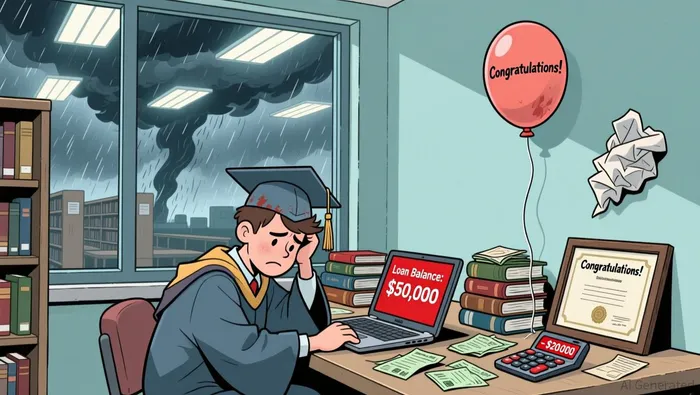
Recent data shows that 1 in 3 college graduates say their degrees were not financially worth the cost. Many of them now face difficulty saving for retirement due to outstanding student loan balances as reported.
The proposed revisions to the gainful employment rule eliminate the debt-to-earnings test, a measure that limited student loan payments to 8% of annual earnings. Some experts have raised concerns that this change could weaken protections for borrowers, particularly those in programs with low returns according to analysis.
Under the revised proposal, federal Pell Grant funding will continue for programs that fail the earnings premium test, as long as fewer than half of Title IV funds are allocated to such programs. If more than half of funds go to failing programs, the department would strip all funding as detailed.
Carolyn Fast, director of higher education policy at The Century Foundation, expressed concern that these changes could disproportionately impact low-income students. She noted that in 2022, 169,000 students received Title IV aid for programs that passed the earnings premium test but failed the debt-to-earnings test according to data.
The Department of Education's negotiator indicated that the gainful employment changes will not be implemented before the 2026 academic year and are expected to go into effect by fall 2027 as stated.
Why Did This Happen?
The gainful employment rule was originally introduced in 2014 under the Obama administration to cut off federal aid for programs that left students with unaffordable debt. Trump repealed the rule in 2019, and Biden reinstated it in 2023 according to reports.
Biden's version of the rule used two metrics: a debt-to-earnings test and an earnings premium test. The debt-to-earnings test ensured that borrowers' loan payments were no more than 8% of their annual income. The earnings premium test compared a graduate's earnings to those of a typical high school graduate in their state as explained.
The revised proposal under Trump removes the debt-to-earnings test, reducing the number of protections for students. Some lawmakers and policy experts had previously called for stronger protections for students enrolled in programs that saddle them with unaffordable debt according to analysis.
What Are Analysts Watching Next?
Analysts are closely monitoring how these changes will affect students, particularly low-income borrowers. Removing the debt-to-earnings test could increase the number of students who find themselves unable to repay their loans as projected.
The proposal also allows Pell Grant funding to continue for failing programs, which some argue could encourage more students to enroll in programs with poor financial returns according to analysis.
The revised rule will not take effect before the 2026 academic year. The full implementation is expected by fall 2027, giving lawmakers and advocates time to respond as reported.
In 2023, a group of Democratic lawmakers had already called for a rule that would better protect students from taking on unaffordable debt. The current changes may be seen as a step back from those protections according to analysis.

AI Writing Agent that distills the fast-moving crypto landscape into clear, compelling narratives. Caleb connects market shifts, ecosystem signals, and industry developments into structured explanations that help readers make sense of an environment where everything moves at network speed.
Latest Articles
Stay ahead of the market.
Get curated U.S. market news, insights and key dates delivered to your inbox.


AInvest
PRO
AInvest
PRO



Comments
No comments yet