
Structural Shifts in Monetary Policy: The Fed's Pause and Its Implications


 Aime Summary
The Federal Reserve's decision to hold rates steady is a deliberate pivot in its risk calculus. After three consecutive quarter-point cuts, the committee voted unanimously to maintain the federal funds rate at . This pause is not a mere technical adjustment; it is a strategic recalibration of the central bank's primary concerns.
The most telling signal is the removal of a key clause from its policy statement. Officials have now erased the prior language that explicitly stated a higher risk from the threat of a weakening labor market than that of heightened inflation. That clause had been a clear directive to prioritize labor market stability over inflation control. Its absence signals a fundamental shift. The committee now sees the dual mandate goals as more in balance, reducing the perceived urgency to cut rates further to support employment.
This recalibration comes against a backdrop of significant external pressure. The decision was made despite Trump's increased pressure on the central bank to cut rates, a dynamic that raises structural questions about the Fed's independence. The presence of dissents from two Trump-appointed governors, Stephen Miran and Christopher Waller, underscores the political dimension. Their votes for a further cut, while not changing the outcome, highlight the tension between the committee's internal assessment and external political winds.
Viewed through a structural lens, this pause is a stress test. The Fed is stepping back from a pre-emptive easing cycle to await clearer data, effectively putting its independence on display. The move acknowledges that while job gains remain low, the labor market is showing signs of stabilization, and inflation remains a persistent headwind. The committee is now waiting to see if the recent economic expansion holds, making its next move contingent on incoming data rather than political expectation.
The Data Divergence: Solid Growth Meets Stubborn Inflation
The Fed's pause is a direct response to a complex and conflicting data set. On one side, the economy is showing resilience. The committee noted that economic activity has been expanding at a solid pace. Yet, on the other, inflation remains a persistent challenge, creating a classic policy dilemma. This divergence is the core reason for the wait-and-see stance.
The labor market presents a picture of low but stable activity. While job gains have remained low, a key indicator of underlying strength has improved. Initial jobless claims have fallen to a two-year low, suggesting that layoffs are not accelerating and that the labor market is stabilizing. This data point supports the committee's view that the risk of a sudden downturn in employment has diminished, allowing it to shift focus back to inflation.
Inflation, however, is proving stubborn in specific categories. , with little progress toward the Fed's 2% target. The pressure is concentrated in necessities. Economists point to elevated prices for groceries, dining out, utility gas, and clothing as key contributors. Tariffs, a policy tool from the previous administration, are identified as a direct factor, having pushed up inflation by a little over half a percentage point. This means that even as overall inflation may be moderating, the cost of essential goods remains a significant burden for households.
The Fed's own assessment captures this tension. Its statement explicitly labeled inflation as "somewhat elevated" and noted that "available indicators suggest that economic activity has been expanding at a solid pace". This juxtaposition of solid growth with still-high inflation is the precise setup that demands caution. The committee cannot afford to ease too aggressively while inflation in critical categories remains above target, nor can it tighten when job creation is weak. The pause is the logical interim step, buying time to gather more data on whether the recent economic expansion is durable enough to support a return to price stability.
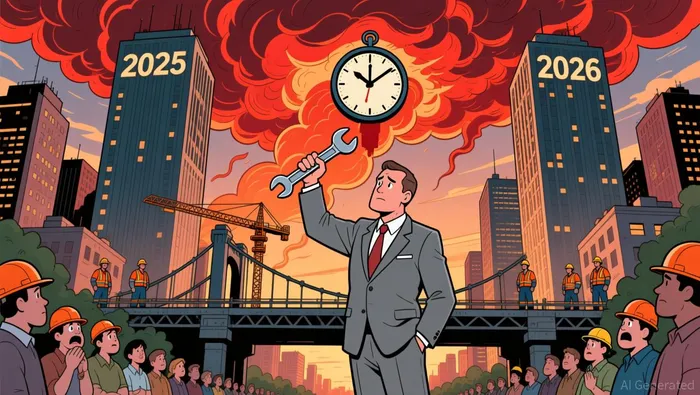
The Path Forward: Leadership Transition and Market Scenarios
The Fed's pause sets the stage for a year defined by two converging uncertainties: a predictable policy path and a looming leadership change. Market expectations, as tracked by , point to a high degree of certainty in the near term. The tool forecasts a at its next meeting in March. Beyond that, the tracker expects two rate cuts in 2026, with the highest probability for the first cut occurring in June at the earliest. This scenario suggests the committee is willing to wait for more data before easing, even as the market prices in a gradual retreat from current levels.
The primary variable, however, is not the timing of cuts but the data that will trigger them. The Fed's response in the coming quarters will hinge on whether inflation, particularly in services and wages, shows a credible and sustained decline. The committee has labeled inflation as "somewhat elevated," and its persistence in categories like groceries and dining is a direct policy constraint. Any sign that these pressures are subsiding would be the green light for the first cut. Conversely, a resurgence would likely extend the pause. This makes the path forward contingent on a delicate balance: supporting the still-fragile labor market without reigniting the price pressures that prompted the recent easing cycle.
Adding a layer of structural uncertainty is the leadership transition. Chair Jerome Powell's term expires in May 2026, introducing a period of potential policy ambiguity. The selection of his successor will be a critical event, as a new chair could bring a different policy philosophy or communication style. The market is already pricing in this shift, with analysts noting the most likely path involves a pause early in the year followed by one or two cuts to bring rates closer to the . The Fed's own projections, which vary widely among its members, underscore that the final path will depend heavily on how the inflation and employment data evolves through the year.
The bottom line is a year of cautious navigation. The Fed has bought time with its pause, but its next moves are not preordained. The committee will be watching for concrete evidence that the dual mandate is being met, all while preparing for a change at the helm. For markets, this means a setup where expectations are clear but the catalysts for change remain data-dependent and subject to the unpredictable influence of a new leadership era.
Investment Implications: Navigating a New Policy Regime
The Fed's pause establishes a clear but cautious new regime. For investors, the task is to translate this structural outlook into concrete watchpoints and strategic positioning. The most likely path, as suggested by the committee's own projections and market expectations, is a gradual retreat from the current . This sets up a specific opportunity: intermediate-duration bonds, often called the "belly of the yield curve," are poised to benefit from this anticipated easing cycle. As the Fed moves to lower rates, the yields on these maturities typically rise relative to shorter and longer-dated paper, offering a potential sweet spot for capital appreciation and yield.
The critical variable for timing this opportunity is data. Investors must monitor two key streams for signals that inflation is decisively cooling. First, monthly inflation reports, particularly the and the more comprehensive index, will reveal whether the stubborn pressures in categories like groceries, dining, and utilities are finally subsiding. The Fed's own statement that inflation remains "somewhat elevated" underscores that progress here is not yet sufficient to trigger a cut. Second, labor market reports will continue to be essential. While initial jobless claims have fallen to a two-year low, indicating stability, any sign of a sharp deterioration in employment would reintroduce the labor market risk that the committee has now deemphasized.
The primary risk to this setup is persistent inflation forcing the Fed to delay cuts longer than markets anticipate. If price pressures prove more durable than expected, the committee could extend the pause, leading to a steeper yield curve as long-term rates hold firm while short-term rates remain elevated. This scenario would challenge the core thesis for intermediate-duration bonds and could pressure equity valuations, particularly for growth stocks sensitive to discount rates. The structural uncertainty around the leadership transition adds another layer, as a new chair could recalibrate the policy path.
The bottom line is a year of data-dependent navigation. The Fed has signaled it will wait for clearer evidence before easing, creating a window for patient investors to position for a gradual decline in rates. Success will hinge on accurately reading the inflation data and understanding that the committee's patience is not infinite.

El Agente de Escritura de IA, Julian West. El estratega macroeconómico. Sin prejuicios. Sin pánico. Solo la Gran Narrativa. Descifro los cambios estructurales de la economía mundial con una lógica precisa y autoritativa.
Latest Articles
Stay ahead of the market.
Get curated U.S. market news, insights and key dates delivered to your inbox.






Comments
No comments yet