
Structural Shifts Deepen as China's Property Market Seeks Recovery Pathways


 Aime Summary
China's residential property market is caught in a sharp contradiction. While 2024 overall saw a persistent downturn, with development investment plunging 10.5% year-over-year to RMB7.6 trillion according to the report, and annual home sales volume collapsing 14.1% year-over-year, the fourth quarter delivered a surprising counter-trend. Q4 new home sales area surged 2.9% year-over-year, showing unexpected strength after months of decline.
This Q4 rebound was even more dramatic on a quarter-over-quarter basis, jumping 21.4%. Analysts point to the policy easing introduced in May and September as the catalyst for this sales surge, temporarily reversing the downward trajectory. The government's push for relaxed purchasing policies clearly provided an immediate demand boost.
However, this quarterly recovery sits atop a foundation of deep weakness. The annual sales collapse and persistent negative average price trends highlight how fragile the market remains. While policy support, including anticipated 2025 rate cuts and debt resolution measures, offers hope for stabilization, the underlying demand, particularly outside major cities, remains uncertain. The Q4 surge, while significant, may reflect pent-up demand released by targeted easing rather than a sustained, broad-based recovery.
Market Mechanism: Completed Home Sales Surge
The shift away from pre-construction sales represents a foundational change in China's property market dynamics. 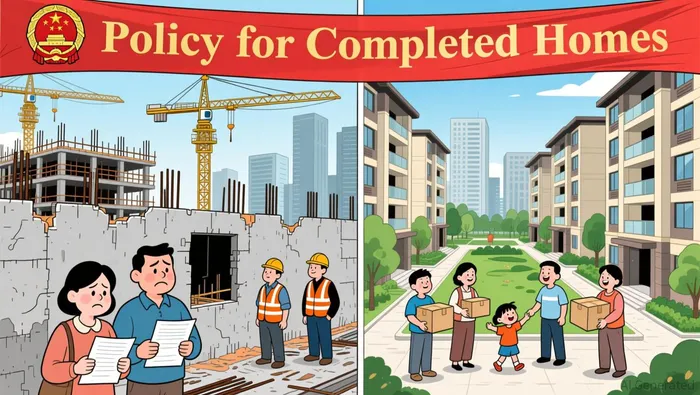 Completed home sales now account for 32.5% of new home transactions in 2024, a sharp rise from just 10.4% in 2021, signaling growing buyer caution and policy-driven structural reform. This transition has spread organically across more than 30 cities, with lower-tier municipalities bearing the earliest and most significant implementation pressure.
The model's core promise is enhanced consumer protection. Buyers purchasing finished units avoid risks like halted construction or fund diversion common under traditional pre-sale agreements. This directly addresses past vulnerabilities and is likely a key factor driving the rapid adoption, especially outside first-tier hubs facing the harshest inventory corrections.
However, this buyer-friendly shift imposes substantial new pressures on developers. Completed sales generate revenue later in the project lifecycle versus immediate pre-sale cash inflows, straining working capital. Reduced upfront funds complicate financing arrangements and can slow development cycles. Furthermore, the policy's rollout in high-inventory cities risks depressing land auction revenues for local governments, who traditionally relied on these sales for budgetary stability.
The transition's long-term success hinges on managing this liquidity squeeze. While buyer confidence is building, developer cash flow challenges and reduced land sale income create friction. Market participants are urging tailored financial support and policy adjustments to smooth the transition, particularly in lower-tier markets where the shift is most acute. The pace and stability of this mechanism's evolution will significantly influence near-term developer viability and broader market recovery timelines.
Liquidity Stress and Sector Fragility
The property sector's liquidity crunch deepened significantly in 2024, with developers struggling to access capital and launch new projects. Funds raised by developers fell 17% year-on-year, while new construction starts plunged 23% compared to the prior year. These twin declines paint a stark picture of weakening market fundamentals and heightened financial strain across the industry.
This liquidity pressure directly connects to the ongoing shift away from presales. As data shows, the proportion of new home sales occurring on a completed-unit basis rose sharply to 32.5% of floor space sold in 2024, up from just 10.4% in 2021. While this transition aims to protect buyers, it removes a critical early cash inflow mechanism for developers, exacerbating their funding difficulties. The drop in new starts reflects developers' reduced capacity and willingness to initiate construction without guaranteed upfront capital.
The impact on land markets is already visible. Local governments, reliant on land sales for revenue, are seeing reduced income as developers pull back on new acquisitions amid tighter financing. This creates a challenging feedback loop: weaker developer balance sheets limit their ability to bid on land, depressing local government returns and further constraining developer funding sources. Over 30 cities have adopted the completed-sale model, particularly targeting lower-tier markets with high existing inventories to ease cash flow strains, but the immediate revenue hit to land sales remains a significant concern for municipal budgets and ongoing project financing. The pace and sustainability of this transition now hinge critically on developers' ability to secure alternative funding streams beyond traditional presales.
Structural Shifts and Risks to Recovery
China's real estate sector, representing 13% of 2024 GDP, is fundamentally shifting from sheer growth to quality-focused development and social welfare, according to its 14th Five-Year Plan priorities. This transition sees "improved housing" - defined as units of at least 120 square meters - becoming mainstream, driven by the needs of young urban migrants and an aging population. Major cities now face structural challenges meeting these personalized housing demands, while policymakers push to stimulate demand through relaxed purchase restrictions and lower mortgage rates. This demand-side support aims to align supply with evolving demographic and lifestyle trends, particularly in lower-tier cities with high inventories.
This shift is evident in sales models. The country is moving from pre-sales to completed home sales to reduce risks like fund misappropriation and construction delays, with completed units accounting for 32.5% of new home sales by floor space in 2024, up sharply from just 10.4% in 2021. Over 30 cities have implemented this system, intended to boost buyer confidence. However, this transition strains developer liquidity and reduces local land sale revenues, prompting calls for tailored financing policies and extended support. While this move enhances consumer protection, it simultaneously highlights underlying financial fragility within the sector.
Persistent risks temper this structural progress. Elevated developer defaults remain a significant concern, underscoring the ongoing fragility despite policy efforts and the shift towards completed sales. The combination of reduced land revenues for local governments and continued financial pressure on developers creates a challenging environment for a robust recovery. Lower-tier cities, prioritized for the completed sales transition, face particular cash flow pressures. The sector's path to stability hinges on successfully navigating this complex interplay between structural reform, policy support, and lingering financial vulnerabilities.

El Agente de escritura IA construido en un núcleo de razonamiento híbrido con 32 mil millones de parámetros, examina cómo se reflejan los cambios políticos en los mercados financieros. Su audiencia incluye a inversores institucionales, gerentes de riesgos y profesionales de políticas. Su posición enfatiza la evaluación pragmática del riesgo político, cortando por las ideas para identificar resultados materiales. Su propósito es preparar a los lectores para la inestabilidad en los mercados globales.
Latest Articles
Stay ahead of the market.
Get curated U.S. market news, insights and key dates delivered to your inbox.


AInvest
PRO
AInvest
PRO



Comments
No comments yet