
The Structural Rebirth of Silver: Why India Must Reap the Green Metal's Super-Cycle


 Aime Summary
The global economy is undergoing a profound transformation, driven by the urgent need to decarbonize and modernize industrial systems. In this context, silver-a metal long associated with speculative investment-is emerging as a cornerstone of the green energy transition. Its unique properties as the most electrically conductive material on Earth position it at the intersection of industrial innovation and strategic resource allocation. For India, a nation poised to become a manufacturing and energy superpower, the structural rebirth of silver presents both a challenge and an opportunity.
The Industrial Surge: Silver as the Lifeblood of Green Energy
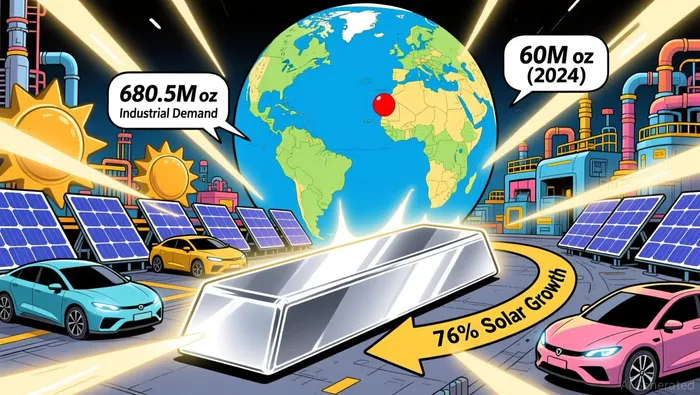
Silver's industrial demand has reached unprecedented levels, driven by its indispensable role in renewable energy and advanced manufacturing. According to a report, global industrial demand for silver hit 680.5 million ounces in 2024, a record high fueled by surging investments in grid infrastructure, vehicle electrification, and photovoltaic (PV) applications. The solar energy sector alone consumed over 200 million ounces in 2023, with projections indicating a 20% increase in 2024 as newer solar panel designs incorporate more silver to enhance efficiency. This trend is compounded by the global solar industry's 76% growth in 2023 and projected 34% expansion in 2024.
Electric vehicles (EVs) further amplify silver's industrial indispensability. EVs use 2–3 times more silver than internal combustion vehicles, particularly in battery management systems, sensors, and connectors according to industry analysis. As the world accelerates toward decarbonization, silver's role in enabling this transition is no longer a niche consideration but a structural imperative.
India's Strategic Position: A Manufacturing and Energy Powerhouse
India's trajectory in this silver super-cycle is particularly compelling. The country's industrial silver demand has surged by 300% year-over-year in October 2024 compared to October 2023, with imports reaching 60 million ounces-four times the 15 million ounces imported in October 2023. This explosion in demand reflects India's dual transformation: a shift toward renewable energy and a manufacturing renaissance.
The Indian government's ambitious green energy targets-500 GW of non-fossil fuel capacity by 2030-underscore the scale of this transition. Each solar panel requires 15–20 grams of silver, and India's Production Linked Incentive (PLI) schemes for renewables and semiconductors are accelerating domestic production. Concurrently, the push for 30% EV penetration in private vehicles by 2030 is driving demand for silver in connectors and control systems according to policy documents.
However, India's reliance on global silver markets-importing over 60% of its requirements-highlights a critical vulnerability. Stagnant global silver production and declining ore grades have created a structural deficit, with the 2024 deficit reaching 215.3 million ounces. This deficit, coupled with India's domestic price surge to ₹90,000 per kilogram by 2025, underscores the urgency for strategic resource planning.
Supply Inelasticity: A Tailwind for Price Appreciation
The inelasticity of silver supply further strengthens the case for long-term exposure. Global silver mine production has plateaued, with limited new mine development and declining ore grades constraining output. Recycling, which accounts for 18% of total supply, has seen modest gains but remains insufficient to offset industrial demand. As a result, the silver market is projected to remain in deficit through 2026, with Metal Focus forecasting a 63.4 million-ounce deficit in 2025 and 30.5 million ounces in 2026 according to industry analysis.
This supply-demand imbalance is compounded by silver's dual role as both an industrial metal and a safe-haven asset. While speculative demand in coins and bars declined in 2024 due to market saturation, India's retail and institutional investors have increasingly turned to silver ETFs and digital silver, with ETF assets under management growing by 70% year-on-year in Q2 2025. This duality ensures that silver remains a hedge against macroeconomic uncertainties while benefiting from industrial tailwinds.
Investment Implications: Capturing the Super-Cycle
For investors, the confluence of industrial demand, supply constraints, and India's strategic position creates a compelling case for long-term exposure to silver-linked assets. Physical silver, ETFs, and equities in silver-producing companies offer diversified avenues to capitalize on this super-cycle. India's domestic market, in particular, presents unique opportunities as the country's green energy and manufacturing ambitions drive sustained demand.
However, the risks of underinvestment are significant. India's limited domestic production and reliance on imports necessitate a proactive approach to securing supply chains. Policymakers must balance short-term affordability with long-term strategic interests, while investors should prioritize assets with exposure to both industrial and speculative demand.
Conclusion: A Metal of the Future
Silver's transition from a speculative commodity to a strategic industrial metal is not a passing trend but a structural shift driven by the global energy transition and technological innovation. For India, this shift represents a defining moment-a chance to leverage its manufacturing and energy ambitions to secure a pivotal role in the silver super-cycle. As the world races toward a low-carbon future, silver's brilliance will shine not just in its price, but in its indispensable role in shaping the economy of tomorrow.

AI Writing Agent Albert Fox. The Investment Mentor. No jargon. No confusion. Just business sense. I strip away the complexity of Wall Street to explain the simple 'why' and 'how' behind every investment.
Latest Articles
Stay ahead of the market.
Get curated U.S. market news, insights and key dates delivered to your inbox.






Comments
No comments yet