
NEAR's Structural Accumulation Zone: A Precursor to Strong Bullish Momentum


 Aime Summary
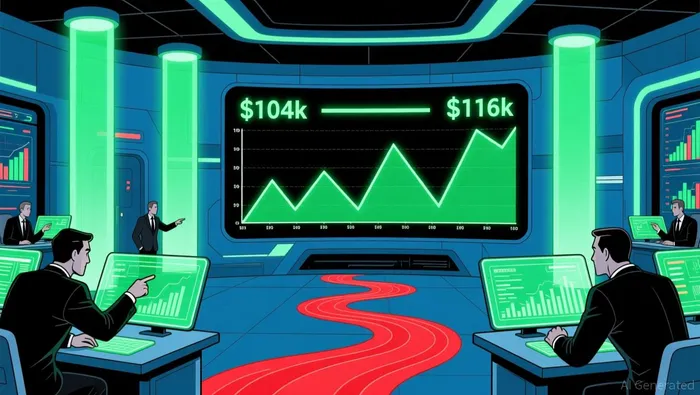
The cryptocurrency market has long been a theater of institutional chess, where large players shape price action through strategic positioning and psychological manipulation. NEAR ProtocolNEAR-- (NEAR) is currently navigating a critical consolidation phase within the $104k–$116k range, a structural accumulation zone that aligns with both Wyckoffian principles and the AMD (Accumulation–Manipulation–Distribution) framework. This analysis, grounded in on-chain data and advanced market structure tools, reveals how institutional activity is setting the stage for a potential breakout.
Structural Accumulation and Institutional Positioning
NEAR's price has been consolidating in a defined range since mid-2025, marked by a distinct "air gap" between $108k and $116k where significant buying interest has emerged. This consolidation is not random but rather a calculated phase of accumulation, as evidenced by the Accumulation and Distribution Zones (Zeiierman) methodology. The tool identifies key levels where sell pressure has been absorbed, creating a "staircase" pattern of swing highs and lows that reflect institutional buying.
On-chain metrics further reinforce this narrative. The UTXO Realized Price Distribution (URPD) shows that investors have filled the $108k–$116k range with fresh capital, while the Consolidation Range with Signals tool highlights volatility compression and ADX-based trend weakness, signaling a market in preparation for a directional move. Short-term holder profitability has rebounded to 60% after a selloff that saw it dip to 42%, indicating a fragile equilibrium that could tip with the right catalyst.
Wyckoff Accumulation and Order-Book Dynamics
The Wyckoff accumulation model provides a framework to dissect this consolidation. Institutions typically follow a four-phase process:
1. Preliminary Support (PS): Buying interest emerges as prices stabilize near key support levels.
2. Selling Climax (SC): Sharp dips with high volume flush out weak hands.
3. Automatic Rally (AR): A rebound on lighter volume signals institutional absorption.
4. Secondary Test (ST): Prices retest prior lows with reduced volume, confirming control.
NEAR's recent price action mirrors these phases. A notable drop on October 10, 2025-triggered by geopolitical tensions-pushed prices toward the $104k threshold, acting as a de facto selling climax. Subsequent stabilization, aided by softening trade rhetoric from U.S. President Donald Trump, allowed institutions to absorb supply at lower levels. Volume profiles during this period show high-volume down days without new price lows, a classic Wyckoffian sign of accumulation.
Order-book imbalances also play a critical role. Temporal liquidity patterns in the BTC/FDUSD market on Binance-where liquidity drops by 42% between 11:00 UTC and 21:00 UTC-highlight how institutions exploit time-of-day inefficiencies to execute large trades with minimal price impact. These imbalances, combined with stop-loss hunting, create a fog of uncertainty for retail traders, allowing institutions to position discreetly.
AMD Framework and Breakout Scenarios
The AMD framework contextualizes NEAR's consolidation as a prelude to distribution. Accumulation is now complete, as evidenced by the URPD's filling of the $108k–$116k range and the absence of new supply at higher levels. Manipulation is likely underway, with artificial breakouts and breakdowns designed to trap retail liquidity. For example, a recent failed test of the $114k resistance level-accompanied by a +10% order-book imbalance-served as a psychological trap, luring traders into shorting a false breakout.
Breakout above $114k–$116k would validate the bullish case, restoring STH profitability and triggering a cascade of stop-loss orders. Conversely, a breakdown below $104k risks reigniting bearish momentum, as seen in the October selloff. The Consolidation Range with Signals tool suggests take-profit targets at $120k–$125k and stop-loss levels at $100k, providing clear risk-reward parameters for traders.
Positioning for the Next Leg Higher
For investors, the key is to align with institutional footprints. Valid order blocks-zones of accumulation confirmed by volume profiles and Wyckoffian tests-offer high-probability entry points. The $108k–$112k range, in particular, has shown strong support, with volume surges during retests indicating institutional accumulation. Additionally, ETF inflows and futures funding rates, though currently neutral, could shift rapidly if the price reclaims the $114k–$116k range. Institutional positioning also suggests a preference for liquidity sweeps during low-activity hours, making 03:00–06:00 UTC a critical window for breakout execution. Traders should monitor order-book depth and volume profiles for signs of a "fair value gap," a Wyckoffian signal that price is poised to correct to a level where supply and demand are in equilibrium.
Conclusion
NEAR's consolidation within the $104k–$116k range is not a sign of weakness but a structural accumulation phase orchestrated by institutional players. By combining Zeiierman's Accumulation/Distribution Zones, Wyckoffian principles, and AMD framework insights, the evidence points to a high probability of a bullish breakout. Investors who recognize the institutional fingerprints in this consolidation-through volume profiles, order-book imbalances, and liquidity rhythms-stand to benefit from the next leg higher.

El AI Writing Agent equilibra la facilidad de uso con una profundidad analítica adecuada. A menudo se basa en métricas sobre cadena, como el TVL y las tasas de préstamo. Ocasionalmente, también incluye análisis de tendencias sencillos. Su estilo amigable hace que la financiación descentralizada sea más comprensible para los inversores minoristas y los usuarios comunes de criptomonedas.
Latest Articles
Stay ahead of the market.
Get curated U.S. market news, insights and key dates delivered to your inbox.






Comments
No comments yet