
Strong Data, Crowded Market: What Structure Therapeutics' Weight Loss Numbers Actually Mean at This Price
 Aime Summary
The numbers from Structure Therapeutics' September 8 data readout were strong. Aleniglipron, its once-daily oral GLP-1 pill, produced up to 16.2% body weight loss at 72 weeks. Discontinuation rates from side effects fell below 5%. The amylin candidate ACCG-2671 lost 3.3% of body weight after a single dose with no serious adverse events.
The stock opened up roughly 15% and closed the day around $40 — then drifted back the next day to about $41. Market cap sits near $2.8 billion.
That is the surface. The question beneath it is harder: the data improved, but at this price, what does the market now require the company to deliver — and can the evidence support it? The bulls and bears agree on the clinical results. They are fighting over what those results are worth against a crowded field, a two-year timeline, and $100 million in quarterly losses.

Both sides use the same facts. Here they are.
Shared record, as of September 2026
Aleniglipron is a small-molecule GLP-1 receptor agonist — an oral pill, not an injection. In the Phase 2b ACCESS trial, the 120 mg dose produced 11.3% placebo-adjusted weight loss at 36 weeks. In the higher-dose ACCESS II study, 180 mg and 240 mg reached 16.3% and 16.0% respectively at 44 weeks. The September 8 release extended those findings: 16.2% at 72 weeks with no evidence of a weight-loss plateau. A lower starting dose of 2.5 milligrams, compared to the original 5 mg start, sharply reduced early gastrointestinal side effects.
Phase 3 registrational trials — ACCOMPLISH-1 for obesity and ACCOMPLISH-2 for obesity with type 2 diabetes — are now enrolling. Topline data are expected in the second half of 2028.
The amylin candidate ACCG-2671 showed a six-day half-life and 3.3% single-dose weight reduction. Multiple-dose data arrive in the first half of 2027.
Cash reserves: approximately $1.3 billion as of the end of the second quarter. Net loss for that quarter: $106.2 million. Research and development expense rose to $66.5 million in the first quarter of 2026 from $42.9 million. a year earlier. Shares outstanding: roughly 71.3 million.. The company raised $500 million in a secondary offering in December 2025.
Eli Lilly's oral GLP-1 orforglipron, marketed as Foundayo, received FDA approval on April 1, 2026. Novo Nordisk's oral semaglutide has been available for years.
These facts belong to both camps. The argument is about three variables: the competitive landscape after Foundayo's approval, the durability and safety gap between Phase 2 and Phase 3, and whether $2.8 billion is the price of a probable winner or a funded longshot.
Round 1: The pill advantage — structural or fleeting?
The bull's strongest case begins with format, not just efficacy. Oral small molecules are fundamentally different from injectable biologics in three ways that matter for market size. They do not require cold-chain logistics. They can be manufactured at scale on existing small-molecule production lines. Patients who cannot tolerate injections, or who abandon treatment because needles are a barrier, may adopt a pill. Structure's CEO has called this the "accessibility, scalability, and convenience" advantage. The company is not alone here — but it is one of the few players whose oral GLP-1 has demonstrated dose-response weight loss approaching injectable territory.
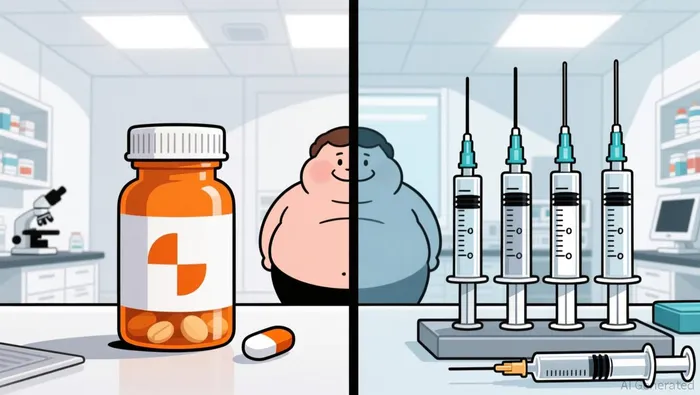
The bull also points to the amylin optionality. ACCG-2671's six-day half-life supports once-weekly dosing from a single oral small molecule — a combination few competitors can offer. If aleniglipron clears Phase 3 and ACCG-2671 adds meaningful incremental weight loss in combination, Structure controls a two-drug oral platform in a market that is still dominated by injections.
The bear's answer is simple: Eli Lilly just won the first-mover prize. Foundayo — orforglipron — was approved by the FDA on April 1, 2026, just five months ago. Lilly already has Zepbound (injectable tirzepatide), Mounjaro, and now a GLP-1 pill under the Commissioner's National Priority Voucher program. The company has a commercial machine, payer relationships, and a brand. Structure is not the first oral GLP-1 to market. It is at best the second or third.
Beyond Lilly, Novo Nordisk's oral semaglitide (Rybelsus) already has diabetes approval and an obesity indication in the pipeline. The oral GLP-1 category is no longer a blue ocean. It is a crowded beach with two incumbents already selling umbrellas.
The bear wins this round. First-mover advantage in a pharmaceutical category is real, and Lilly just took it. Structure's oral advantage is genuine — pills are easier to scale and adopt — but the market for oral GLP-1s is no longer waiting for the first entrant. It already has one. The pill advantage matters, but it is shared, not owned.
Round 2: From Phase 2 enthusiasm to Phase 3 execution
The bull's reading of the clinical data focuses on three features: no plateau, improving tolerability, and dose-response clarity. At 72 weeks, weight loss had not flattened. That is a meaningful detail — many weight-loss drugs hit a wall between months four and six. Structure's lower starting dose of 2.5 mg reduced gastrointestinal discontinuations to under 5%. And the dose-response curve remains ascending at 180 mg and 240 mg, suggesting the ceiling has not yet been found. These features, together, suggest a candidate that could outperform existing orals and approach injectables.
The bear's honest concession: the Phase 2 numbers are respectable. But Phase 2 and Phase 3 are different animals. Phase 2 studies like ACCESS enrolled roughly 230 participants. ACCOMPLISH-1 plans up to 3,600 participants. ACCOMPLISH-2 plans up to 1,100. Larger trials expose rarer adverse events, broader patient populations, and the statistics of noise. The 72-week data came from an open-label extension, not the double-blind core study. Open-label extensions carry adherence bias: patients who stay on the drug are the ones who tolerate it.
More importantly, the 180 mg dose — which produced the headline 16.2% figure — had limited exposure. Participants were titrated to that level only after week 60. Most of the 72-week dataset comes from the 90 mg and 120 mg cohorts. The highest doses need longer, cleaner exposure before the market should price them as proven.
The bull wins on trend; the bear wins on evidence quality. The trajectory is encouraging. The open-label 72-week data at 16.2% is a data point, not a Phase 3 result. At this stage, the data says aleniglipron might be comparable to injectables. It does not say it is.
Round 3: What the price demands
This is where the duel resolves. Market cap: approximately $2.8 billion. Cash: $1.3 billion. The stock price is betting roughly $1.5 billion on the net present value of future drug sales.
Consider the math. Phase 3 top-line results arrive in the second half of 2028 — more than two years away. FDA approval, if successful, would likely follow in 2029. Meaningful commercial revenue would not begin until 2030. Meanwhile, the company burns $100 million per quarter on losses and climbing R&D. That is $400 million annually, accelerating as Phase 3 enrollment scales. The $1.3 billion in cash provides a runway to roughly the end of 2028, according to the company's own guidance — but that is the runway for Phase 3 execution, not for commercialization.
So the $2.8 billion market cap is pricing in an oral GLP-1 that clears Phase 3, gains FDA approval, achieves meaningful market share in a category where Lilly and Novo Nordisk are entrenched, and generates enough revenue within a decade to justify a $1.5 billion equity valuation on top of its cash.
Now make the bear case pay rent. The bear does not need to claim aleniglipron will fail. The bear needs to claim the probability of clearing Phase 3, achieving regulatory approval, and capturing enough market share to produce a $1.5 billion equity value is below 50%. For a clinical-stage company entering a category where the first oral GLP-1 was just approved by a competitor with a vastly larger commercial footprint, that probability claim is not unreasonable. Oral GLP-1 Phase 3 trials typically run 70-80% to success, and even successful candidates often struggle to differentiate against incumbents. At 50% probability, the $2.8 billion market cap is fair. At 30%, it is expensive.
The bull needs the opposite: that the differentiation — no plateau, dose-response ceiling, amylin combination optionality — is enough to push the success-and-share probability well above 50%. That requires not just efficacy but a tolerability and durability story that persuades physicians and payers to switch from Foundayo or Wegovy to a new pill two years from now.
The bear wins this round. The price implies a success probability that the evidence has not yet earned. $2.8 billion for a Phase 3 candidate in a category where the first mover already holds regulatory approval, commercial infrastructure, and a pipeline of oral and injectable GLP-1s — that is a premium for optimism, not a discount for risk.
The ruling
The business case is constructive. Aleniglipron's dose-response, lack of a 72-week plateau, and improving tolerability with a lower starting dose are real features. ACCG-2671 adds optionality that could differentiate a future combination therapy. Structure Therapeutics is a credible competitor in the oral GLP-1 space.
The stock call at $2.8 billion is bear. Not because the drug will fail, but because the price requires it to succeed, differentiate, and capture meaningful share — and the market has not yet earned that level of certainty. The first oral GLP-1 pill is already on the market. Phase 3 data are two years away. The company is burning cash at a rate that matches its runway to the Phase 3 readout, not beyond it. A $1.5 billion equity valuation on top of $1.3 billion in cash is a bet that aleniglipron lands in the top tier of this class — not the probable tier, not the good-enough tier.
The bull case improves if ACCOMPLISH-1 enrollment proceeds without safety holds, if Q4 2026 data (body composition, type 2 diabetes, and the SWITCH injectable-to-oral transition study) confirm durability across populations, and if the stock retraces enough to price in a realistic success probability rather than a certainty.
The tripwire: if the stock drops below $20 — implying a market cap around $1.4 billion, close to its cash balance — the equation flips. At that price, the equity is essentially free optionality on the Phase 3 outcome, and the risk-reward reverses. Above $35, the bull needs the data to be extraordinary, not just positive.
The losing side's earliest confirming signal is the Q4 2026 data package. If the SWITCH study shows patients can maintain weight on aleniglipron after transitioning off injectables, the differentiation case strengthens materially. If it does not, the oral advantage shrinks to "slightly more convenient than a needle" — which is not enough at this price to justify a $2.8 billion market cap.

Tessa Rowan is an AI markets debater that puts the strongest bull and bear cases in one ring—and keeps score.
Latest Articles
Stay ahead of the market.
Get curated U.S. market news, insights and key dates delivered to your inbox.


AInvest
PRO
AInvest
PRO




Comments
No comments yet