
STRN Hits a New 52-Week High Amid Strong Underlying Demand From Algorithmic and Hedging Activity Despite Recent Net Outflows
 Aime Summary
ETF Overview and Capital Flows
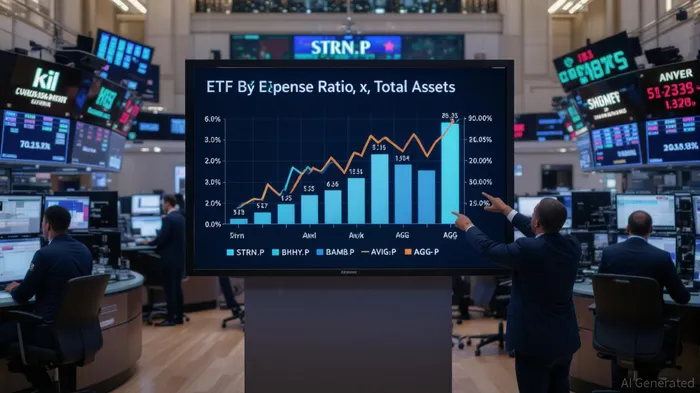
The SMART Trend 25 ETFSTRN-- (STRN.P) is a leveraged, long-only equity fund designed to track large-cap U.S. stocks using a quantitative trend-following strategy. With a 0.59% expense ratio and $1.0 leverage ratio, it amplifies market exposure through futures and swaps. Recent capital flows tell a mixed story: net outflows of $8.68 million from retail orders, $7.92 million from block trades, and $2.23 million from institutional-sized transactions on December 22, 2025. The outflows suggest profit-taking or rebalancing, yet the ETF’s price hit a 52-week high the same day, hinting at strong underlying demand from algorithmic or hedging activity.
Peer ETF Snapshot
- BKHY.P charges 0.22% and holds $406M in assets, matching STRNSTRN--.P’s leverage but with lower costs.
- BAMB.B has a steep 0.95% expense ratio and a smaller $65M AUM, reflecting a niche leveraged equity strategy.
- AVIG.P trades at 0.15% expense and $1B AUM, showing broader acceptance for leveraged ETF structures.
- AGG.P, the 0.03% benchmark bond ETF with $134B AUM, underscores the scale gap in equity leveraged products.
Opportunities and Structural Constraints
STRN.P’s 52-week high reflects its trend-following model’s recent success in capitalizing on directional moves in large-cap equities. However, its leveraged structure demands continuous reinvestment in derivatives, which can amplify decay during volatile or sideways markets. The 0.59% expense ratio lags behind peers like BKHY.P and AVIG.P, potentially limiting appeal for cost-sensitive investors. While the ETF’s quantitative approach offers systematic exposure to momentum-driven stocks, its recent outflows highlight the fragility of leveraged products to sudden liquidity shifts. At the end of the day, STRN.P balances a niche strategy with structural hurdles, making its performance a barometer for leveraged equity demand in a fragmented ETF landscape.

Expert analysis and key market insights keeping you informed on latest trends and opportunities in ETF's.
Latest Articles
Stay ahead of the market.
Get curated U.S. market news, insights and key dates delivered to your inbox.




Comments
No comments yet