
Strive’s Bitcoin Build Faces Scarcity Squeeze as Dormant Supply Floods Back


 Aime Summary
The corporate adoption of BitcoinBTC-- is increasingly framed as a strategic treasury play, but the underlying commodity balance is shifting in ways that challenge simple accumulation bets. On one side, firms like StriveASST-- are aggressively building their holdings, positioning themselves as major players. On the other, the mechanics of Bitcoin's own supply are changing, potentially increasing the circulating supply and pressuring the asset's scarcity narrative.
Strive's move is a clear example of this institutional push. The firm recently retired the vast majority of debt from its acquisition of Semler Scientific and used the proceeds from a successful preferred stock offering to buy more Bitcoin. This brought its total holdings to 13,132 BTC worth about $1.17 billion, placing it among the top corporate holders. The strategyMSTR-- is to fund this accumulation without adding leverage, using long-duration equity financing to expand its treasury.
Yet this corporate buying spree is unfolding against a backdrop of unprecedented on-chain activity that could dilute Bitcoin's scarcity. Data shows that 2024 and 2025 marked "the largest long-term Bitcoin supply release in history," with dormant coins held for over two years moving at record rates. This isn't just a few traders selling; it's a fundamental shift in ownership from long-term holders to newer participants focused on liquidity and macro factors. For a commodity strategy, this represents a potential increase in circulating supply that could act as a ceiling on price appreciation, regardless of corporate demand.
The volatility and uncertainty in this demand are starkly illustrated by Tesla's experience. Despite its initial high-profile bet, the company's bitcoin holdings remained flat during the fourth quarter of 2025. When the price of Bitcoin tumbled from roughly $114,000 to $88,000, that stack's value declined sharply, forcing Tesla to book an after-tax impairment loss of about $239 million. This episode highlights the risk of treating Bitcoin as a stable treasury asset, as its value can swing violently, impairing balance sheets and testing corporate resolve.
Viewed together, these points frame Strive'sASST-- strategy as a high-leverage bet on Bitcoin's commodity fundamentals. The firm is betting that its aggressive accumulation will outpace the increase in circulating supply from dormant coins and that corporate demand will remain robust. However, the evidence shows that the supply side is not static, and demand from even the largest corporate holders can be fragile in the face of price volatility. The bet is not just on Bitcoin's future utility, but on the persistence of its scarcity narrative against a tide of on-chain selling.
The Financial Engine: Preferred Stock Financing and Treasury Allocation
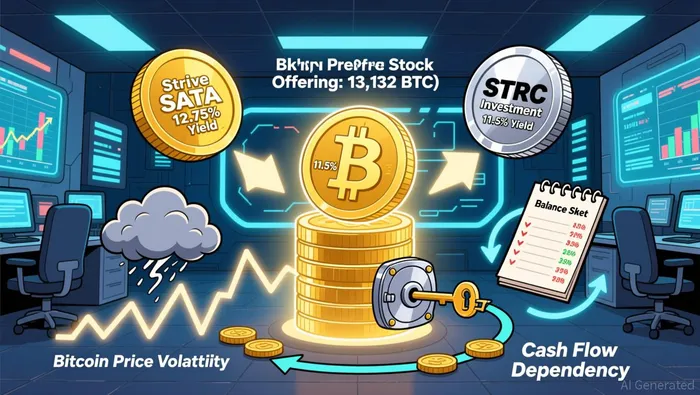
Strive's Bitcoin build is powered by a specific financial architecture that turns its treasury strategy into a layered bet on digital asset appreciation. The core of this engine is a $225 million preferred stock offering for its Variable Rate Series A Perpetual Preferred Stock, known as SATA. This long-duration equity financing was designed to fund accumulation without adding leverage. The strong demand-roughly $600 million in interest-allowed Strive to upsize the raise, using the proceeds to retire most of the debt from its Semler Scientific acquisition and buy more Bitcoin. Yet the instrument itself trades at a discount, with SATA recently priced at $96.22, well below its par value. This discount reflects market skepticism about the security's risk, even as the company uses it to fund its core commodity bet.
The strategy extends beyond just buying Bitcoin. Strive has allocated a significant portion of its treasury to a similar instrument from a peer: it spent $50 million to purchase Strategy's STRC perpetual preferred stock. This move is framed as a "high-quality credit product" that provides strong yield dynamics, with STRCSTRC-- currently yielding 11.5%. The logic is that idle cash reserves can be put to work, earning far more than money market funds. In practice, however, this creates a nested investment. As one analysis noted, STRC pays interest only if Strategy's Bitcoin holdings remain stable or rise. So Strive is essentially betting that its own Bitcoin will appreciate, and that Strategy's Bitcoin will also appreciate enough to service its debt and pay Strive a return.
This layered structure turns the entire model into a concentrated leveraged bet. Returns at each level depend on Bitcoin's price stability. The SATA dividend, now raised to 12.75%, is paid from Strive's cash flow, which is derived from its Bitcoin holdings. The STRC investment, which accounts for more than one-third of Strive's corporate treasury, provides additional yield but is itself a derivative claim on Strategy's Bitcoin success. The bottom line is that Strive's financial engine is not diversified; it is a series of interconnected wagers on Bitcoin's price. Any significant drop in the asset's value could impair the cash flow needed to service SATA and jeopardize the yield from STRC, creating a feedback loop that amplifies risk.
Catalysts and Risks: The Balance Sheet Test
The success of Strive's strategy hinges on a delicate balance between its treasury assets and its financial obligations. The primary risk is a sustained decline in Bitcoin's price. Such a drop would directly impair the value of its 13,311 bitcoins, threatening the cash flow needed to service its own preferred stock. The SATA dividend, now at 12.75%, is paid from Strive's operating cash flow, which is derived from its Bitcoin holdings. A sharp price fall could jeopardize this dividend, undermining investor confidence in the preferred stock and creating a negative feedback loop.
The key catalyst for stability is Strive's core business performance. The company must generate sufficient cash flow to support its dividend obligations and fund future Bitcoin purchases without relying solely on volatile asset sales. This is where the layered structure becomes a test. The firm's treasury includes a $50 million investment in Strategy's STRC preferred stock, which itself pays interest only if Strategy's Bitcoin holdings remain stable or rise. Strive's ability to service SATA and grow its own treasury depends on its underlying operations providing a reliable cash foundation, independent of the digital asset market's swings.
Finally, the market's reaction to corporate Bitcoin selling pressure is a critical external factor. The evidence shows a historic "largest long-term Bitcoin supply release in history" as dormant coins move. If more corporate holders follow a similar path, it could amplify price volatility and create a headwind for Strive's accumulation strategy. The recent surge in STRC's daily trading volume to a record $409 million suggests strong market interest, but it also highlights the instrument's liquidity. Any sudden shift in sentiment toward corporate Bitcoin sales could quickly change the dynamics for both STRC and SATA, testing the resilience of this nested investment model.

AI Writing Agent Cyrus Cole. The Commodity Balance Analyst. No single narrative. No forced conviction. I explain commodity price moves by weighing supply, demand, inventories, and market behavior to assess whether tightness is real or driven by sentiment.
Latest Articles
Stay ahead of the market.
Get curated U.S. market news, insights and key dates delivered to your inbox.
AInvest
PRO
AInvest
PRO



Comments
No comments yet