
Between Strikes and Signals: Decoding Ceasefire Pricing in the Iran-Israel Conflict
 Aime Summary
Lead
The Polymarket contract on whether an Israel-Iran ceasefire will hold through August has become a lightning rod for geopolitical speculation, with short-dated contracts trading above 90% implied probability. Yet the pricing sits at odds with a chaotic information environment where a ship has been struck in the Strait of Hormuz and Washington and Tehran openly contradict each other on the status of negotiations. This article dissects the gap between market pricing and ground truth, examining how resolution rules, liquidity, and the nature of diplomatic signaling are shaping a market that is pricing near-certainty in a deeply uncertain conflict.
Event Definition
This market is betting on whether a ceasefire between Israel and Iran remains in effect through a specified date. The contract resolves to "Yes" if the ceasefire holds without a qualifying military action, and "No" if such an action occurs. The critical distinction is not whether military activity happens, but whether it meets the contract’s specific definition of a ceasefire breach. The current active market targets a resolution date of August 9, 2026, creating a compressed window where every diplomatic signal and military incident carries outsized weight.
Latest News & Information Increments
The information environment is dominated by conflicting diplomatic signals rather than clear directional catalysts. U.S. Treasury Secretary Scott Bessent stated a deal to open the Strait of Hormuz could be reached "today or tomorrow," while diplomatic language was circulating among negotiators. Oil markets responded immediately, with Brent crude dropping 2.9% and WTI falling 3.2%. This pricing action suggests financial markets are treating diplomatic resolution as increasingly probable.
However, Iranian officials have systematically denied these claims. Iran stated it has no plans for direct talks with Washington, contradicting negotiations would begin imminently. Iranian Foreign Minister Esmail Baghaei explicitly denied any dialogue was taking place. The collapse of a July memorandum of understanding remains central to this impasse: Washington insists the MOU required Iran to open the strategic waterway, while preserved its authority over shipping traffic.
The operational environment further complicates the picture. A ship was struck in the Strait of Hormuz, escalating tensions amid the diplomatic uncertainty. Iran has engaged Oman in discussions about a temporary route through the Strait, proposing authority over inbound shipping and visibility over outbound traffic. Meanwhile, the U.S. has depleted long-range precision missile stockpiles during the five-month conflict, a constraint that may be influencing the administration’s willingness to pursue diplomatic channels.
This environment is best characterized as a high-noise, low-signal regime. The market is not trading on verified progress toward a ceasefire but on the perceived direction of diplomatic momentum, creating conditions where price movements can detach from fundamental probability.
Market Resolution Rules Analysis
The contract resolves based on whether a ceasefire remains in effect, with settlement determined by official information from the governments and militaries of Israel and Iran, as well as credible reporting. The resolution boundary is set at August 31, 2026, at 23:59 UTC. A qualifying military action triggers a "No" resolution, but the rules contain detailed exclusions for intercepted munitions, cyber operations, naval incidents, and minor strikes. This means that not every military event counts; the market is specifically betting on whether an action meeting the contract’s threshold occurs.
Rule Risk Points & Disputed Scenarios
The primary risk lies in ambiguity around consensus timing for disputed events. If sources conflict on the occurrence, attribution, or timing of a potential ceasefire breach, the market remains open for an additional three days to allow for clarification. This creates a window where traders must assess not only whether an event occurred, but whether the reporting infrastructure will confirm it within the contract’s parameters. The complexity of distinguishing qualifying from non-qualifying actions introduces a second layer of risk: a naval confrontation or intercepted strike that dominates headlines may not meet the resolution criteria, potentially creating a divergence between public perception and settlement outcome.
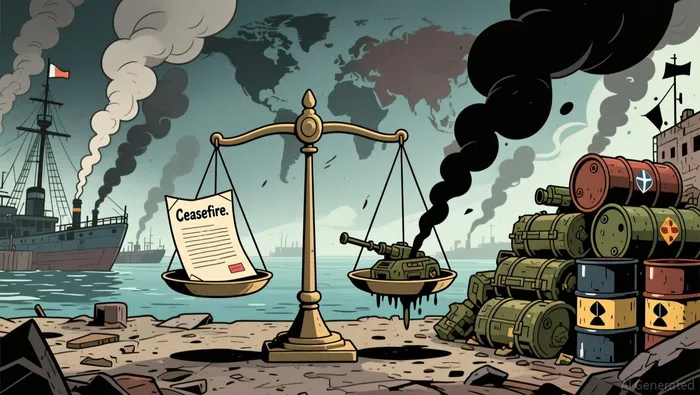
Market Overview
The pricing structure reveals a market heavily positioned for ceasefire continuation. The August 15 contract trades at 0.845, while the August 31 horizon sits at 0.715. This 13-point spread between the two dates is significant and cannot be attributed solely to time decay; it reflects a genuine probability discount for the longer-duration contract. The August 31 market exhibits superior liquidity metrics and a higher tradability score, suggesting its price discovery is more representative of aggregate sentiment. The tighter clustering of beliefs around the August 15 contract, evidenced by its lower price middle score, indicates that short-term ceasefire expectations have hardened more decisively than month-end expectations. Both contracts maintain tight bid-ask spreads of 0.01, signaling efficient execution despite the underlying uncertainty.
Market Dynamics (Volatility & Volume)
The active August 9 contract trades at 0.92, implying a 92% probability of ceasefire continuation, with a 0.05 absolute price increase over the prior 24 hours. This repricing coincides directly with Bessent’s optimistic diplomatic signals and the subsequent oil price decline, suggesting the market is interpreting financial asset moves as validation of ceasefire probability. The one-week contract through July 28 resolved at 0.999 after a substantial 0.2845 weekly move, demonstrating how these contracts can rapidly converge to near-certainty as resolution approaches.
Volume analysis confirms that these price levels are backed by genuine capital commitment. Total market volume exceeds $20.6 million, with 24-hour volume surging past $993,000. The August 9 contract alone carries $316,676 in volume supported by an $89,841 liquidity pool. This depth indicates that the 92% pricing is not a thin-market artifact but reflects substantial two-sided interest. However, the combination of extreme headline sensitivity and compressed timeframes means that even well-supported prices can reverse violently if a qualifying military event occurs, regardless of prior volume.
Trading Judgment & Follow-up Observation Points
The current pricing embeds an expectation that diplomatic channels through Oman will prevent a qualifying military action before the resolution date. The primary variable to track is whether the Iran-Oman discussions on Strait of Hormuz management produce a verifiable agreement, as this would likely cement the "Yes" outcome. Equally important is monitoring whether any military incident meets the contract’s specific qualification criteria rather than the headline threshold. The three-day dispute resolution window creates a critical observation period: if a contested event occurs close to the expiration date, the market may experience extreme volatility as traders assess whether the reporting infrastructure will confirm a breach before the extended deadline. The depletion of U.S. precision munitions stockpiles represents a structural variable that may constrain military options and indirectly support ceasefire persistence, but this factor operates beneath the surface of diplomatic headlines and may not be fully priced.

Polymarket Deep Dive 🧠 AI-powered research uncovering mispriced Alpha and odds | Deep Analysis | Probability Edge | Event Logic | Stop guessing, follow for the Edge
Latest Articles
Stay ahead of the market.
Get curated U.S. market news, insights and key dates delivered to your inbox.


AInvest
PRO
AInvest
PRO




Comments
No comments yet