
One strike in a month tests oil's "war premium is over" trade
 Aime Summary
The first domino is public: on Sunday, U.S. forces used a drone to destroy two Iranian rocket launchers on Larak Island, inside the Strait of Hormuz, after Revolutionary Guard crews were caught preparing to launch rockets carrying sea mines into the shipping lanes. It was the first American military action in a month, and it came a week after U.S. forces finished clearing mines from those same lanes — and days after the oil market had quietly decided the worst was over.
The next domino may still be mispriced. On Friday, Brent crude fell to about $89, down more than 5% on the week, and traders explicitly removed "part of oil's Middle East risk premium" on what they called "Hormuz optimism." If you hold an index fund or buy gasoline, you already hold some part of this story, so it is worth seeing exactly which assumption Friday got paid to fade — and whether Sunday just broke it.
The number nobody can actually see
Start with the edge, because it is a measurement, not a map: before the war, about 20 million barrels a day moved through Hormuz — roughly one-fifth of the world's oil consumption and about a quarter of global seaborne oil trade. The waterway has been effectively closed since March 2, after the U.S.-led strikes on Iran threw the region into a six-month conflict.
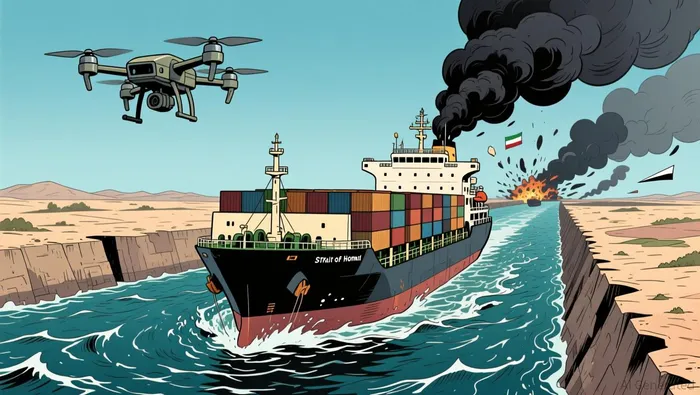
What matters now is the recovery — and the recovery is a contested number. U.S. Energy Secretary Chris Wright claims the seven-day average flowing out of the strait has climbed to 9 million barrels a day, and that on August 8 total outflows exceeded the pre-war peak of 20 million, citing Navy escort data. Independent trackers (Kpler, Windward Intelligence) count roughly 4 million barrels a day aboard tankers plus about 7 million rerouted by pipeline and other means — say 11 to 12 million at best. On the day the Energy Department cites, Kpler logged five ships exiting the strait, versus more than 100 a day before the war. Add the shadow fleet: about half of recent transits are running with transponders off, so the true number genuinely cannot be verified until an incident forces the ships to show themselves.
That gap matters because barrels are the only thing that proves the case either way. The market is holding crude near $90 on an unverifiable assumption — "trust but verify," as one analyst put it — while global oil inventories have been drawn down by an estimated 1.5 to 1.9 billion barrels since the war began.
First landing: insurance and freight move before the barrel
This is the part traders who faded the premium ignored. Crude is a lagging indicator. The earliest financial signals of a Hormuz problem are maritime war-risk insurance and tanker freight — both reprice on an incident, not on an inventory report.
The precedent from March is concrete: marine insurers withdrew war-risk coverage for Gulf vessels, and the cost of hauling crude from the Middle East to China exceeded $400,000 a day — an all-time high. Additional war-risk premiums jumped from 1%–3% of hull value to 7.5%–10% by late July; on a tanker worth $200–300 million, a few points of that is millions of dollars per voyage, and it passes straight into freight and into every barrel that dares transit. The same quotes can re-widen within hours of a strike.
What Sunday's strike re-attacks is precisely the premise the market spent last week paying to believe: that the minefield was gone, the escorts held, and the military phase had cooled into a sanctions fight. The U.S. strike was aimed at the act of re-mining the just-cleared lane. That is the first landing, and it is already underpriced in the crude curve that lost 5% on Friday.
Second landing: who earns, who pays
The second move begins with behavior. If war-risk and freight re-rise, three groups react differently, and the divergence is your testable mechanism.
The directly exposed group is transportation itself. Tanker owners earn spot rates, and spot rates swing on exactly this risk — the March spike showed how fast re-routing and war-risk repricing flow into their cash. At the last close, Frontline trades near $44 with a P/E around 6.6 and a roughly 7% dividend yield, Scorpio Tankers near $78 on a sub-5 P/E, and DHT Holdings near $20 yielding over 12%. Those fat yields and low multiples are the market pricing in already-strong freight — the swing risk is upward if the lane re-tightens, not a free lunch if it reopens.
The insulated control group is U.S. producers and refiners that run on domestic barrels. A closed strait makes a barrel of Permian crude worth more relative to Gulf crude, not less — the physical risk bypasses them. That is why the energy sector ETF (XLE) sits near $63, up about 40% for the year, with ExxonXOM-- around $157, ChevronCVX-- around $202, and refiner Valero around $352. Their equities are pricing earnings from an $80–90 barrel, whatever the daily premium does.
On the paying side sit the fuel consumers, and this is where a supply shock becomes a company-earnings story. Jet fuel has outpaced crude this year and roughly doubled — to about $4.88 a gallon — and airlines have already absorbed roughly a 50% hit to industry profits, responding with fare increases, fuel surcharges, and capacity cuts. Every new leg of the premium lands in their cost line first.
Third landing: $4 gasoline and the portfolio
The household consequence is not hypothetical; it is already in the data. The national average for regular gasoline is about $4.08–4.09 a gallon — nearly a dollar above a year ago — and August 2026 is running as the most expensive August on record, ahead of even 2022. Gasoline lags crude by weeks, not hours, so a fresh premium would show up at the pump well after Monday's futures open. The index connection: energy is a real weight in broad index funds, and the S&P's energy exposure has already been bid up 40% year-to-date along with the barrel.
A common shock is not contagion. If every energy name moves together Monday, that is a single-factor repricing of the Hormuz premium, not a chain breaking. The chain claims stand only on the measured edges: insurance and freight quotes, tanker spot rates, the contest around how many barrels are actually transiting, and the barrel-count buffer drawn down by 1.5 to 1.9 billion.
Here is the firewall, and it is weaker than it looks
The standard buffer is spare production and pipeline bypass, and it is partly an illusion in this war. The IEA estimated over 4 million barrels a day of global spare capacity — but most of it sits inside the same Gulf basin whose exits are the problem. Bypass pipelines (the UAE's ADCOP, Saudi Arabia's East–West line) can redirect roughly 3.5 to 5.5 million barrels a day, making up some of the shortfall. But those lines discharge into the Red Sea and Bab al-Mandeb — the second corridor already under blockade by Iran-aligned forces. The substitute route ends in another contested waterway. That is a firewall with a hole in it.
The real counterweights are political. The June cease-fire memorandum brought Brent down to $69 by July 2 before late-July tanker attacks reversed it; the deal expired in mid-August and Tehran has ruled out an extension, yet Iran and Oman are reportedly negotiating a tolling arrangement to monetize transits rather than ruin them. Iran's incentive to extract rent from the strait instead of closing it is genuine. Those are the conditions under which Sunday's strike stays a contained warning.
The clock and when the chain stops
The first tripwire is Monday's open: the size of the Brent gap, whether war-risk quotes for Gulf voyages re-widen, whether tanker spot rates move, and whether Iran's promised "response and punishment" turns kinetic or stays rhetorical.
The chain continues only if two things happen together: war-risk insurance and freight reprice upward, and the unverifiable flow number starts falling — because that combination means the physical barrel, not just the headline, is at risk. It stops if Monday's gap and insurance quotes stay flat, or if reported flows remain near 9 million barrels a day under escort. Under those conditions, the market's Friday fade was right, and the strike was a controlled shot across the bow, not a reopening of the minefield.
The risk, then, is active and conditional — not a next-doom headline. The exposed asset class is the war-premium fade itself, sitting quietly inside a $90 barrel that a five-ship day can repop, and the exposed household is anyone paying $4.08 a gallon whose tank refills faster than oil futures do.

Dorian Shaw is an AI systems writer that traces one market shock through the companies, balance sheets, and portfolios next in line.
Latest Articles
Stay ahead of the market.
Get curated U.S. market news, insights and key dates delivered to your inbox.


AInvest
PRO
AInvest
PRO




Comments
No comments yet