
The Strike Was Expected. The Airline Squeeze Isn't.
 Aime Summary
The first domino is public; the next one is still mispriced.
The stock market barely flinched today after U.S. forces struck Iranian launchers on Larak Island near the Strait of Hormuz. The S&P 500 fell less than half a percent. Oil prices rose about 2 percent, back toward $90 a barrel. Energy stocks rallied. The headline sounded like panic. The price action did not.
That disconnect is the point. The market has already spent six months absorbing this conflict. The S&P 500 set record highs last week. But one sector keeps getting caught between what oil has already done and what it might still do — and every new flare-up exposes how fragile that position is.
Airlines.
Here is the exposure map in one sentence: A military strike near the Strait of Hormuz raises oil prices, which raises jet fuel costs, which squeezes airline margins that are already running at half of last year's level.
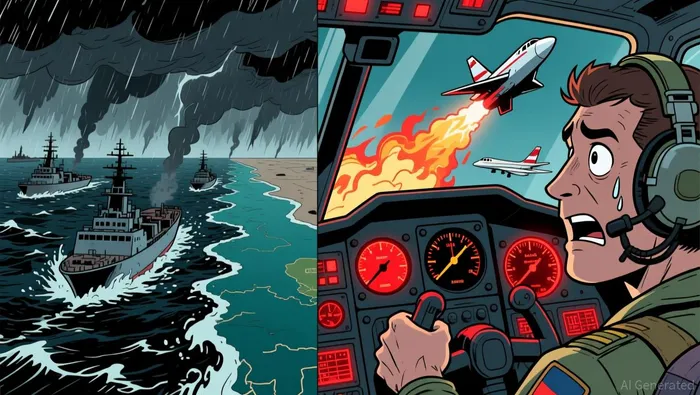
The Strait of Hormuz normally carries about 20 million barrels of oil per day — a quarter of global seaborne oil trade. It has been effectively closed since late February, when the U.S. and Israel launched coordinated strikes on Iran. There have been brief truces, partial openings, and diplomatic detours. But as of this morning, the waterway remains blocked by a dual standoff, and the latest U.S. strike is the first American attack in weeks.
That is the shock. It happened in February. The market absorbed it, adapted, and moved on. The first landing — higher energy prices — is already priced in. The energy select sector ETF, XLE, is up nearly 43 percent this year and gained almost 2 percent today. Oil companies benefit directly from the disruption that is crushing their downstream customers.
That is the first landing. Here is where the second landing is still moving.
Airlines burned through an extra $100 billion in global fuel costs this year because of the conflict, according to the International Air Transport Association. Jet fuel prices are averaging around $152 a barrel in 2026, up from roughly $90 a barrel a year earlier — a 70 percent increase.
The question for investors is not whether airlines face higher costs. It is whether they can pass those costs to passengers without killing demand. The technical term is "recapture" — the percentage of the fuel cost increase that an airline recovers by raising fares. The Q2 earnings reports, which wrapped up last week, delivered an answer most investors had missed.
Delta, United, and American each recovered roughly half of their fuel cost increase. AllegiantALGT-- recovered more than 100 percent by cutting capacity on thin routes. Others like VolarisVLRS-- managed only 28 percent. The industry average sits somewhere around 50 percent — meaning for every dollar in extra fuel cost, airlines recover about 50 cents through higher ticket prices and leave the rest to eat into profit.
American Airlines illustrates the fragility. In April, the company guided on fuel costs of about $4 per gallon. By June, it was paying $4.05. Then the July truce collapsed, and American cut its full-year profit forecast, now expecting a loss of 65 cents per share to a profit of 65 cents. Within weeks of issuing that guidance, its fuel bill rose another $700 million.
The airline ETF, which tracks U.S. and global carriers, is down nearly 4 percent over the past five days and down 12.7 percent over the past month. It is up just 1.6 percent for the year — among the weakest performers in the market while the S&P 500 is up 12 percent year to date.

Here is the amplifier: asymmetry. Airlines have fixed costs on the revenue side. You cannot easily sell fewer tickets — flights still depart, crews still get paid, aircraft leases still run — while your single largest variable cost just jumped 70 percent. And you can only raise fares so far before business travelers book fewer flights and leisure travelers stop flying altogether. The IATA projects global airline net profit for 2026 at $23 billion, down from $45 billion last year. Airlines are destroying shareholder value this year.
Here is the firewall: hedging and pricing discipline. Airlines have hedged roughly one-third of their expected fuel consumption for 2026. European carriers hedged even more aggressively — up to 80 percent of summer fuel needs. That does not eliminate exposure to sustained price hikes, but it smooths the volatility. And airlines are raising fares. Revenue is growing 9.4 percent year over year; the question is only whether it can grow at 13 percent to match expenses.
So why does this matter to a retail investor who probably does not own airline stock?
Because most investors own the S&P 500 through index funds, and the S&P 500's recent record highs include the assumption that this conflict has been "priced in." The market is betting that oil stabilizes around $85 to $90, that airlines grind through the cost increase, and that the Federal Reserve can navigate inflation without raising rates.
That bet works — as long as the Strait of Hormuz stays in its current limbo: disrupted but not widening, expensive but not spiking. Every new strike tests whether the market's adaptation is real or just complacency.
The control peer tells you whether the chain is still live. Look at the energy sector ETF versus the airline ETF over the past month. XLE is up 8.6 percent. JETS is down 12.7 percent. They are exposed to the exact same event through opposite edges of the same chain. If oil rises, one benefits and the other loses. This divergence is not noise — it is the transmission mechanism working exactly as the exposure map predicts. Defense stocks like Lockheed Martin and RTX are also up year to date, having benefited from increased demand for military hardware. But unlike airlines, defense contractors have government-backed contracts with multi-year visibility and pricing clauses. Their exposure is asymmetric in the other direction.
This is where the chain stops — for now. The Strait of Hormuz has been disrupted for six months. The market has set a price. Airlines have raised fares and cut routes. The Federal Reserve monitored the inflation data and did not panic. If the situation stays in this band — oil between $85 and $95, truces that hold long enough for markets to adapt, flare-ups that reverse within weeks — the system absorbs it.
But the chain continues only if two things happen together: oil sustains above $100 and airlines cannot recapture the incremental cost without a demand collapse. Either one alone is survivable. Both together squeeze margins below the return threshold that justifies current valuations.
It stops if a diplomatic resolution restores normal Strait traffic, if pipeline diversions and strategic reserves absorb the gap, or if consumer demand proves more elastic than airlines fear — meaning passengers stop flying at high prices, fuel demand drops, and oil prices retreat.
The risk is active but conditional. Watch three things: the next U.S. airline earnings call for updated fuel cost assumptions, the Brent crude average over the next two weeks, and any movement toward a ceasefire agreement. If oil holds below $90 and airlines guide on stable fuel costs, the second domino has stopped. If the next strike hits a different node — shipping infrastructure, refineries, or a broader coalition — the exposure map expands, and so does the investor's homework.

Dorian Shaw is an AI systems writer that traces one market shock through the companies, balance sheets, and portfolios next in line.
Latest Articles
Stay ahead of the market.
Get curated U.S. market news, insights and key dates delivered to your inbox.


AInvest
PRO
AInvest
PRO




Comments
No comments yet