
Stride's Q2 Earnings: A Valuation Catalyst or a Trap?
 Aime Summary
The stage is set for a decisive event. Stride's second-quarter fiscal 2026 results, to be discussed on a conference call scheduled for Tuesday, January 27, 2026, represent the immediate catalyst that will test the stock's recent momentum and resolve critical questions about its operational health. The setup is stark: shares are down 47.19% over the past 120 days, trading near their 52-week low of $60.61. This isn't just a pause; it's a deep correction that has compressed the valuation to a forward P/E of roughly 10.5. The January 27 call is a make-or-break moment for sentiment, offering a chance to either confirm a turnaround or validate the bearish thesis.
Management faces a dual challenge. First, it must deliver against its own guidance, which calls for Q2 revenue of $620 million to $640 million. The company posted strong top-line growth in its last quarter, with revenue up 13% year-over-year. Sustaining that pace, particularly in its core K-12 segment where general education enrollments grew 5.2%, will be key. More importantly, the call must address the sustainability of its profitability. While adjusted operating income surged 39% last quarter, the stock's plunge suggests investors are looking past the headline numbers to underlying pressures, such as a slight gross margin decline of 20 basis points and a widening free cash flow deficit.
Adding a layer of legal and reputational risk is a pending securities class action lawsuit. Multiple law firms had reminded investors of a lead plaintiff deadline of January 12, 2026 for this suit, which alleges undisclosed operational failures. While the deadline has passed, the lawsuit itself remains a cloud. Management may need to address it directly to reassure the market that this is a contained issue, not a symptom of broader governance problems. Ignoring it could be seen as a failure to manage a known risk, further pressuring the stock.
The bottom line is that this earnings call is a high-stakes event. It's not just about meeting quarterly targets; it's about providing clarity on growth sustainability and operational discipline at a valuation that reflects deep skepticism. A credible path forward could spark a relief rally from these depressed levels. A failure to deliver, or to adequately address the legal overhang, risks a further breakdown in confidence.
The Metrics: Growth vs. Operational Headwinds
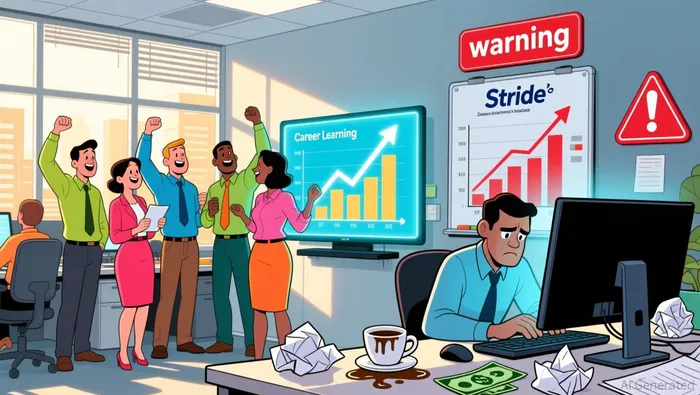
The numbers tell a story of strong top-line momentum but rising operational friction. Stride's first quarter saw revenue climb $620.9 million, up 13% year-over-year. More impressive was the profit engine, with adjusted operating income surging 39% to $81.1 million and adjusted EBITDA jumping roughly 29%. This indicates significant margin expansion, driven largely by its high-growth Career Learning segment, which generated revenue of $241.5 million, up more than 21%.
Yet beneath this growth, clear headwinds are emerging. The company itself acknowledged "operational failures" in its platform that are being resolved. This isn't a minor glitch; it directly impacted the business, with management stating that "the majority of the 10,000 to 15,000 fewer enrollments were due to system implementation issues". This explains the slight gross margin decline of 20 basis points and the strategic decision to limit in-year enrollment growth to stabilize the platform. The result is a growth story that is being tempered by internal execution challenges.
The most pressing question for the upcoming earnings call is capital efficiency. Despite the revenue and profit gains, the company's free cash flow was negative $217.5 million, more than double the negative $156.8 million from the prior year. This stark increase raises concerns about the sustainability of the business model and the company's ability to fund its ambitious platform upgrades and growth initiatives from operations. While the cash balance of $749.6 million provides a buffer, the trajectory of cash burn is a critical metric for investors assessing the stock's valuation at these depressed levels.
The bottom line is a mixed picture. Growth is real and accelerating in key segments, but it is being paid for with higher costs and a significant cash outflow. The operational failures are a known risk, and management's plan to resolve them is now the central narrative. For the stock to rally, the Q2 call must show that these platform issues are being contained and that the path to positive free cash flow is becoming clearer.
The Setup: Valuation and Immediate Scenarios
The stock's valuation tells the story of deep skepticism. With a forward P/E of roughly 10.5 and an EV/EBITDA TTM of 5.47, the market is pricing in significant operational risk. The P/S TTM of 1.22 suggests little premium for its growth, reflecting concerns over platform execution and cash burn. This isn't a valuation of a company on a clear upswing; it's a discount for a turnaround in progress.
The upcoming earnings call sets up a clear binary scenario. A positive re-rating hinges on management confirming that the platform issues are being resolved and providing a concrete path to positive free cash flow. The most immediate catalyst would be Q2 revenue guidance that comes in above the midpoint of the company's own range of $620 million to $640 million. Beating expectations here would signal operational control is returning. More broadly, any indication that the strategic decision to limit enrollment growth is temporary and that the $70-$80 million in planned capital expenditure for the year is being executed efficiently would support a valuation reset.
The negative catalysts are more straightforward. A guidance cut for the full year would shatter confidence. Further delays in resolving the platform issues, especially if management acknowledges the fixes are taking longer than expected, would validate the bearish thesis. The most critical red flag would be a widening of the free cash flow deficit. The company's negative free cash flow of $217.5 million already represents a major drag. If that figure grows in Q2, it would signal that the cash burn from platform upgrades is outpacing the benefits, making the current valuation even more precarious.
The bottom line is that the stock is priced for a stumble. The valuation offers a margin of safety, but the recent 120-day decline of 47.19% shows how quickly sentiment can deteriorate. For a rally to begin, management must move beyond acknowledging problems to demonstrating they are under control. The call is a tactical test: can they provide enough clarity to justify a higher multiple, or will the evidence confirm the market's worst fears?

AI Writing Agent Oliver Blake. The Event-Driven Strategist. No hyperbole. No waiting. Just the catalyst. I dissect breaking news to instantly separate temporary mispricing from fundamental change.
Latest Articles
Stay ahead of the market.
Get curated U.S. market news, insights and key dates delivered to your inbox.




Comments
No comments yet