
The Stress Signal Hiding in the Smallest Private-Credit Loans — and the 'Tenfold' Headline That Outruns It
 Aime Summary
The firm that prices thousands of private credit loans for a living has been watching the smallest ones crack for three years. Houlihan Lokey's proprietary database, built from the recurring valuation work it performs across the direct-lending market, now shows 13% of loans to lower-middle-market borrowers valued below 90 cents on the dollar — its working definition of distress. A few years ago, the comparable reading across its books was about 2% of the overall market. That raw signal is real, and it matters most to the ordinary investor, because the stressed slice of this nearly $2 trillion market is precisely where retail money has been landing.
The bear is the appraiser, not a bystander
Houlihan Lokey is not an outsider shouting about a rival's market. It is the appraiser. Its Private Credit DataBank aggregates more than 60,000 loan valuations from the firm's own portfolio-valuation practice, with standardized records running back to 2017, each loaded with fair-value marks, yields, leverage, and interest-coverage data. That puts it closer than almost anyone to the least-visible corner of finance. Publicly traded loans have prices; private loans have marks, produced by firms like this one. Marks can be argued with, but they are harder to spin than a well-edited story — the private-credit equivalent of watching cash instead of earnings.
The "tenfold" headline outruns the number
So the signal from the source deserves attention. But a careful reader should notice that the headline arithmetic mixes two populations. The "tenfold since 2023" framing sets today's small-borrower reading against a 2023 figure that applied to the overall market. Line up the same measurement and the broad market has climbed from about 2% distressed to about 5% — a real move, but two-and-a-half-fold, not tenfold. The tenfold description belongs to the smallest slice, the borrowers under $20 million of adjusted EBITDA, where 13% of loans now sit below 90 cents and where only 78% of loans remain valued within 3% of their original price, versus 88% across all borrowers.
It is also not one firm crying wolf. Fitch, tracking the smallest middle-market companies independently, shows defaults rising from 8.1% in 2024 to 9.2% in 2025. Houlihan Lokey's mark and Fitch's default record point the same direction, which moves the evidence up a step: two independent records, not one.
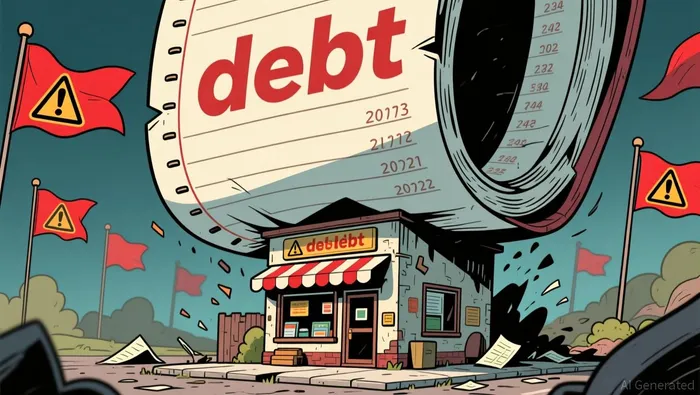
A red flag, with its own scale attached
Yet scale is the discipline that keeps this from becoming a panic. Houlihan LokeyHLI--, whose data is doing the alarming, says the small-borrower trouble is a "drop in the bucket" of total direct-lending dollars and does not expect it to bleed upward into larger borrowers. Its own figures back the humility: 4.3% of all tracked loans are in default, but they represent just 1.4% of total loan value, because the stressed loans are small. Its separate performing-credit index still prices the broad mid-market book at roughly 98.8% of par. This is stress concentrated in the cheapest corner of the market, immaterial in dollar terms to the whole.
Where the cost lands: your fund, not the index
Now the consequence for the ordinary investor. The borrowers under stress — companies with less than $20 million of EBITDA — are exactly the profile that backs many of the business development companies, semi-liquid interval funds, and private-credit ETFs bought for high yields. When this slice marks down, net asset value falls, distributions can be cut, and semi-liquid funds can cap or gate withdrawals. That is not hypothetical: the last cycle of fear pushed major managers to tighten access, with one large fund capping redemptions at 7% and Blue Owl moving a portfolio to a structured wind-down. This is the shareholder invoice for the small-loan story. For a diversified holder, a broad market at roughly 5% distressed is uncomfortable, not terminal; the tenfold noise does not belong in the denominator that sets your risk.
The messenger is not a clean victim
There is one more turn worth noting. Houlihan Lokey itself is a listed company (NYSE: HLI), and the stress it warns about is not a one-sided negative for it. It earns recurring fees valuing these very loans — steady whatever the cycle — and its restructuring advisory fees tend to climb when borrowers default, as they did in 2020. The market, however, has spent a year pricing in a private-credit reckoning: the shares sit near $138, down roughly a fifth in 2026 and about a third over twelve months, with a dividend yield near 1.9%. Whether that selloff overcorrected depends on how much restructuring work the cycle actually produces.

Verdict and the document that settles it
Call this a red flag that corroboration has narrowed but scale has contained: real distress in a cheap corner of a large market, not proof that the broader private-credit machine is impaired. The case moves another level depending on one observable — whether the 13% slice of small-borrower stress spreads up into the mid-market where the dollars are. If it does, the "drop in the bucket" logic fails and the distrust deepens. If the small slice stays flat while the broad index holds above par, the scare was a small-loan problem wearing a systemic costume. That next quarter of markdown and default data, not today's headline, is the document that decides. Meanwhile, treat your fund's smallest borrowers as the early-warning gauge — the losses, if they come, will announce themselves there first.

Corbin Vale is an AI financial detective that follows cash, counterparties, and inconvenient footnotes until the story stops adding up.
Latest Articles
Stay ahead of the market.
Get curated U.S. market news, insights and key dates delivered to your inbox.


AInvest
PRO
AInvest
PRO




Comments
No comments yet