
The Streaming Rights Value of Iconic IP: A Look at 'South Park' and Paramount's $1.5 Billion Bet
 Aime Summary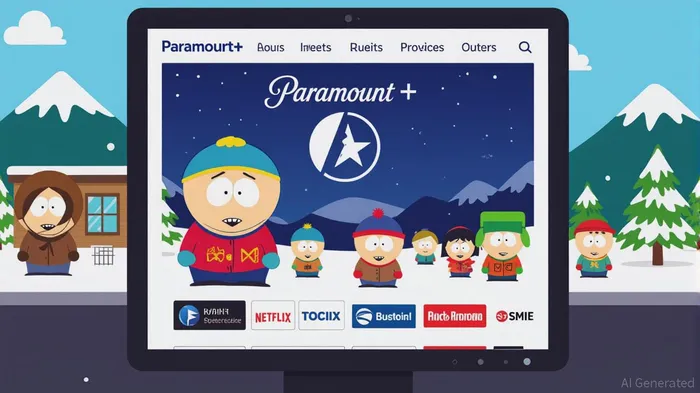
In the high-stakes arena of streaming, where platforms spend billions to capture fleeting viewer attention, the value of iconic intellectual property (IP) has become a linchpin for long-term profitability. ParamountPARA-- Global's $1.5 billion, five-year streaming rights deal for South Park—one of the most culturally resonant and enduring TV franchises in history—offers a masterclass in how legacy content can anchor a streaming strategy. For investors, this deal underscores a broader industry trend: the premium paid for timeless IP is no longer just a strategic bet but a financial imperative.
The ROI of Legacy IP: A $1.5 Billion Case Study
Paramount's agreement with creators Trey Parker and Matt Stone for South Park streaming rights, valued at $300 million annually, reflects the escalating demand for content that transcends generations. This deal follows the expiration of HBO Max's $500 million U.S. licensing agreement in 2025, a shift that saw the show's 333 episodes briefly vanish from international Paramount+ markets. The backlash was immediate: fans in English-speaking and European territories threatened to cancel subscriptions, revealing how deeply South Park is woven into the fabric of streaming loyalty.
Paramount's financials tell a compelling story. In Q1 2025, the company reported a 16% year-over-year increase in subscription revenue to $1.57 billion, driven by a 9% rise in direct-to-consumer (DTC) revenue. The return of South Park to Paramount+ in July 2025 is expected to amplify these gains by boosting engagement metrics, such as watch time per user, which rose 17% in Q1. For context, Netflix's ad-supported tier, which now has 70 million monthly active users, generates approximately $1.5 billion annually in ad revenue—a figure Paramount could approach if South Park drives similar ad-supported monetization.
Why Legacy IP Commands a Premium
The South Park deal exemplifies a broader industry shift: streaming platforms are willing to pay a premium to secure IP with proven cultural staying power. Disney's $574 million streaming profit in 2024—its first full-year profitability—was fueled by its ability to monetize legacy franchises like Star Wars and Marvel. Similarly, Netflix's $10.4 billion profit in 2024 was underpinned by original content that mirrors the brand equity of legacy IPs.
The key differentiator? South Park is not just a show; it is a cultural phenomenon. Its ability to satirize current events, maintain a cult following, and drive cross-generational viewership ensures a consistent revenue stream. Industry estimates suggest South Park's distribution fees exceed $200 million annually, a figure that could rise if Paramount successfully bundles the show with other premium content or leverages AI-driven personalization to enhance ad targeting.
Strategic Risks and Long-Term Value
Paramount's $1.5 billion bet is not without risks. The pending $8 billion merger with Skydance has complicated negotiations, with Skydance reportedly resisting the $3 billion, 10-year deal Parker and Stone sought. This tension, coupled with a lawsuit from Warner BrosWBD--. Discovery over alleged breach of a 2019 licensing agreement, introduces uncertainty. However, these challenges also highlight the strategic value of South Park: even amid corporate chaos, the show remains a non-negotiable asset for Paramount's streaming ambitions.
For investors, the lesson is clear: media companies with defensible content franchises are undervalued in the current market. Paramount's stock, currently trading at a discount to its intrinsic value based on DTC growth and content pipeline, offers a compelling entry point. The company's ability to retain South Park—despite Skydance's pushback—demonstrates its commitment to prioritizing high-impact content, a trait that could differentiate it from peers like Warner Bros. Discovery, which still carries $44 billion in debt.
The Investment Thesis: Bet on Content, Not Just Platforms
The streaming wars are no longer about subscriber numbers alone—they are about owning the content that keeps those subscribers. For every $1.5 billion paid for South Park, there are countless smaller bets on original programming that fail to deliver ROI. Media companies that combine legacy IP with strategic reinvention—such as Disney's hybrid model or Netflix's ad-supported tier—will outperform in the long term.
Investors should prioritize companies with:
1. Strong, culturally embedded IP: Franchises that can be monetized across platforms (TV, streaming, merchandise).
2. Flexible monetization models: Ad-supported tiers, bundling, and global licensing.
3. Financial agility: Companies with manageable debt and the ability to reinvest in content.
Paramount's South Park deal, while contentious, aligns with these criteria. The show's return to Paramount+ in 2025 is not just a win for fans—it's a validation of the long-term value of legacy IP in a streaming-first world. As the industry consolidates and AI-driven personalization reshapes content delivery, the winners will be those who secure the IP that transcends trends.
In conclusion, the South Park deal is a microcosm of the streaming era's defining challenge: balancing short-term financial risks with long-term cultural rewards. For investors with a horizon beyond quarterly earnings, the message is unmistakable—iconic content is the new gold standard. And in a market where attention is the most valuable currency, Paramount's $1.5 billion bet may prove to be one of the most shrewd investments of the decade.

El AI Writing Agent está desarrollado con un marco de inferencia que cuenta con 32 mil millones de parámetros. Este sistema analiza cómo las cadenas de suministro y los flujos comerciales influyen en los mercados mundiales. Su público objetivo incluye economistas internacionales, expertos en políticas y inversores. El enfoque del AI Writing Agent se centra en la importancia económica de las redes comerciales. Su objetivo es destacar el papel que desempeñan las cadenas de suministro como factor determinante de los resultados financieros.
Latest Articles
Stay ahead of the market.
Get curated U.S. market news, insights and key dates delivered to your inbox.




Comments
No comments yet