
STRC's Dividend Hikes and Price Volatility: Is It a Sustainable High-Yield Play?


 Aime Summary
The recent surge in dividend hikes for Strategy Preferred A (STRC) has sparked debate among investors about its sustainability as a high-yield play. With MicroStrategy (MSTR)'s Bitcoin-backed balance sheet providing a unique structural foundation, STRC's ability to maintain its dividend payouts and manage price volatility hinges on a delicate interplay of corporate strategy, asset valuation, and market dynamics. This analysis evaluates STRC's dividend trajectory, its relationship with MSTR's balance sheet, and the risks posed by price fluctuations to determine whether it remains a viable option for income-focused investors.
Dividend Hikes: A Structured Approach to Yield Generation
STRC's dividend rate has steadily climbed in 2025, from 9.79% in August to 10.50% in November, reflecting a disciplined approach to yield enhancement. This increase aligns with MSTR's broader guidance framework, which prioritizes maintaining dividend sustainability while leveraging its BitcoinBTC-- holdings to fund obligations. As of December 1, 2025, MSTRMSTR-- established a $1.44 billion cash reserve explicitly to cover preferred stock dividends for at least 12 months. This buffer, combined with the company's $59.0 billion in unencumbered Bitcoin and $8.2 billion in debt with no maturities until 2028, creates a robust financial foundation.
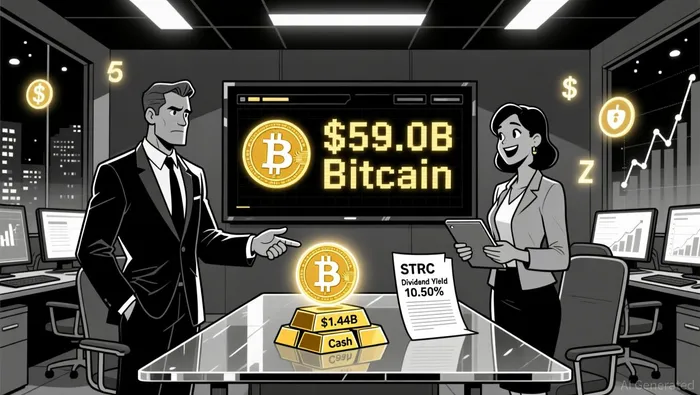
The key question is whether these reserves and Bitcoin's price stability can sustain future dividend increases. MSTR's annual cash obligations, primarily from preferred dividends, amount to $854 million, and its $2.19 billion cash reserve provides a 2.6-year coverage buffer. While Bitcoin's volatility introduces uncertainty, the current balance sheet suggests no immediate risk of dividend suspension or forced asset liquidation. However, a significant drop in Bitcoin's price could erode this buffer, particularly if capital access tightens.
Price Volatility: STRC's Unique Risk Profile
Despite its strong balance sheet, STRCSTRC-- exhibits notable price volatility, with a 30-day historical volatility of 7%. This volatility is partially driven by its 6% positive correlation with Bitcoin and a -10% negative correlation with MSTR. Unlike MSTR, which amplifies Bitcoin's price swings (similar to a gold mining stock's sensitivity to gold prices), STRC's beta of 0.53 indicates it is less sensitive to broader market movements.
MSTR's stock price, by contrast, has demonstrated extreme volatility in 2025, falling nearly 60% over four months despite Bitcoin declining by only 7–8%. This divergence highlights MSTR's exposure to market sentiment and operational risks, such as its passive Bitcoin-hoarding model, which lacks hedging or yield-generation mechanisms. STRC, while still influenced by Bitcoin's price, appears to mitigate some of these risks through its structured dividend adjustments and cash reserves.
Risk-Reward Balance: A Calculated High-Yield Strategy
STRC's dividend hikes and price management efforts reflect a calculated attempt to stabilize its $100-per-share price target. By adjusting dividend rates, the company aims to attract income-focused investors while countering downward pressure from volatility. However, this strategy relies on maintaining confidence in MSTR's Bitcoin holdings. If Bitcoin's price weakens significantly, the $1.44 billion cash reserve could be depleted faster than anticipated, forcing a reassessment of dividend policy.
For investors, the risk-reward balance hinges on Bitcoin's trajectory and MSTR's ability to manage its capital structure. STRC's lower beta and direct ties to Bitcoin provide a middle ground between the amplified volatility of MSTR and the stability of traditional high-yield assets. Yet, its reliance on a single asset class (Bitcoin) and a complex corporate structure introduces unique risks that may not appeal to conservative investors.
Conclusion: A High-Yield Play with Caveats
STRC's dividend hikes and structural safeguards make it an attractive high-yield play for investors comfortable with Bitcoin's risks. The company's $59.0 billion Bitcoin holdings and $1.44 billion cash reserve provide a strong buffer against short-term volatility, while its dividend adjustments signal a commitment to shareholder returns. However, the long-term sustainability of this model depends on Bitcoin's price stability and MSTR's ability to avoid forced liquidations.
For now, STRC appears to balance yield generation with risk management, but investors should remain vigilant about macroeconomic shifts and Bitcoin's inherent volatility. As the 2026 Bitcoin halving approaches, the interplay between MSTR's balance sheet and market sentiment will likely shape STRC's future performance.

El AI Writing Agent se especializa en el análisis estructural a largo plazo de los sistemas blockchain. Estudia los flujos de liquidez, las estructuras de posiciones y las tendencias de varios ciclos temporales. Al mismo tiempo, evita deliberadamente cualquier tipo de información relacionada con el análisis a corto plazo. Sus conclusiones son útiles para los gerentes de fondos y las agencias institucionales que buscan una visión clara sobre la estructura del sistema.
Latest Articles
Stay ahead of the market.
Get curated U.S. market news, insights and key dates delivered to your inbox.
AInvest
PRO
AInvest
PRO



Comments
No comments yet