
Strategizing for a Powell Exit: The Case for Short-Dated Convertible Bonds
 Aime Summary
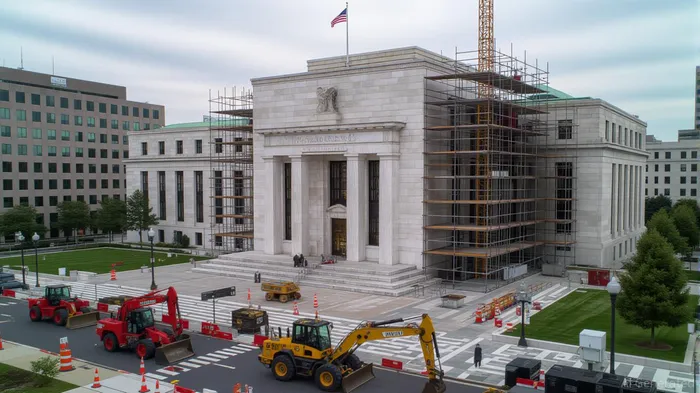
The Federal Reserve's independence has long been a cornerstone of U.S. economic policy. Yet in 2025, that independence is under siege. With President Donald Trump's unrelenting pressure on Jerome Powell and the administration's public scrutiny of the Fed's $2.5 billion headquarters renovation, the specter of an early Powell exit looms large. For investors, the implications are profound. A shift in Fed leadership could tilt monetary policy toward rate cuts and a more dovish stance, reshaping yield curves and asset allocation strategies in the process. Hedge funds, particularly those with a knack for navigating macroeconomic shifts, are already positioning for this eventuality—and their playbook offers a compelling roadmap for investors.
The Powell Conundrum: Political Pressure and Policy Uncertainty
President Trump's public demands for Powell's resignation have oscillated between bluster and calculated strategy. While Trump has denied plans to issue a formal termination letter, his administration's fixation on the Fed's renovation project—and its perceived “ostentatious” features—has provided a convenient narrative for those seeking to erode Powell's credibility. Treasury Secretary Scott Bessent has further stoked the fire, suggesting Powell should step down from the Fed board entirely when his chair term ends in May 2026 to avoid market confusion. Meanwhile, potential successors like Christopher Waller and Kevin Warsh, both Trump appointees, have signaled openness to rate cuts, contrasting with Powell's cautious approach.
The political theater has already rattled markets. Two-year Treasury yields dipped in response to rumors of Powell's removal, while 30-year yields surged, reflecting divergent expectations about short-term and long-term policy shifts. For investors, the key question is whether a new Fed chair would prioritize rate cuts to stimulate growth or maintain Powell's focus on inflation. The answer, many hedge funds believe, hinges on the broader economic context—and the inflationary risks posed by Trump's tariff policies.
Hedge Funds Hedge: The Convertible Bond Play
Amid this uncertainty, Fourier Asset Management, a 2024-founded convertible bond specialist, has carved out a high-conviction strategy. The firm is heavily invested in short-dated convertible bonds issued by Coinbase, a crypto exchange whose 2026 and 2030 bonds offer conversion prices of $370.45 and $333.55, respectively. According to CIO Orlando Gemes, these bonds are ideal for a post-Powell world.
“Short-dated convertibles provide dual benefits: income and equity upside,” Gemes explained. “If Powell is replaced and the Fed pivots to rate cuts, yields on these bonds will fall, but their conversion value will rise. That's a win-win in a dovish environment.”
The logic is rooted in the interplay between inflation and interest rates. A new Fed chair, under pressure from the Trump administration, would likely lower rates to reduce borrowing costs and stimulate economic activity. However, Trump's tariffs—designed to protect domestic industries—risk pushing inflation higher. Convertible bonds, which combine fixed-income yields with equity participation, offer a hedge against this duality. They allow investors to collect income while retaining the flexibility to capitalize on equity gains if inflation drives asset prices upward.
Yield Curves and the Inflation Premium
The Fed's current policy of holding rates steady at 4.25% to 4.50% has kept 10-year Treasury yields in a tight range of 4.1% to 4.7% over the past 18 months. But a dovish pivot could flatten the yield curve, compressing long-term rates while short-term rates adjust to reflect the new policy regime. Short-dated convertible bonds, with their lower duration, would be less exposed to this flattening effect, making them a tactical advantage.
Moreover, the inflation premium embedded in these bonds is critical. With the Consumer Price Index (CPI) at 2.7% in June 2025, markets are pricing in a moderate but persistent inflationary backdrop. Convertible bonds, particularly those tied to growth sectors like crypto, offer a buffer against this trend. For instance, Coinbase's bonds are hedged by the company's exposure to digital assets, which have historically outperformed in inflationary cycles due to their decentralized, non-correlated nature.
The Investment Case: Act Now, Hedge Later
For investors, the key takeaway is to act before the market fully prices in a Powell exit. The Fed's June 2025 meeting minutes revealed limited support for rate cuts, but political pressures could force a quicker pivot. Short-dated convertible bonds, with their shorter maturity and conversion flexibility, allow investors to lock in current yields while positioning for equity gains.
Fourier's strategy also highlights the importance of sector selection. While the S&P 500 has been dominated by large-cap tech stocks, smaller, high-growth names like Coinbase offer asymmetric upside in a dovish environment. This approach mirrors the broader hedge fund playbook: underweight long-duration assets, overweight sectors with inflation-linked revenue, and maintain a liquidity buffer to capitalize on volatility.
Conclusion: Balancing Risk and Reward
The potential departure of Jerome Powell is more than a political drama—it's a structural shift with far-reaching implications for markets. By favoring short-dated convertible bonds, hedge funds are betting on a world where rate cuts and inflation coexist. For investors, the challenge is to balance the risks of policy uncertainty with the rewards of strategic positioning. In a landscape where every day brings new volatility, the playbook of firms like Fourier offers a compelling case: hedge against the Fed's next move, and position for the inflationary tailwinds that may follow.
As the Fed's July 2025 meeting approaches, the question isn't whether Powell will leave—it's how quickly the market will adapt to his absence. For those who act now, the rewards could be significant.

Eli escribe principalmente para inversores, profesionales del sector y personas con curiosidad económica, para desafiar ampliamente las perspectivas habituales. El analista enfatiza un enfoque ágato pero también crítico de las dinámicas de mercado, con la meta de educar, de informar y, a veces, de hacer que fluyan narrativas conocidas. Sin dejar de lado la credibilidad y la influencia del medio de comunicación financiero, Eli se centra en economía, en tendencias del mercado y en análisis de inversión. El estilo de escritura directo y analítico de Eli mantiene la clareza, permitiendo que incluso temas complejos sean accesibles a un público amplio sin sacrificar el rigor.
Latest Articles
Stay ahead of the market.
Get curated U.S. market news, insights and key dates delivered to your inbox.






Comments
No comments yet