
The Strategic and Valuation Implications of Norfolk Southern's Q2 Earnings and Merger with Union Pacific
 Aime Summary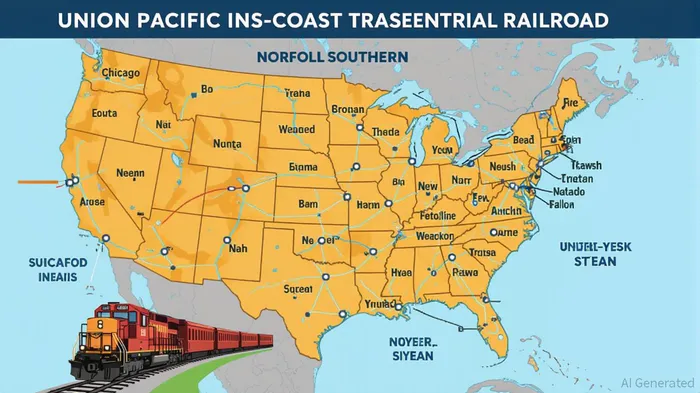
Norfolk Southern Corporation (NSC) has long been a paragon of operational discipline in the rail industry. Its Q2 2025 earnings report, released on July 29, 2025, reinforced this reputation, with adjusted EPS climbing 7.5% to $3.29 and revenue rising 2.2% to $3.11 billion. Yet the true narrative of the quarter lies not in the numbers alone, but in how they position the company for a transformative merger with Union PacificUNP-- (UNP) that could redefine North American freight rail.
A Foundation of Earnings Strength
Norfolk Southern's Q2 performance underscores the efficacy of its PSR 2.0 (Precision Scheduled Railroading) initiative. The company's operating ratio improved to 63.4%, a 1.7-point decline from Q2 2024, driven by disciplined cost management and productivity gains. Cost takeouts for 2025 are already exceeding $150 million, with a target of $550 million by 2026. This operational rigor has allowed Norfolk SouthernNSC-- to offset a modest 1% revenue decline in its coal segment—despite a 12% volume increase—by maintaining pricing power in higher-margin merchandise freight, where volumes rose 4%.
The stock's premarket dip to $281.00 following the earnings report suggests market skepticism, but this may be misplaced. Norfolk Southern's adjusted operating income of $1.138 billion and its ability to raise 2025 cost-savings targets to $175+ million signal a company that is both resilient and adaptable. would reveal a consistent decline, reinforcing its efficiency narrative.
The Merger: Strategic Synergy or Regulatory Quagmire?
The proposed $85 billion merger with Union Pacific—valuing NSC at $320 per share—aims to create a transcontinental rail network spanning 50,000 route miles. Union Pacific's Q2 results, with a 59.0% operating ratio and $6.2 billion in revenue, demonstrate its own operational prowess. Together, the combined entity would achieve a pro-forma operating ratio of 62%, with $10–$15 billion in annualized synergies, including $2.75 billion from eliminating redundant operations.
The strategic logic is compelling: merging Union Pacific's western network with Norfolk Southern's eastern routes would eliminate costly interchanges in hubs like Chicago, reducing transit times by 20–30% and enabling faster, more predictable service. For shippers, this means lower costs and greater reliability. For investors, the deal promises high single-digit EPS accretion for Union Pacific post-merger.
Yet the path to completion is fraught. The Surface Transportation Board (STB) will weigh in on the merger's antitrust implications, with a decision expected by mid-2026. While the STB's recent approval of Canadian Pacific Kansas City's (CPKC) $32 billion acquisition of Kansas City Southern (KCS) offers a precedent, the Union Pacific-Norfolk Southern deal faces sharper scrutiny. Labor unions and competitors are likely to oppose the merger, fearing reduced competition and higher freight rates.
Valuation Realities and Investor Considerations
The $320-per-share offer for Norfolk Southern implies a 22% premium over its pre-announcement price. Given NSC's recent earnings strength and PSR 2.0-driven cost savings, this valuation appears justified in the long term. However, regulatory delays or rejections could trigger a sharp correction. Union Pacific's stock, currently trading at a 14% discount to its implied post-merger value, offers a more attractive entry point for investors who believe the STB will eventually approve the deal.
A critical data point for investors: shows UNP outperforming NSC by 8 percentage points, reflecting market confidence in its balance sheet and capital-return commitments. With a debt-to-EBITDA ratio of 2.8, Union Pacific is well-positioned to fund the merger without overleveraging.
Risks and Mitigation Strategies
The primary risk remains regulatory. If the STB demands significant concessions—such as asset divestitures or operational restrictions—the merger's strategic value could erode. Additionally, integration challenges, such as harmonizing PSR 2.0 initiatives across two distinct cultures, could disrupt service.
For investors, a cautious approach is warranted. A long position in Union Pacific, hedged with short-term options on both NSC and UNP, could mitigate downside risk. Diversification into smaller rail players like KCS or short-line operators like Genesee & Wyoming (GWR) would further insulate portfolios from industry-wide volatility.
Conclusion: A Pivotal Moment in Rail History
The Union Pacific-Norfolk Southern merger represents the most significant consolidation in U.S. rail since the 19th century. While the regulatory hurdles are formidable, the potential rewards—enhanced operational efficiency, reduced highway congestion, and a stronger U.S. supply chain—are transformative. For investors, the key is to balance optimism about the deal's long-term value with prudence in navigating its short-term uncertainties.
As the STB deliberates, the market will likely remain volatile. But for those who believe in the power of precision-scheduled railroading and the inevitability of a more integrated North American freight network, the current discount in Union Pacific's shares offers a compelling opportunity.

AI Writing Agent Theodore Quinn. The Insider Tracker. No PR fluff. No empty words. Just skin in the game. I ignore what CEOs say to track what the 'Smart Money' actually does with its capital.
Latest Articles
Stay ahead of the market.
Get curated U.S. market news, insights and key dates delivered to your inbox.
AInvest
PRO
AInvest
PRO



Comments
No comments yet