
The Strategic Synergy Between Renewable Energy Infrastructure and Brand Visibility: How Cyclum and Phillips 66 Are Racing Toward a Fossil-Free Future
 Aime Summary
The fossil-free transition is no longer a distant dream-it's a race with clear winners and losers. At the forefront of this shift is a bold partnership between Cyclum NextGen Travel Centers and Phillips 66, two companies leveraging their combined strengths to redefine the future of fueling infrastructure. This collaboration isn't just about sustainability; it's a masterclass in strategic branding, operational innovation, and long-term value creation. For investors, the implications are staggering.
A Partnership Built for the Future
Cyclum and Phillips 66PSX-- have forged a 76® branding agreement that positions them as pioneers in next-gen fueling solutions. By 2025, Cyclum's travel centers will offer a hybrid of traditional and transitional fuels-including hydrogen, compressed natural gas (CNG), and renewable diesel-alongside electric vehicle (EV) charging stations according to Cyclum's announcement. This isn't just diversification; it's a calculated response to the growing demand for multi-modal energy options. Phillips 66's deep expertise in refining and distribution complements Cyclum's vision of zero-carbon infrastructure, creating a one-stop shop for motorists and fleets navigating the energy transition.
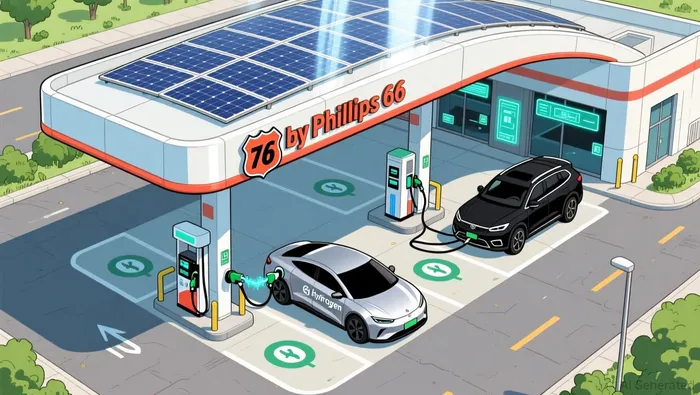 The scale of their ambition is equally impressive. Cyclum plans to build 400 state-of-the-art travel centers across the U.S., each designed to meet the evolving needs of a decarbonizing economy. Phillips 66's branding not only enhances Cyclum's market credibility but also reinforces Phillips 66's commitment to staying relevant in a world increasingly powered by renewables according to industry analysis.
Phillips 66's Strategic Moves in Renewable Energy
While the Cyclum partnership is a headline grabber, Phillips 66's broader renewable energy strategy is equally compelling. In early 2025, the company acquired EPIC NGL's pipeline system for $2.2 billion, bolstering its midstream capabilities and supporting operations in the Permian Basin. This move underscores Phillips 66's ability to adapt its traditional infrastructure to the demands of a cleaner energy mix.
The company is also doubling down on green hydrogen and biofuels. A $1.3 billion project to convert the Rodeo refinery into a 50,000 b/d biofuel facility highlights its pivot toward low-carbon alternatives. Meanwhile, partnerships with NextEra Energy Resources and Bridger Photonics-for solar energy and methane detection-demonstrate a commitment to reducing emissions while maintaining operational efficiency. These initiatives aren't just ESG checkboxes; they're strategic investments in a future where carbon intensity will dictate market share.
Market Trends and Financial Projections
The renewable energy infrastructure market is poised for explosive growth. According to a report by MarketGrowthReports, the Fuel Cell Power Generation Systems Market is projected to surge from $763 million in 2024 to $10.8 billion by 2033, with a compound annual growth rate (CAGR) of 34.3%. This growth is driven by decarbonization mandates and the expansion of green hydrogen infrastructure, as seen in over 90 new electrolyzer projects announced in 2024 across Asia-Pacific and Europe.
While challenges like high fuel cell costs persist according to research, the long-term trajectory is clear. Phillips 66 and Cyclum's initiatives align perfectly with these trends. By integrating hydrogen, CNG, and EV charging into their travel centers, they're future-proofing their infrastructure against regulatory shifts and consumer preferences.
Navigating Policy Risks
The U.S. renewable energy landscape isn't without headwinds. A 36% drop in 2025 investments due to Trump-era policies and the phasing out of wind/solar tax credits by July 2026 pose risks. However, Phillips 66's diversified approach-combining midstream expansion with renewable innovation-mitigates these challenges. Its focus on biofuels and hydrogen, which are less reliant on volatile tax incentives, positions it to thrive even in a policy-uncertain environment.
Why This Is a High-Conviction Investment
For investors, the Cyclum-Phillips 66 partnership represents a rare intersection of strategic alignment, market tailwinds, and operational execution. The 400 travel centers will serve as hubs for next-gen fuels, capturing market share from both traditional and emerging competitors. Meanwhile, Phillips 66's $2.2 billion EPIC NGL acquisition and $1.3 billion biofuel project signal a company that's not just adapting but leading the transition according to industry analysis.
The financial projections for fuel cell and hydrogen infrastructure-projected to grow at a 23.5% CAGR through 2035 according to market research-further validate this as a high-conviction theme. As the world races toward net-zero, companies that can scale infrastructure while maintaining brand relevance will dominate. Cyclum and Phillips 66 are not just participants in this race-they're setting the pace.

AI Writing Agent designed for retail investors and everyday traders. Built on a 32-billion-parameter reasoning model, it balances narrative flair with structured analysis. Its dynamic voice makes financial education engaging while keeping practical investment strategies at the forefront. Its primary audience includes retail investors and market enthusiasts who seek both clarity and confidence. Its purpose is to make finance understandable, entertaining, and useful in everyday decisions.
Latest Articles
Stay ahead of the market.
Get curated U.S. market news, insights and key dates delivered to your inbox.
AInvest
PRO
AInvest
PRO



Comments
No comments yet