
The Strategic Significance of Pineapple Financial's $100M INJ Token Investment and Its Implications for Institutional DeFi Adoption


 Aime Summary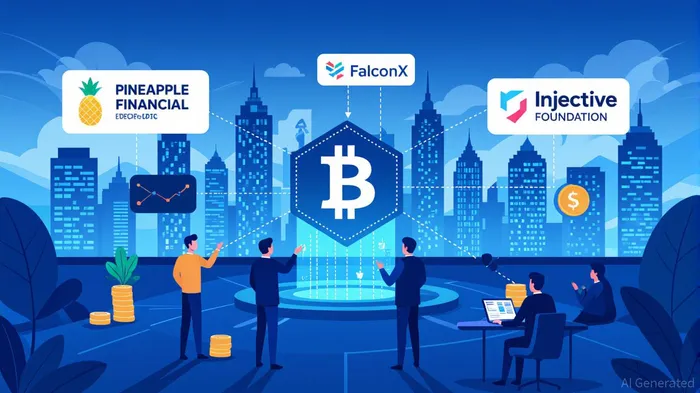
In the rapidly evolving landscape of decentralized finance (DeFi), the convergence of institutional capital and blockchain infrastructure is reshaping the contours of global markets. PineapplePAPL-- Financial’s recent $100 million investment in INJ, the native token of the Injective Protocol, marks a pivotal moment in this transition. By anchoring its digital assetDAAQ-- treasury strategy to INJ, Pineapple has not only positioned itself as the first publicly traded company to hold the token but has also signaled a broader institutional validation of blockchain’s role in modern finance [1]. This move, underpinned by a projected 12% passive yield, reflects a strategic bet on the tokenization of financial assets and the infrastructure that supports it [2].
The Infrastructure Case for INJ: Scalability, Interoperability, and Institutional-Grade Security
Injective Protocol’s architecture is uniquely positioned to address the limitations of legacy financial systems. Unlike many blockchain platforms, Injective offers a modular framework that enables developers to deploy high-performance applications without grappling with technical complexities [1]. Its MultiVM system ensures compatibility with EthereumETH-- Virtual Machines (EVM), CosmosATOM-- SDK, and SolanaSOL--, allowing cross-chain applications to operate seamlessly. This interoperability is critical for institutions seeking to integrate decentralized solutions without abandoning existing ecosystems.
Recent upgrades, such as the Ethernia upgrade in August 2025, have further solidified Injective’s appeal. By activating an EVM-compatible mainnet, the platform now supports Ethereum-based decentralized applications (dApps) without requiring code modifications, effectively bridging the Ethereum and Cosmos ecosystems [2]. This has already driven a 1,700% surge in daily active addresses, underscoring the network’s scalability and adoption potential [2]. For institutional investors, the deflationary tokenomics of INJ—coupled with partnerships like those with Libre Capital and Paxos for real-world asset tokenization—add layers of scarcity and utility that align with long-term value creation [2].
Institutional Adoption: FalconX, Monarch, and the Injective Foundation’s Role
The institutional credibility of INJ is further reinforced by strategic partnerships. FalconX, a CFTC-registered swap dealer, has leveraged Injective’s infrastructure to launch institutional-grade derivatives contracts settled against regulated indices like the CME CF BitcoinBTC-- Reference Rate. These products, including swaps, options, and non-deliverable forwards (NDFs), cater to sophisticated investors seeking secure exposure to crypto assets while benefiting from FalconX’s deep liquidity [3].
Meanwhile, the Injective Foundation has taken proactive steps to align the protocol with institutional expectations. Initiatives such as the Injective Ambassador Program and the Injective Council—a body of leaders from traditional finance, crypto, and big tech—demonstrate a commitment to governance and regulatory alignment [4]. The Foundation’s collaboration with Deutsche Telekom and GoogleGOOGL-- Cloud further underscores its ambition to become an institutional-grade infrastructure provider [4].
Monarch’s contributions, though less publicized, have also been significant. The Injective Mainnet Performance Upgrade (v1.16.2) in August 2025 enhanced blockchain reliability, while the launch of an onchain market for tokenized NVIDIANVDA-- H100 GPU rentals expanded the platform’s utility beyond traditional finance [5]. These innovations highlight Injective’s adaptability to emerging sectors like AI-driven compute markets.
Why INJ Is a High-Growth Institutional On-Ramp for 2025–2026
The strategic significance of Pineapple’s investment lies in its alignment with macroeconomic trends. As global institutions explore tokenization—a market projected to reach trillions of dollars—Injective’s infrastructure provides a scalable, secure, and interoperable foundation [1]. The platform’s ability to support Ethereum’s $380 billion ecosystem via bidirectional bridges and its EVM execution environment make it an attractive on-ramp for institutions seeking to hedge against the inefficiencies of legacy systems [3].
Moreover, the recent Staked INJ ETF filing and Injective’s regulatory engagements suggest a path toward mainstream adoption. For DeFi investors, this represents a critical inflection point: INJ is no longer a speculative asset but a foundational component of institutional-grade blockchain infrastructure.
Conclusion
Pineapple Financial’s $100 million bet on INJ is more than a financial maneuver—it is a vote of confidence in the future of finance. By anchoring its treasury strategy to a blockchain platform that combines institutional-grade security, interoperability, and innovation, Pineapple has set a precedent for how traditional fintech can coexist with decentralized systems. As Injective continues to attract partners like FalconX, Monarch, and the Injective Foundation, the INJ token is emerging not just as a speculative asset but as a high-growth on-ramp for institutional DeFi adoption in 2025–2026.
Source:
[1] Pineapple FinancialPAPL-- Announces the Launch of $100M Injective Digital Asset Treasury Strategy Becoming the First Publicly Traded INJ Holder Worldwide [https://www.newsfilecorp.com/release/264735/Pineapple-Financial-Announces-the-Launch-of-100M-Injective-Digital-Asset-Treasury-Strategy-Becoming-the-First-Publicly-Traded-INJ-Holder-Worldwide]
[2] Injective (INJ) on the Brink of a Breakout: Network Effects ... [https://www.ainvest.com/news/injective-inj-brink-breakout-network-effects-defi-infrastructure-catalysts-long-term-price-momentum-2508]
[3] FalconX and CF Benchmarks Partner to Create Institutional Grade Derivatives Contracts [https://www.falconx.io/newsroom/falconx-and-cf-benchmarks-partner-to-create-institutional-grade-derivatives-contracts]
[4] Injective Summit 2025 Recap: The Future of Finance Is Now [https://www.coindesk.com/sponsored-content/injective-summit-2025-recap-the-future-of-finance-is-now]
[5] Injective Protocol Price, INJ to USD, Research, News & ... [https://messari.io/project/injective-protocol]

Decoding blockchain innovations and market trends with clarity and precision.
Latest Articles
Stay ahead of the market.
Get curated U.S. market news, insights and key dates delivered to your inbox.
AInvest
PRO
AInvest
PRO



Comments
No comments yet