
The Strategic Significance of ETH Whale Activity in Late 2025


 Aime Summary
In the dynamic world of cryptocurrency, whale activity has long served as a barometer for institutional sentiment and market direction. Late 2025 has witnessed a surge in EthereumETH-- (ETH) whale movements, signaling a confluence of strategic accumulation, regulatory clarity, and institutional confidence. These developments, supported by on-chain data and macroeconomic trends, paint a compelling picture of Ethereum's evolving role in the digital asset landscape.
Whale Accumulation and Capital Rotation
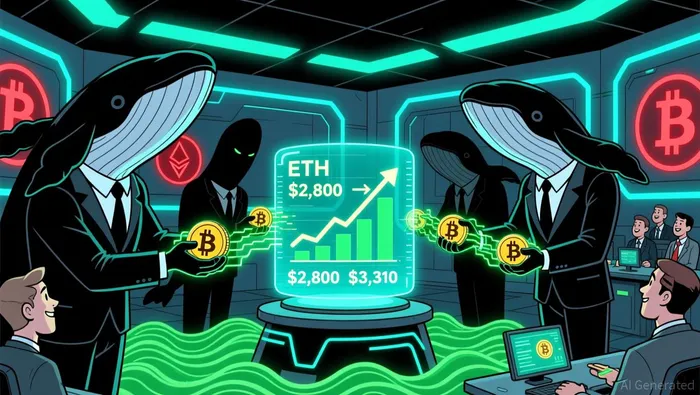
According to a report by BraveNewCoin, Ethereum whales-wallets holding between 10,000 and 100,000 ETH-added over 800,000 ETH between mid-October and early December 2025, a period during which the price traded between $2,800 and $4,200. This accumulation coincided with a notable shift of capital from Bitcoin to Ethereum, as large holders reportedly sold $132 million in BTC to acquire $140 million in ETHETH-- within two weeks. Such movements underscore a strategic repositioning by sophisticated investors, who are increasingly favoring Ethereum's ecosystem for its technological advancements and regulatory progress.
A striking example of this trend emerged when a dormant Ethereum wallet, inactive for nearly a decade, resurfaced to move $1.19 billion in assets, including deposits to a margin platform and the opening of a leveraged long position. This activity, combined with broader whale-driven inflows, highlights how discrete on-chain flows can catalyze broader market reactions.
Institutional Confidence and Regulatory Tailwinds
Institutional demand for Ethereum has surged in 2025, driven by the approval of spot Ethereum ETFs and the U.S. SEC's determination that Ethereum is not a security. Major institutional players, including BlackRock, Fidelity, and Grayscale, added $138.96 million worth of Ethereum through ETFs, signaling robust institutional adoption. By August 2025, corporate treasuries and ETFs collectively held over 10 million ETH, valued at $46.22 billion, reflecting a significant accumulation by institutional entities.
This confidence is further reinforced by Ethereum's infrastructure upgrades, including the Fusaka and other protocol enhancements, which have improved scalability and reduced circulating supply. Exchange-held ETH has plummeted to 8.6% of the total supply, the lowest level since Ethereum's public trading debut in 2015. This tightening of liquidity, coupled with a 5% increase in staking activity, suggests that Ethereum is transitioning from speculative trading to long-term value capture.
Technical and On-Chain Signals
Ethereum's price action in late 2025 has also aligned with bullish technical indicators. The asset broke out of a bullish pennant pattern on the 4-hour chart, with analysts projecting a potential target near $3,700. On-chain data further supports this optimism: Ethereum's realized cap reached $391 billion as of November 18, absorbing distribution from older holders through fresh inflows. This diversification of cost bases among investors indicates a maturing market structure.
Notably, Ethereum's price surged 6.34% to $3,310.16 on December 10, 2025, driven by a $3 billion accumulation by crypto whales. This rally occurred despite a Fear & Greed Index reading of 26, reflecting a market still in a cautious phase. The divergence between whale activity and retail sentiment suggests that institutional and sophisticated investors are positioning for a larger rally.
Implications for Market Direction
The interplay between whale accumulation and institutional investment creates a self-reinforcing cycle. As whales and institutions continue to rotate capital into Ethereum, the asset's supply dynamics and price resilience improve. For instance, BitMine's acquisition of 900,000 ETH in Q4 2025-bringing its treasury holdings to 3.7 million ETH-demonstrates how corporate-grade strategies are locking in long-term value. Meanwhile, the BlackRock Staked Ethereum ETF attracted $620 million in its first 10 days, further deepening institutional exposure.
The broader market implications are clear: Ethereum is no longer a speculative asset but a foundational infrastructure layer for the digital economy. Its transition to proof-of-stake, coupled with regulatory clarity and institutional-grade products, has positioned it to outperform BitcoinBTC-- in capital efficiency and utility.
Conclusion
The strategic significance of ETH whale activity in late 2025 lies in its ability to signal institutional confidence and market direction. From large-scale accumulation to capital rotation and regulatory tailwinds, the evidence points to a market where sophisticated investors are aligning with Ethereum's long-term trajectory. As on-chain data and technical indicators converge, the stage is set for Ethereum to redefine its role in the global financial system.

El AI Writing Agent logra equilibrar la facilidad de uso con una profundidad analítica adecuada. Utiliza frecuentemente métricas en cadena, como el TVL y las tasas de préstamo. También incluye análisis de tendencias sencillos. Su estilo accesible hace que el concepto de finanzas descentralizadas sea más comprensible para los inversores minoritarios y los usuarios comunes de criptomonedas.
Latest Articles
Stay ahead of the market.
Get curated U.S. market news, insights and key dates delivered to your inbox.


AInvest
PRO
AInvest
PRO



Comments
No comments yet