
Strategic Shift: How Taiwanese Entrepreneurs Navigate Cross-Strait Tensions and Redefine Global Supply Chains
The geopolitical fault line between China and Taiwan has never been deeper. As cross-strait tensions escalate—marked by military posturing, political interference, and economic friction—Taiwanese entrepreneurs operating in China are facing an existential reckoning. The era of "Taishang" (Taiwanese business elites in China) as a linchpin of cross-strait relations is fading, replaced by a scramble to diversify supply chains and mitigate risks. For investors, this upheaval presents both peril and opportunity.
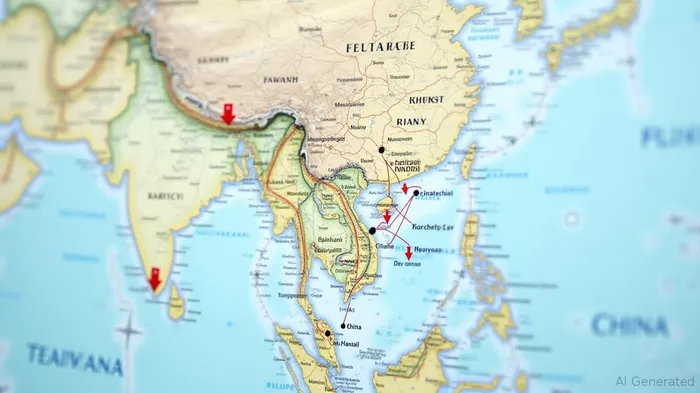
The Geopolitical Gauntlet: Why Taiwan's Entrepreneurs Are Exiting
Taiwanese businesses have long been caught in the crossfire of China's "united front" strategies and military saber-rattling. Recent developments underscore the growing risks:
Political Repression: Beijing's crackdown on perceived "Taiwan independence activities" has created a climate of fear. Taiwanese entrepreneurs report self-censorship, with one industrialist quoted as saying, "We have to be very careful when we speak." New regulations encouraging citizens to report pro-independence sentiments have turned business environments into potential traps.
Economic Headwinds: China's slowing growth, rising labor costs, and U.S.-China trade wars have eroded the cost advantages that once drew Taiwanese firms. Investments in China fell by 62% between 2016 and 2024, while Vietnam saw a 129% surge in Taiwanese investments, reaching over $1 billion annually.
Military Posturing: PLA naval exercises breaching the second island chain and nuclear modernization programs signal Beijing's willingness to escalate. For companies like Foxconn—whose founder faced investigations linked to political tensions—the risk of operational disruption looms large.
The Great Supply Chain Shuffle: Where Are Taiwanese Firms Going?
The exodus from China is reshaping global manufacturing. Key trends include:
- Southeast Asia Boom: Vietnam, Thailand, and Indonesia are emerging as top destinations. Taiwanese firms are leveraging these countries' lower costs, young labor forces, and proximity to China. Vietnam's industrial parks, for instance, now host nearly 1,500 Taiwanese companies, up from 800 in 2018.
- Return to Taiwan: A subset of businesses are repatriating production to Taiwan, driven by advanced manufacturing needs and government incentives. Taiwan's semiconductor ecosystem, exemplified by TSMC, is a magnet for high-tech firms.
- U.S. and Japan Partnerships: Pressure from U.S. tariffs and subsidies (e.g., the CHIPS Act) is pushing companies like TSMC to invest in Arizona, while Japan's tech sector collaborates with Taiwanese firms to bypass China's dominance.
Data shows ASEAN overtaking China as Taiwan's largest export destination by 2024.
Investment Opportunities in the New Geopolitical Landscape
The reshuffling of supply chains creates investment themes to watch:
- Southeast Asia Manufacturing Plays:
- Vietnam: Focus on companies like Vingroup (VCB), which operates industrial parks, and tech firms like FPT Corporation benefiting from Taiwanese semiconductor investments.
Thailand: Look for logistics and automotive suppliers (e.g., PTT Global Chemical) serving diversified supply chains.
Taiwan's Tech Dominance:
- Semiconductors: TSMC (TSM) remains a pillar, but smaller firms like ASE Technology (6109.TW) offering advanced packaging are critical to the ecosystem.
Renewable Energy: Rising demand for solar and EV components (e.g., GlobalWafers) aligns with Taiwan's green energy targets.
U.S.-Japan-Taiwan Alliances:
- U.S. Subsidy Beneficiaries: Companies like Intel (INTC) and Applied Materials (AMAT) partnering with Taiwanese firms to build domestic chip capacity.
- Japan-Taiwan Collaboration: Invest in firms like Sony (SNE) or Toyota (TM) expanding joint ventures with Taiwanese tech partners.
Risks and Caution Flags
- Geopolitical Volatility: A military escalation could disrupt global supply chains overnight. Monitor PLA activity near Taiwan and U.S.-China diplomatic signals.
- Labor Costs in Southeast Asia: Rapid wage growth in Vietnam and Thailand may narrow cost advantages over time.
- Supply Chain Complexity: Diversification adds logistical and coordination costs; firms lacking scale may struggle.
Conclusion: Betting on Resilience
The exodus of Taiwanese businesses from China is a harbinger of a broader geopolitical realignment. Investors should prioritize companies positioned to thrive in fragmented supply chains and politically stable regions. Southeast Asia's growth, Taiwan's tech leadership, and U.S.-Japan partnerships are the pillars of this new order.
As one Taiwanese entrepreneur put it: "We're not leaving China—we're building Plan B for when Plan A fails." For investors, Plan B is now Plan A.
Vietnam's 6–7% annual growth vs. China's 4–5% signals long-term momentum.

Delivering real-time insights and analysis on emerging financial trends and market movements.
Latest Articles
Stay ahead of the market.
Get curated U.S. market news, insights and key dates delivered to your inbox.


AInvest
PRO
AInvest
PRO



Comments
No comments yet