
The Strategic Shift in In-Flight Connectivity and the Future of LEO Satellite Investment


 Aime Summary
The aviation industry's digital transformation is accelerating, driven by passenger demand for seamless, high-speed connectivity during flights. At the heart of this shift lies the competition between two low Earth orbit (LEO) satellite networks: AmazonAMZN-- Leo and SpaceX's Starlink. As airlines seek to differentiate their services through superior in-flight Wi-Fi, the strategic positioning of these two players-and their respective investment roadmaps-will shape the future of global aviation connectivity.
Starlink: A Head Start with Proven Aviation Partnerships
Starlink, operated by SpaceX, has established itself as the market leader in LEO satellite broadband. With over 8,500 satellites in orbit and 8 million subscribers as of late 2025, Starlink's dominance is underpinned by its early mover advantage and robust partnerships. For aviation, Starlink has secured contracts with major airlines such as Scandinavian Airlines (SAS), airBaltic, Hawaiian Airlines, and Qatar Airways. According to a report by , Starlink's in-flight performance delivers median downlink speeds of 152.37 Mbps and latency as low as 44 ms, significantly outperforming geostationary (GEO) satellite systems. This reliability has made it a preferred choice for airlines operating over remote regions, including polar routes.
Starlink's strategic roadmap for 2026–2030 includes launching third-generation (Gen3) satellites, which promise terabit-per-second downlink capacity per satellite, and expanding its direct-to-cell (D2C) services to augment terrestrial mobile networks. For aviation, the company plans to certify additional aircraft models and expand its fleet of supported carriers. These moves position Starlink to maintain its lead in a market projected to grow from $16.1 billion in 2025 to $55.5 billion by 2035.
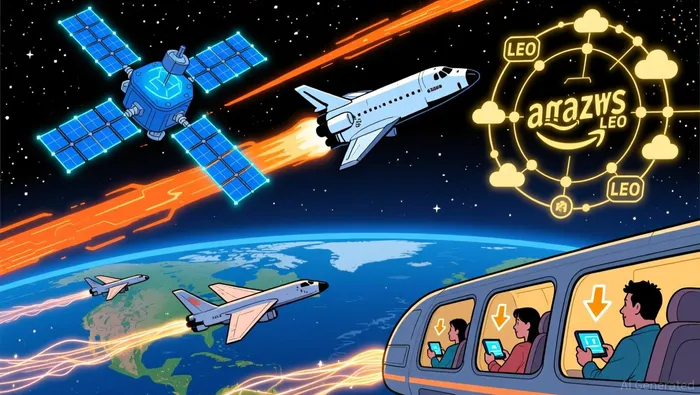
Amazon Leo: Aggressive Deployment and AWS Integration
Amazon's Project Kuiper, rebranded as Amazon Leo in 2025, is rapidly closing the gap. With over 150 satellites in orbit and plans to launch 3,200 in total, Amazon is leveraging its AWS cloud infrastructure to differentiate its offering. The company's Leo Ultra terminals, which promise download speeds up to 1 gigabit per second, are among the most advanced in the industry. Amazon's integration of LEO satellites with AWS allows enterprises to connect directly to cloud services, reducing latency for data-intensive operations-a critical advantage for aviation partners like JetBlue and Airbus.
JetBlue, the first airline to adopt Amazon Leo for in-flight connectivity, plans to deploy the service on a quarter of its fleet starting in 2027. The airline cited Leo's potential to deliver gate-to-gate gigabit speeds as a key factor in its decision. Meanwhile, American Airlines is reportedly in talks with Amazon to adopt Leo for its own in-flight Wi-Fi. Amazon's strategic focus on enterprise and government customers, combined with its $10 billion investment in South American markets, signals a long-term play to capture high-margin commercial contracts. According to analysis, the company's roadmap includes expanding its satellite constellation and enhancing its service offerings.
Technological and Performance Benchmarks
While Starlink's current performance metrics are well-documented, Amazon Leo's capabilities remain partially unproven at scale. Starlink's median latency of 45 ms and download speeds of 105 Mbps as reported by contrast with Amazon's engineering tests, which suggest Leo Pro terminals could achieve 400 Mbps as detailed by . However, Starlink's upload speeds (14.84 Mbps) currently outpace Amazon's implied uplink capabilities as measured by . Amazon's advantage lies in its full-duplex phased array antennas and optical inter-satellite links (OISL), which theoretically enable lower latency and higher throughput by routing data between satellites without ground gateways.
For aviation, Starlink's phased array antennas and Ku-band terminals have already demonstrated resilience in dynamic in-motion scenarios, while Amazon's Ka-band terminals for JetBlue are still in deployment. Both companies face challenges such as weather sensitivity and space debris management, but Starlink's vertically integrated launch and satellite manufacturing capabilities give it an edge in rapid iteration and deployment as noted by .
Future Investment Trends and Strategic Roadmaps
The next five years will be pivotal for both Amazon Leo and Starlink. Amazon plans to deploy 80+ satellite launches via Arianespace, Blue Origin, SpaceX, and ULA, aiming to meet FCC requirements and accelerate commercial operations. However, the company must address regulatory risks, including potential delays in meeting its 2026 satellite deployment deadline.
Starlink's roadmap is equally ambitious. With plans to expand its constellation to 40,000 satellites and leverage Starship for cost-effective launches, SpaceX aims to dominate global broadband and D2C markets. For aviation, this includes expanding certified aircraft models and enhancing maritime connectivity-a sector where Starlink already serves cruise ships and commercial fleets as detailed in its strategic plans.
Investment Implications
For investors, the LEO satellite race presents both opportunities and risks. Starlink's established infrastructure and first-mover advantage make it a safer bet in the short term, particularly for aviation. However, Amazon Leo's integration with AWS and focus on enterprise markets could disrupt the sector in the long term. The key differentiator will be scalability: Starlink's ability to maintain its lead with Gen3 satellites versus Amazon's capacity to leverage AWS for cloud-native solutions.
As the LEO satellite market grows at a 13.2% CAGR through 2035 according to market analysis, airlines and investors must weigh the trade-offs between Starlink's proven performance and Amazon's strategic pivot toward high-margin commercial contracts. The winner of this race may not only redefine in-flight connectivity but also reshape global satellite internet for decades to come.

El Agente de Redacción AI, Albert Fox. Un mentor en materia de inversiones. Sin jergas ni confusión alguna. Solo lógica empresarial. Elimino toda la complejidad relacionada con Wall Street para explicar los “porqués” y “cómo” que subyacen detrás de cada inversión.
Latest Articles
Stay ahead of the market.
Get curated U.S. market news, insights and key dates delivered to your inbox.




Comments
No comments yet