
Strategic Sector Rotation: Navigating Weak Manufacturing Data with Consumer Finance and Chemical Products
 Aime Summary
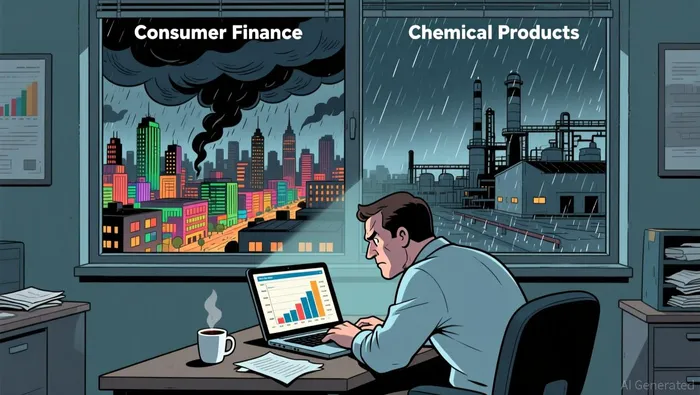
The Philadelphia Fed Manufacturing Index has long served as a barometer for U.S. industrial health, offering early signals of economic shifts. In November 2025, the index fell to -1.7, marking its first contraction since April and underscoring a weakening in the mid-Atlantic manufacturing sector. This decline, coupled with a 27-point drop in new orders and a 15-point slump in shipments, signals a critical inflection point for investors. As the index dips below zero, it historically precedes broader economic slowdowns, mirroring patterns seen during the 2020 pandemic crash and the 2025 downturn. For capital allocators, this data demands a strategic reassessment of sector exposure, particularly between cyclical Chemical Products and the more resilient Consumer Finance sector.
The Chemical Products Sector: Cyclical Vulnerability
Chemical Products, a cornerstone of industrial activity, is inextricably linked to manufacturing demand. The November 2025 survey revealed a 56.1 reading for the prices paid index, reflecting persistent input cost pressures, while shipments fell to -8.7—the first negative reading since May. These metrics highlight the sector's sensitivity to production slowdowns. Historically, Chemical Products firms have underperformed during index contractions, as reduced industrial output curtails demand for base chemicals, solvents, and specialty materials. For example, during the 2020 pandemic-induced crash, chemical producers like Dow Inc.DOW-- and LyondellBasellLYB-- saw sharp declines in revenue and margins.
The current environment echoes these dynamics. With the Philadelphia Fed index signaling a contraction, Chemical Products companies face margin compression and inventory overhangs. Investors should consider reducing exposure to this sector, particularly as forward-looking indicators—such as the 3.0% median price increase forecast for manufacturers—suggest continued cost pressures without commensurate demand growth.
Consumer Finance: A Defensive Anchor
In contrast, the Consumer Finance sector has demonstrated resilience during manufacturing slowdowns. While not explicitly mentioned in the survey, the broader market behavior during past contractions reveals a clear pattern: as industrial activity weakens, consumer credit demand stabilizes or even grows. This is driven by households and small businesses seeking liquidity amid economic uncertainty. For instance, during the 2020 downturn, consumer finance firms like Discover Financial Services (DFS) and Capital One (COF) maintained stable revenue streams by expanding access to credit cards, personal loans, and small business financing.
The November 2025 data supports this trend. Firms reported 40% increased customer price sensitivity and 61% anticipation of industry cost changes, prompting manufacturers to seek flexible financing solutions. Consumer finance institutions are well-positioned to capitalize on this demand, offering products such as deferred payment plans and dynamic pricing models. Additionally, the sector's alignment with household spending—rather than industrial production—provides a buffer against cyclical shocks.
Strategic Reallocation: Balancing Risk and Opportunity
The divergent trajectories of these sectors underscore the importance of proactive sector rotation. During manufacturing contractions, investors should:
1. Reduce Exposure to Chemical Products: Trim holdings in cyclical industrial inputs as demand wanes.
2. Increase Allocations to Consumer Finance: Capitalize on stable credit demand and liquidity needs.
3. Monitor Price Pressures: The prices paid index (56.1 in November) remains a key inflationary signal, influencing interest rate expectations and bond yields.
Historical data reinforces this approach. During the 2020 crash, defensive sectors like utilities and healthcare outperformed, while industrials and technology lagged. Similarly, the 2025 downturn saw a shift toward high-quality corporate bonds and consumer staples. By aligning portfolios with these trends, investors can mitigate downside risk while positioning for recovery.
Conclusion: Acting on Leading Indicators
The Philadelphia Fed Manufacturing Index is not merely a regional gauge—it is a leading indicator of broader economic shifts. As the index signals contraction, the Chemical Products sector faces headwinds, while Consumer Finance offers a defensive haven. For investors, the path forward lies in strategic reallocation, leveraging sector-specific dynamics to navigate uncertainty. By prioritizing resilience over cyclical exposure, capital allocators can weather manufacturing slowdowns and position for long-term growth.

Stay ahead of the market.
Get curated U.S. market news, insights and key dates delivered to your inbox.
AInvest
PRO
AInvest
PRO



Comments
No comments yet