
Strategic Sector Rotation: Navigating Divergent Retail and Construction Trends in 2025
 Aime Summary
The U.S. retail landscape in 2025 is a study in contrasts. While holiday sales surged by 4.1%, driven by digital products and apparel, the broader retail sector remains a patchwork of winners and losers. Year-over-year retail sales rose 3.54% in December, masking deeper structural shifts: construction-related activity is gaining traction, while consumer staples face a perfect storm of behavioral and economic headwinds. For investors, these divergences demand a recalibration of portfolio allocations, favoring sectors aligned with durable demand and policy tailwinds.
The Bearish Signal in Consumer Staples
Consumer staples, long a refuge for risk-averse investors, have underperformed the S&P 500 in 2025. The sector's struggles stem from a confluence of factors. First, the rise of GLP-1 weight-loss drugs has dampened demand for packaged foods and beverages, while shifting alcohol consumption patterns (toward craft and premium products) have eroded margins for mass-market brands. Second, the hyper-value retail environment—dominated by WalmartWMT-- and Costco—has squeezed mid-tier players like TargetTGT-- and Kohl'sKSS--, which reported same-store sales declines of -1.7% and -4.0% in Q3 2025.
Compounding these challenges is the sector's unattractive valuation. With investors flocking to AI-driven growth stocks, consumer staples have traded at a discount to historical averages. The Fidelity Advisor® Consumer Staples Fund highlights that even blue-chip names like Mondelez and Keurig Dr Pepper are undervalued, reflecting overreactions to near-term headwinds. However, these discounts may not persist if consumer spending normalizes in 2026.
The Bullish Tailwinds in Construction
In stark contrast, the construction sector—anchored by infrastructure spending and international demand—is emerging as a relative outperformer. Non-U.S. industrials delivered a 35.1% return in 2025, outpacing their U.S. counterparts (19.5%), as global trade policies and infrastructure projects in Asia and Europe offset domestic tariffs. U.S. construction spending, though down 3.3% in 2025, is projected to rebound with a 7.8% gain in 2026, driven by retail and warehouse construction.
The retail construction subsector is particularly compelling. CoStar Group notes that quick-service restaurants and dollar-store concepts are capitalizing on smaller-footprint demand, while constrained supply and near-historic low vacancy rates (peaking under 4.4% in late 2026) suggest pricing power for developers. Moreover, the ConstructConnect forecast highlights a 8.1% growth in retail and warehouse construction spending in 2026, signaling a shift toward physical retail amid e-commerce saturation.
Strategic Rotation: Where to Allocate and Avoid
For investors, the divergent trajectories of these sectors demand a proactive approach:
Underweight Consumer Staples: Avoid overexposure to underperforming subsectors like packaged foods and household goods. Instead, consider selective plays in distillers (e.g., Constellation Brands) and premium beverage producers, which are better positioned to weather shifting consumption trends.
Overweight Construction-Linked Sectors: Prioritize industrials and construction materials firms with international exposure. Companies like Caterpillar and Vulcan Materials, which benefit from global infrastructure spending, are prime candidates. Additionally, regional construction firms with retail and warehouse expertise (e.g., McCarthy Building Companies) could capitalize on the 2026 rebound.
Monitor Policy Risks: Tariffs and immigration policies remain critical variables. A 5–10% cost increase from tariffs on imported materials could delay construction projects, while labor shortages tied to immigration enforcement could strain margins. Investors should hedge against these risks by favoring firms with diversified supply chains.
Conclusion: Balancing Caution and Opportunity
The U.S. retail market is at an inflection point. While consumer staples face a near-term bearish outlook, construction and industrials offer a compelling counterbalance. Investors who rotate into sectors aligned with durable demand—such as infrastructure and small-format retail—while avoiding overvalued or structurally challenged staples, will be better positioned to navigate the macroeconomic uncertainties of 2026. As always, the key lies in aligning portfolio allocations with the evolving narrative of consumer behavior and policy dynamics.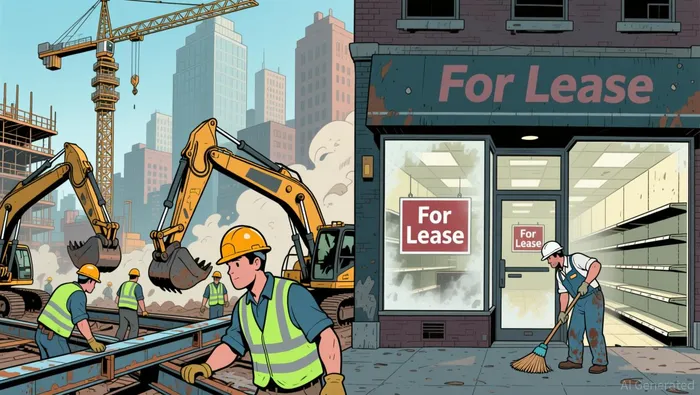

Stay ahead of the market.
Get curated U.S. market news, insights and key dates delivered to your inbox.




Comments
No comments yet