
Strategic Sector Rotation in the U.S. Automotive Industry: Navigating the EV Transition and Infrastructure Surge
 Aime Summary
The U.S. automotive sector is undergoing a profound transformation, driven by shifting consumer demand, regulatory pressures, and a surge in infrastructure investment. For investors, this dynamic environment presents both risks and opportunities, demanding a strategic approach to sector rotation. The interplay between electric vehicle (EV) adoption, hybrid technology, and traditional internal combustion engine (ICE) vehicles, coupled with federal and private-sector infrastructure spending, is reshaping the industry's value chain. Understanding these forces is critical for positioning portfolios to capitalize on emerging trends while mitigating exposure to declining segments.
The Shifting Landscape of U.S. Car Sales
Recent data underscores a bifurcated market. In August 2025, U.S. new-vehicle sales hit 1.48 million units, a 8.2% year-over-year increase, with retail sales reaching 1.28 million units. However, this growth masks underlying fragility. The EV segment, once a beacon of innovation, faces headwinds as federal tax credits expire. In July 2025, EV sales surged to 12% of total retail transactions, driven by last-minute purchases before the September 30 deadline. Yet, inventory levels for EVs have plummeted by 24% year-over-year, with models like the Honda Prologue and FordF-- Mustang Mach-E seeing declines of 65% and 16%, respectively. This suggests a post-incentive slowdown is imminent, forcing automakers to recalibrate pricing strategies and production plans.
Meanwhile, hybrids are gaining traction. Hybrid inventory has risen 47% year-over-year, with ToyotaTM-- and Kia leading the charge. The RAV4 Hybrid and Sportage Hybrid, for instance, saw inventory increases of 28% and 313%, respectively. This shift reflects consumer pragmatism: as EV tax credits fade and ICE vehicles remain cost-competitive, hybrids offer a middle ground. For investors, this signals a potential inflection point for hybrid manufacturers and suppliers, particularly those with strong R&D pipelines.
The ICE segment, though dominant (72.2% of retail sales in August 2025), is under pressure. Rising prices—averaging $50,080 for new vehicles—have pushed consumers to retain older cars longer, with the average age of vehicles on the road now 12.8 years. This trend is boosting demand for used cars and automotive repair services, creating opportunities in the aftermarket sector.
Infrastructure Investment: A Catalyst for Sector Rotation
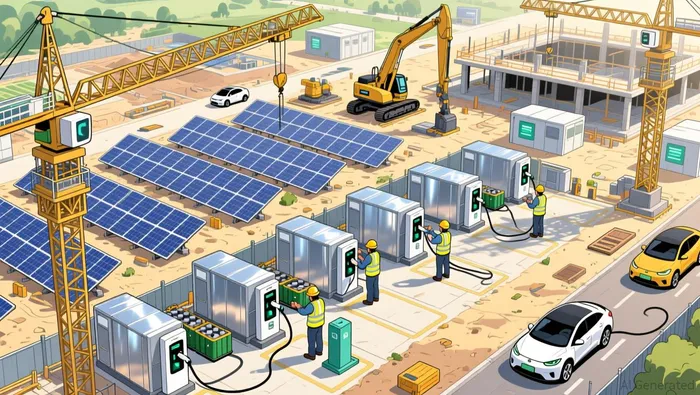
The U.S. government's $5 billion National Electric Vehicle Infrastructure (NEVI) Formula Program and the Inflation Reduction Act's (IRA) tax incentives are accelerating EV infrastructure deployment. By October 2025, 121 EV chargingBLNK-- stations had been energized across 16 states, with 80% of eligible costs now covered for public and on-site installations. These investments are not merely supporting EV adoption; they are reshaping the entire supply chain.
Battery manufacturing, in particular, is a focal point. Ford's $50 billion commitment to EVs and GM's 3 million EV production target by 2030 hinge on domestic battery capacity. Companies like Panasonic and LG Energy Solution, which supply these automakers, are poised to benefit from sustained demand. For investors, this underscores the importance of overweights in battery technology and raw material suppliers, such as lithium and nickel producers.
Private-sector players are also capitalizing on infrastructure gaps. Retailers like Shell and Chevron are integrating EV charging into their stations, while startups like Revel are pivoting entirely to charging networks. These developments highlight a broader trend: infrastructure is becoming a revenue stream, not just a cost center.
Strategic Sector Rotation: Where to Allocate Capital
EV Infrastructure and Battery Manufacturing:
The NEVI and IRA programs are creating a virtuous cycle: infrastructure deployment drives EV adoption, which in turn fuels battery demand. Investors should prioritize companies like Plug and Charge (for charging solutions) and Northvolt (for battery production). A reveals volatility tied to production bottlenecks, but long-term growth potential remains tied to infrastructure progress.Hybrid Technology and ICE Aftermarket Services:
As EV tax credits expire, hybrids will fill the gap. Toyota's dominance in hybrid inventory (34% of total) positions it as a key player. Meanwhile, the used car market's 18% share of consumer purchases suggests growth in repair services and parts suppliers. Companies like Advance Auto Parts and O'Reilly Auto Parts could see increased demand.Traditional Automakers with Electrification Roadmaps:
Ford and GMGM--, with their aggressive EV targets and hybrid offerings, are better positioned than peers like Volkswagen or Mercedes-Benz, which have seen U.S. sales decline. Ford's Bronco and Bronco Sport, for example, achieved 14.36% and 5.60% year-over-year growth in August 2025, demonstrating the power of product diversification.Rural and Low-Income Infrastructure Providers:
The Charging and Fueling Infrastructure (CFI) Discretionary Grant Program prioritizes underserved areas, creating opportunities for companies like ChargePoint and A Better Tomorrow (ABT) to expand their networks. These projects also align with ESG mandates, attracting impact-focused capital.
Risks and Considerations
While the EV and hybrid sectors offer compelling growth, investors must remain cautious. The expiration of tax credits could lead to a short-term slump in EV sales, and battery supply chains remain vulnerable to geopolitical risks (e.g., lithium sourcing). Additionally, high interest rates and inflation could dampen consumer demand for high-priced vehicles. Diversification across ICE, hybrid, and EV segments is prudent.
Conclusion
The U.S. automotive industry is at a crossroads, with infrastructure investment and consumer behavior driving a realignment of value. For investors, strategic sector rotation—shifting capital toward EV infrastructure, hybrid technology, and battery manufacturing while hedging against ICE volatility—is essential. The coming months will test the resilience of automakers and suppliers, but those that adapt to the new normal will emerge as leaders in a cleaner, more electrified future.

Stay ahead of the market.
Get curated U.S. market news, insights and key dates delivered to your inbox.
AInvest
PRO
AInvest
PRO



Comments
No comments yet