
The Strategic Value of Satellite Broadband in Aviation: Unlocking New Frontiers with SpaceX's Starlink


 Aime Summary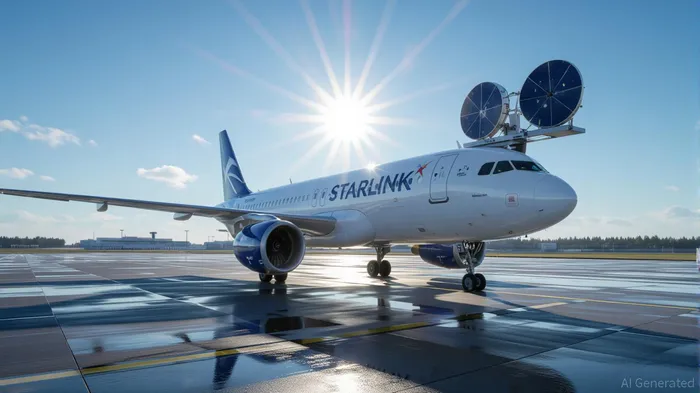
The aerospace and connectivity sectors are undergoing a seismic shift, driven by the convergence of satellite broadband and next-generation aviation technology. At the forefront of this revolution is SpaceX's Starlink, whose partnerships with luxury airlines like Emirates, Saudia, and Qatar Airways are redefining in-flight connectivity. These alliances are not just about Wi-Fi—they represent a strategic pivot toward a future where high-speed, low-latency satellite internet becomes a cornerstone of global air travel. For investors, this marks a pivotal moment to explore the infrastructure opportunities and long-term value creation in space-based broadband.
The Airline Partnerships: A Catalyst for Growth
Starlink's collaborations with premium carriers are unlocking new growth levers by addressing a critical pain point: the demand for real-time connectivity at 35,000 feet. Traditional geostationary (GEO) satellite systems, operated by legacy providers like ViasatVSAT-- and SESSES--, have long dominated the in-flight connectivity (IFC) market. However, Starlink's low-Earth orbit (LEO) satellite constellation—operating at altitudes of 550–600 km—delivers latency under 20 milliseconds and speeds up to 100 Mbps, far surpassing GEO capabilities. This technological edge has made Starlink a preferred partner for airlines seeking to differentiate their offerings.
For example, Qatar Airways CEO Badr Mohammed Al-Meer demonstrated Starlink's capabilities during a trial flight by conducting a video call with Elon Musk at 30,000 feet. Such high-visibility endorsements underscore the brand value of partnering with SpaceX, while the financial terms—$300,000 per BoeingBA-- 737 for hardware installation and $120–$240 per seat monthly for connectivity—position Starlink as a cost-competitive solution. By 2026, Starlink's aviation segment is projected to generate over $1.2 billion in annual revenue, assuming 1,000 aircraft are operationalized.
Reshaping the In-Flight Experience
The impact of Starlink's partnerships extends beyond technical metrics. Luxury airlines are leveraging the service to enhance passenger experience, offering seamless streaming, video conferencing, and even live television. For high-net-worth travelers, this transforms long-haul flights into mobile offices or entertainment hubs. Airlines like Emirates and Saudia, with their extensive global networks, are particularly well-positioned to capitalize on this shift.
Moreover, Starlink's ability to provide connectivity in remote regions—such as over the Pacific or Atlantic—addresses a gap in legacy systems. This is especially valuable for Middle Eastern carriers, which operate numerous long-haul routes. The financial structure of these partnerships, including tiered pricing models and loyalty-based access, allows airlines to monetize connectivity while maintaining exclusivity for premium customers.
Infrastructure Opportunities: Beyond the Airlines
While airline partnerships are a headline-grabbing win, Starlink's broader infrastructure investments are equally compelling for investors. The company's satellite manufacturing and launch capabilities are scaling rapidly, with over 7,600 Starlink satellites in orbit by mid-2025. The Gen2 "V2 Mini" satellites, costing $800,000 each, are being produced at an unprecedented rate, with plans for even more advanced V3 models. This industrialization of satellite production mirrors the efficiency gains seen in the automotive and tech sectors, creating a durable competitive moat.
Ground infrastructure is another growth lever. Starlink's partnerships with T-MobileTMUS-- for direct-to-cell 5G connectivity and Axiom Space for orbital habitats highlight its diversification into adjacent markets. These collaborations not only expand Starlink's revenue streams but also validate its role as a foundational infrastructure provider for future aerospace applications.
Regulatory and Sustainability Challenges
Investors must also consider the regulatory and environmental landscape. SpaceX is navigating complex licensing requirements across countries, particularly in aviation and maritime sectors. Additionally, the rapid deployment of thousands of satellites has raised concerns about space debris and light pollution. SpaceX's mitigation strategies—such as autonomous collision avoidance and experimental sunshades—demonstrate its commitment to sustainability, but ongoing scrutiny from bodies like the FCC and ITU could impact expansion timelines.
Investment Thesis: A Long-Term Play on Connectivity
The strategic value of satellite broadband in aviation lies in its ability to create network effects. Each aircraft retrofitted with Starlink enhances the value of its satellite network, attracting more carriers and passengers. This flywheel effect positions Starlink to dominate the $100 billion satellite communications market, with aviation representing a high-margin segment.
For investors, the key is to identify companies positioned to benefit from this ecosystem. SpaceX's direct-to-cell partnerships with telecom giants like T-Mobile (TMUS) and its R&D collaborations with aerospace firms open doors to cross-sector opportunities. Additionally, the broader satellite broadband market, projected to grow at 18.1% CAGR through 2030, offers exposure to a range of players, from satellite manufacturers to ground infrastructure providers.
Conclusion: A New Era of Connected Skies
SpaceX's Starlink is not just a technological marvel—it's a strategic asset reshaping the aviation and connectivity sectors. By securing partnerships with luxury airlines and investing in scalable infrastructure, Starlink is building a foundation for long-term growth. For investors, the opportunity lies in capitalizing on the convergence of aerospace, broadband, and next-gen tech. As the skies become more connected, the companies that enable this transformation will define the future of global mobility.
The time to act is now. The next chapter of satellite broadband is being written, and those who invest in its infrastructure today will reap the rewards of tomorrow.

Delivering real-time insights and analysis on emerging financial trends and market movements.
Latest Articles
Stay ahead of the market.
Get curated U.S. market news, insights and key dates delivered to your inbox.
AInvest
PRO
AInvest
PRO



Comments
No comments yet