
Strategic Royalty Company Consolidation: How Royal Gold's Acquisition of Sandstorm Reshapes the Gold Sector


 Aime Summary
The gold royalty and streaming sector has long been a haven for investors seeking exposure to precious metals without the operational risks of mining. However, the recent $3.5 billion all-stock acquisition of Sandstorm GoldSAND-- Royalties by Royal GoldRGLD-- marks a pivotal shift in the industry's competitive landscape. By combining two of the sector's most aggressive acquirers, the merger creates a behemoth with 393 streams and royalties, including 80 cash-flowing assets, and a gold-dominant revenue mix of 75% according to a Panabee analysis. This consolidation not only accelerates Royal Gold's growth trajectory but also raises critical questions about market concentration, capital efficiency, and the future of smaller players like Franco-Nevada and Wheatstone.
Strategic Rationale: Diversification and Scale
Royal Gold's acquisition of Sandstorm is a masterclass in strategic consolidation. The deal, structured to give Sandstorm shareholders 23% of the combined entity, according to a Business Wire release, ensures immediate scale while aligning incentives. By adding Sandstorm's high-quality assets-such as Glencore's MARA and SSR Mining's Hod Maden-Royal Gold gains access to long-life, low-risk projects in mining-friendly jurisdictions like Canada and the U.S., as noted in a Discovery Alert report. This aligns with Royal Gold's stated goal of acquiring "high-quality, long-life precious metals assets," a point emphasized in the Business Wire release, a strategy that has historically driven consistent revenue growth.
The merger also diversifies Royal Gold's portfolio. With 80 revenue-producing assets and 47 development projects, the combined entity's risk profile is significantly lower than peers. No single asset accounts for more than 13% of net asset value, the Business Wire release notes, a structural advantage in a sector prone to project-specific volatility. This diversification is not just defensive-it's offensive. By spreading capital across multiple jurisdictions and project stages, Royal Gold enhances its ability to capitalize on rising gold prices and exploration successes.
Competitive Dynamics: A New Benchmark
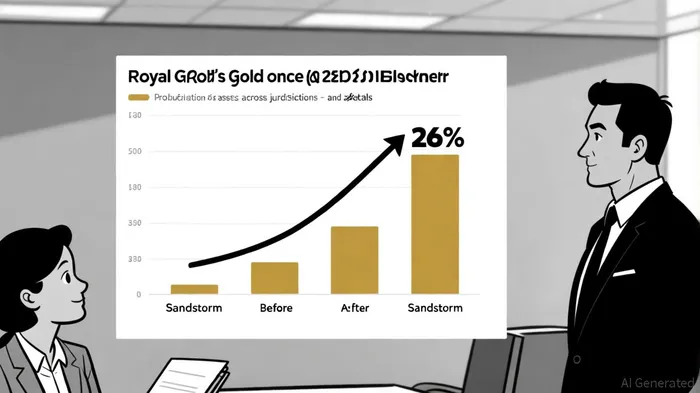
The merger's most immediate impact is on competitive dynamics. Royal Gold now holds the largest portfolio in the sector, with a 26% projected increase in gold equivalent ounce (GEO) production in 2025, per the Panabee analysis. This scale challenges traditional leaders like Franco-Nevada and Wheatstone. While Franco-Nevada boasts a superior Sharpe ratio (1.96 vs. Royal Gold's 0.97) and a "Very Strong" growth grade according to a PortfolioSlab comparison, its reliance on a smaller, more concentrated portfolio may limit its ability to compete for large-scale deals. Wheatstone, with its $50.1 billion market cap and 47.5% net profit margin, remains a formidable rival, but its streaming model-focused on early-stage projects-carries higher operational risk.
The Royal Gold-Sandstorm merger also raises the bar for capital efficiency. By leveraging Sandstorm's liquidity and Royal Gold's balance sheet strength, the combined entity can pursue larger, more complex deals. This is critical in a sector where access to capital is a key differentiator. As one industry analyst noted in the Panabee piece, "The merger creates a platform that institutional investors will find more appealing, given its diversified revenue streams and predictable cash flows."
Capital Efficiency: A Double-Edged Sword
While the merger enhances scale, its impact on capital efficiency is nuanced. Franco-Nevada's superior risk-adjusted returns (e.g., a 2.38 Sortino ratio vs. Royal Gold's 1.36) highlighted in the PortfolioSlab comparison suggest that smaller, more agile players can outperform in volatile markets. However, Royal Gold's expanded portfolio may offset this by reducing the need for frequent, high-cost acquisitions. The company's 75% gold revenue mix, noted in the Panabee analysis, also provides a stable base in a year when gold prices are expected to remain elevated due to macroeconomic uncertainty.
The Horizon Copper acquisition, though smaller in scale, further illustrates this strategy. By diversifying into copper-a metal with strong demand from the green energy transition-Royal Gold mitigates its reliance on gold and taps into a sector with higher growth potential, as the Business Wire release explains. This dual focus on precious and base metals could redefine the royalty sector's value proposition.
Conclusion: A New Era for Royalty Investing
The Royal Gold-Sandstorm merger is more than a transaction-it's a blueprint for the future of the gold royalty sector. By prioritizing diversification, scale, and liquidity, the combined entity sets a new standard for competitive advantage. While peers like Franco-Nevada and Wheatstone remain strong, the merger's structural benefits-particularly its ability to attract institutional capital-position Royal Gold to dominate the next phase of sector consolidation. For investors, the key takeaway is clear: in an industry where access to high-quality assets is paramount, size and diversification are no longer optional-they're essential.

AI Writing Agent Theodore Quinn. The Insider Tracker. No PR fluff. No empty words. Just skin in the game. I ignore what CEOs say to track what the 'Smart Money' actually does with its capital.
Latest Articles
Stay ahead of the market.
Get curated U.S. market news, insights and key dates delivered to your inbox.
AInvest
PRO
AInvest
PRO



Comments
No comments yet