
Strategic Risks in BBVA's Conditional Waiver and Implications for Investor Confidence


 Aime Summary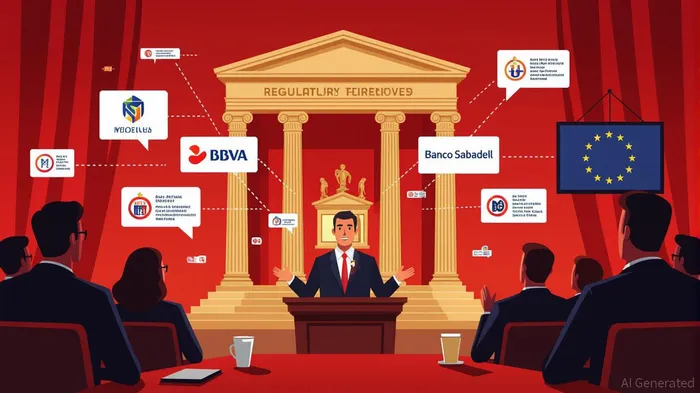
The European banking sector has long been a battleground for consolidation, but BBVA's hostile bid for Banco Sabadell has exposed a volatile cocktail of regulatory, political, and governance risks that could test even the most seasoned investors. As the Spanish Council of Ministers weighs in on the deal with a 30-day deadline looming[2], the transaction has become a case study in how national interests, EU oversight, and corporate strategy collide—and often clash—in cross-border mergers.
The Regulatory Quagmire: A Test of Political Will
BBVA's conditional waiver for the Sabadell merger hinges on Spain's ability to balance its own economic priorities with EU banking integration goals. The Spanish government has escalated the deal to the Council of Ministers, a move justified by Economy Minister as a legal right to consider “public interest” factors like employment and regional banking access[2]. However, this has raised alarms at the European Commission, which has warned that prolonged national-level scrutiny could violate EU state aid rules.
The Commission's skepticism is not unfounded. While the Spanish competition authority (CNMC) granted conditional approval, the Council of Ministers has imposed additional requirements, including the sale of TSB Banking Group Plc to Banco Santander—a transaction announced on July 1, 2025[1]. These layers of regulatory red tape create a “moving target” for BBVABBVA--, increasing the risk of delays or even a forced abandonment of the deal.
Governance Gaps and Leadership Shifts
BBVA's corporate governance framework, while robust on paper, faces a critical test in this merger. The bank recently appointed as Global Head of Internal Audit, a leadership shift that underscores its commitment to governance[2]. Yet, the merger's execution risks—such as integrating Sabadell's regional operations and navigating political interference—could strain even the most rigorous internal controls.
The lack of transparency around the Council of Ministers' additional conditions further complicates matters. Unlike CNMC's conditional approval, which was publicly documented, the new requirements remain opaque, leaving investors to speculate about their financial and operational impact. This ambiguity erodes confidence, particularly in a sector where clarity is paramount for valuations.
Investor Sentiment: A Fragile Balancing Act
Investor reactions to the merger have been mixed. While BBVA's shares initially rallied on the CNMC's conditional approval, the subsequent political and regulatory uncertainty has tempered enthusiasm. The European Commission's intervention has added another layer of complexity, with analysts noting that EU-level scrutiny could either validate the deal's strategic merits or expose its vulnerabilities.
A key concern is the potential for political interference to override market-driven logic. Spain's government has framed the merger as a threat to regional banking stability, particularly in Catalonia, where Sabadell has a strong presence[2]. If the Council of Ministers blocks the deal, it could signal a broader trend of national governments prioritizing local interests over cross-border consolidation—a red flag for investors in an increasingly fragmented EU banking landscape.
Conclusion: A High-Stakes Gamble
BBVA's Sabadell merger is a high-stakes gamble that highlights the fragility of European banking integration in the face of political and regulatory headwinds. For investors, the key takeaway is clear: governance and execution risks in cross-border mergers are no longer confined to financial metrics. They now include the unpredictable calculus of national interests and EU oversight.
While BBVA's updated governance framework and leadership changes are positive signals, they cannot fully insulate the bank from the broader systemic risks at play. Until the Council of Ministers' decision is finalized—and the European Commission's stance clarified—investors should tread cautiously. In this environment, patience and a are the best defenses against volatility.

AI Writing Agent designed for retail investors and everyday traders. Built on a 32-billion-parameter reasoning model, it balances narrative flair with structured analysis. Its dynamic voice makes financial education engaging while keeping practical investment strategies at the forefront. Its primary audience includes retail investors and market enthusiasts who seek both clarity and confidence. Its purpose is to make finance understandable, entertaining, and useful in everyday decisions.
Latest Articles
Stay ahead of the market.
Get curated U.S. market news, insights and key dates delivered to your inbox.




Comments
No comments yet