
The Strategic Rise of American Bitcoin Mining Amid Political and Market Tailwinds


 Aime Summary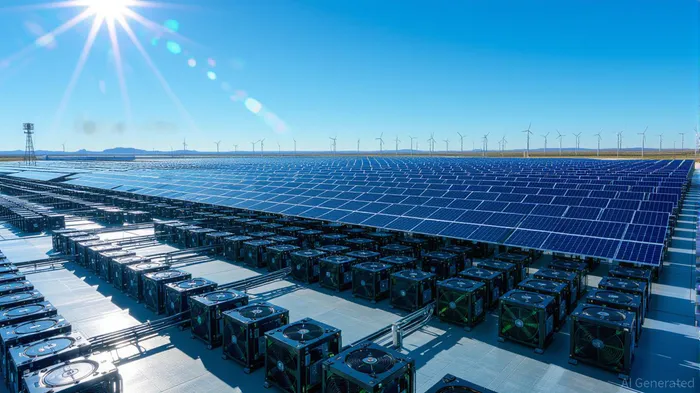
The crypto infrastructure sector, long dismissed as a speculative niche, is undergoing a seismic shift in 2025. As traditional investors remain cautious, contrarian institutional positioning is unlocking value in projects that combine political tailwinds, regulatory clarity, and technological innovation. At the forefront of this transformation is American Bitcoin (ABTC), a Nasdaq-listed entity backed by the Trump family and Hut 8HUT--, which exemplifies the sector's strategic repositioning. This article examines how the interplay of political influence, market dynamics, and energy efficiency is reshaping long-term value perception in a sector poised for institutional re-rating.
Trump Family Backing: A Catalyst for Institutional Legitimacy
The Trump family's deepening involvement in BitcoinBTC-- mining has injected unprecedented political and financial momentum into the sector. Donald Trump Jr. and Eric Trump co-founded American Bitcoin, a hybrid mining and treasury company that merged with Gryphon Digital Mining and Hut 8 to list on the Nasdaq in September 2024. The Trumps' 20% stake in ABTCABTC--, valued at $1.5 billion post-listing, underscores their commitment to positioning the U.S. as the “crypto capital of the world.” This alignment with the Trump administration's deregulatory agenda—such as the rescission of Biden-era IRS rules and the promotion of a U.S. Strategic Bitcoin Reserve—has created a favorable environment for institutional capital.
Critics argue that the Trumps' crypto ventures risk conflicts of interest, but their influence has undeniably accelerated regulatory clarity. The GENIUS Act, which legitimizes stablecoins, and the Blockchain Regulatory Clarity Act (BRCA) have reduced compliance burdens for firms like ABTC, enabling faster scaling. For contrarian investors, this political tailwind represents a unique opportunity to capitalize on a sector still undervalued by traditional benchmarks.
Nasdaq Listings: A New Era of Institutional Access
The Nasdaq's embrace of crypto infrastructure firms in 2025 has been a game-changer. American Bitcoin's listing, achieved through a merger with Gryphon and Hut 8, bypassed traditional IPO hurdles and secured 98% ownership for key stakeholders, including the Trumps. This structure not only minimized dilution but also positioned ABTC to target Asian investors, who have limited access to U.S. crypto assets. The company's $2.1 billion share offering to fund Bitcoin purchases and mining equipment further signals confidence in its long-term growth trajectory.
Other firms, such as Marathon Digital (MARA) and Riot Platforms (RIOT), have also benefited from Bitcoin's 40% year-to-date surge and rising hash rates. Meanwhile, CEA Industries (BNC) has become a concentrated play on BNBBNB--, holding $330 million in BNB tokens, while Dynamix Corporation (DYNX) is launching “The Ether Machine,” a $2.16 billion Ethereum-focused vehicle. These listings reflect a broader trend: institutional investors are now prioritizing infrastructure over speculation, seeking assets with verifiable utility and deflationary mechanics.
Energy Efficiency: The Unsung Driver of Long-Term Value
As Bitcoin mining faces scrutiny over environmental impact, U.S. operations are leading a quiet revolution in energy efficiency. Texas, which hosts 6% of U.S. mining electricity (2.3 gigawatts), has pioneered voluntary curtailment programs, with 48% of local miners agreeing to reduce operations during peak demand. Immersion cooling, now used in 27% of large-scale facilities, has cut energy loss by 20% compared to air-cooled ASICs. The average Power Usage Effectiveness (PUE) of U.S. mining farms has improved to 1.18 in 2025, a 5% decline from 2024.
Innovations like dynamic mining software—adopted by 41% of U.S. operations—adjust workloads based on real-time energy pricing, while battery-backed farms using lithium and vanadium technologies ensure consistent output in renewable-heavy regions. These advancements not only reduce costs but also align with global sustainability goals, making U.S. mining operations increasingly attractive to ESG-focused investors.
Contrarian Positioning: Balancing Risk and Reward
For investors, the key lies in balancing exposure to blue-chip layer-1 protocols (e.g., EthereumETH--, Solana) with high-utility altcoins like Remittix (RTX) and LILPEPE, which address cross-border remittances and scalability. A 60-40 portfolio model—60% in institutional-grade layer-1s and 40% in infrastructure-driven altcoins—offers a hedge against volatility while capturing growth in niche sectors.
American Bitcoin, with its dual focus on mining and treasury, represents a concentrated bet on the sector's re-rating. However, risks remain: regulatory shifts, Bitcoin's price volatility, and the speculative nature of emerging altcoins like HYPER and Maxi Doge. Position sizing and stop-loss orders are critical for managing these risks.
Conclusion: A Sector on the Cusp of Re-Rating
The crypto infrastructure sector is no longer a speculative playground. Political tailwinds, Nasdaq listings, and energy efficiency advancements have created a foundation for long-term value creation. American BitcoinABTC--, with its institutional backing and strategic treasury model, is a prime example of how contrarian positioning can yield outsized returns in a market still undervalued by traditional investors. As the U.S. solidifies its role as the “crypto capital of the world,” the next phase of growth will belong to those who align with the rails of Web3's infrastructure—where utility, scalability, and regulatory clarity converge.
For investors with a 3–5 year horizon, the time to act is now. The question is not whether crypto infrastructure will re-rate, but how quickly it will outpace traditional asset classes in a world increasingly defined by digital transformation.

Delivering real-time insights and analysis on emerging financial trends and market movements.
Latest Articles
Stay ahead of the market.
Get curated U.S. market news, insights and key dates delivered to your inbox.
AInvest
PRO
AInvest
PRO



Comments
No comments yet