
Strategic Retirement Planning Amid Social Security's Uncertain Future
The outlook for Social Security has grown increasingly dire. By 2034, the Old-Age and Survivors Insurance (OASI) trust fund will be depleted, reducing scheduled benefits to just 77% of current levels. Compounding this, the Full Retirement Age (FRA) for claiming full Social Security benefits has risen to 67 for those born in 1960 or later, with proposals to push it higher still. These shifts demand a radical rethinking of retirement planning. The goal is not merely to prepare for delayed benefits but to build resilient income streams that insulate retirees from systemic uncertainty.
The Social Security Crisis: A Clock Ticking Toward 2034
The 2025 Trustees' Report paints a stark picture. The OASI trust fund, projected to run dry by 2033, will force reliance on payroll taxes alone—reducing benefits to 81% of scheduled levels by 2034 and 72% by 2099. While benefits will not disappear entirely, retirees face a future of steadily eroded purchasing power.
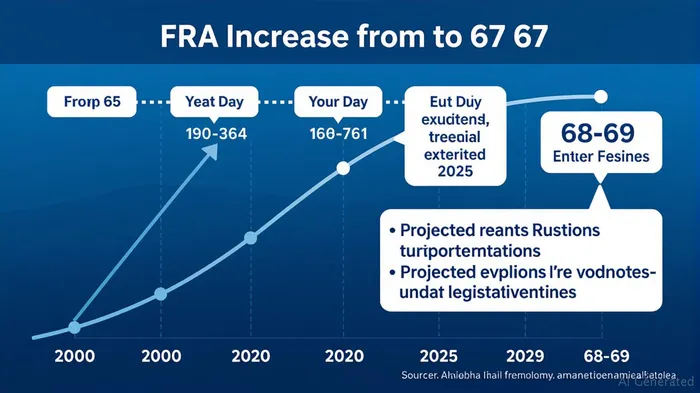
The demographic drivers are clear: an aging population, declining fertility rates, and stagnant wage growth have widened the program's 75-year actuarial deficit to 3.82% of taxable payroll. Without reform, retirees will bear the brunt of this shortfall.
Adapting to Rising Retirement Ages: A Multi-Pronged Strategy
The first imperative is to delay claiming Social Security as long as possible. Each year of delay beyond FRA increases benefits by roughly 8%, capping at 32% by age 70. For those born in 1960, claiming at 62 would reduce benefits by 30%, a penalty too steep to ignore.
But delaying Social Security requires financial flexibility. A 18–24-month cash reserve—held in high-yield savings or money-market accounts—is critical to bridge the gap. Pair this with phased retirement strategies: part-time work (15–30 hours/week) can provide income and health benefits while preserving Social Security's growth.
Maximizing Tax-Efficient Savings: Beyond Roth IRAs
Tax efficiency is the cornerstone of long-term planning. The following vehicles should anchor any retirement portfolio:
Roth Conversions and SECURE 2.0 Compliance
Converting traditional IRAs to Roth accounts pre-retirement can lock in lower tax rates and reduce future taxable income. The 2025 SECURE 2.0 Act mandates that catch-up contributions for high earners ($145k+) must be Roth, incentivizing tax diversification.Qualified Charitable Distributions (QCDs)
For those over 70½, QCDs allow up to $120k/year to be transferred from IRAs to charity, satisfying RMDs without boosting taxable income. This lowers adjusted gross income (AGI), reducing the portion of Social Security subject to taxation.Health Savings Accounts (HSAs)
HSAs offer triple tax benefits (pre-tax contributions, tax-free growth, tax-free withdrawals for medical expenses). The 2025 SECURE 2.0 Act expanded eligible expenses to include dental, vision, and over-the-counter medications, making HSAs a critical tool for covering rising healthcare costs without increasing taxable income.Inflation-Protected Annuities
Indexed annuities, such as those offered by PrudentialPUK--, provide income tied to inflation. A $500k annuity purchased today might generate $30k/year with 3% annual adjustments, shielding retirees from the erosion of fixed benefits.
- Tax-Efficient Investment Vehicles
Municipal bonds, real estate investment trusts (REITs), and tax-loss harvesting strategies can reduce AGI. For example, the Vanguard Real Estate ETF (VNQ) provides dividend income while shielding against housing-cost inflation. Tax-loss harvesting on taxable accounts can offset capital gains and lower income brackets.
Proactive Investment Decisions
Diversify Income Streams
Combine Social Security, Roth withdrawals, annuities, and tax-efficient investments to minimize reliance on any single source. A rule of thumb: no more than 40% of income should come from Social Security.Timing Withdrawals Strategically
Delay Social Security to 70 while drawing from taxable accounts during low-income years (e.g., pre-RMD periods). Use Roth IRAs for high-income years to avoid pushing AGI into brackets that tax Social Security benefits.Leverage State Tax Policies
Relocate to states without income tax (e.g., Florida, Texas) or those that exempt Social Security (e.g., California excludes it from taxable income). Avoid the nine states taxing up to 85% of benefits.Healthcare and Long-Term Care
Pair HSAs with long-term care insurance to avoid depleting retirement savings on medical costs. The One Big Beautiful Bill Act's temporary senior deduction ($6k for those over 65) offers a window to reduce taxable income further.
Conclusion: Prudence in Uncertainty
The writing is on the wall: Social Security will not sustain retirees as it once did. Rising retirement ages and benefit cuts are inevitable. The solution lies in proactive planning—building cash reserves, delaying benefits, and deploying tax-efficient vehicles to maximize after-tax income. Those who treat retirement as a dynamic process, rather than a fixed destination, will navigate these challenges most effectively.
The clock is ticking. By 2034, the trust fund will be gone, and the era of guaranteed income will end. The question is not whether to adapt, but how quickly one can begin.

Stay ahead of the market.
Get curated U.S. market news, insights and key dates delivered to your inbox.


AInvest
PRO
AInvest
PRO



Comments
No comments yet