
Strategic Resource Diversification: The U.S.-Pakistan Critical Minerals Partnership and Geopolitical Risk Mitigation in the Post-U.S.-China Tech Rivalry Era


 Aime Summary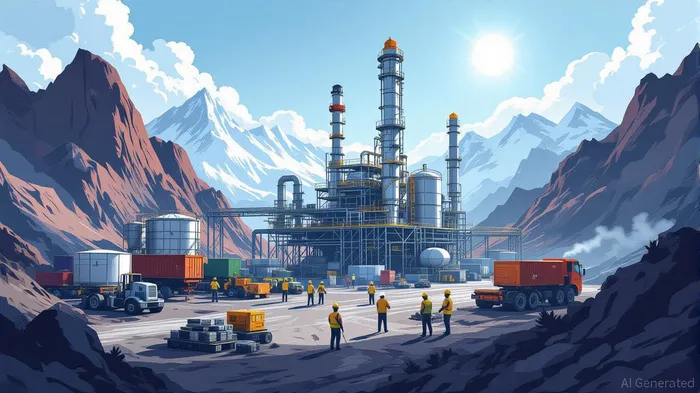
The global race for critical minerals has intensified in the post-U.S.-China tech rivalry era, with nations scrambling to secure supply chains for materials essential to clean energy, semiconductors, and defense technologies. In this context, the U.S.-Pakistan critical minerals partnership of 2025 emerges as a pivotal development, offering a dual promise: strategic resource diversification and geopolitical risk mitigation. For investors, this collaboration represents not just an economic opportunity but a recalibration of global power dynamics.
The Strategic Imperative: Diversifying Supply Chains
The U.S. has long relied on China for processing rare earth elements (REEs), which account for over 60% of global refining capacity. This dependency has exposed the U.S. to supply shocks and geopolitical leverage, particularly as China's influence in South Asia grows through initiatives like the China-Pakistan Economic Corridor (CPEC). The 2025 partnership with Pakistan, however, introduces a critical counterweight. By investing $500 million through U.S. Strategic Metals (USSM) and Pakistan's Frontier Works Organization (FWO), the U.S. is establishing a poly-metallic refinery in Pakistan to process antimony, copper, gold, tungsten, and REEs. This shift from raw ore exports to value-added refining reduces U.S. vulnerability to Chinese dominance and aligns with broader efforts to localize supply chains.
The economic logic is clear: Pakistan's estimated $74 billion in untapped mineral reserves—particularly in Balochistan—position it as a strategic partner for the U.S. The partnership also benefits from a recent trade agreement that reduced U.S. tariffs on Pakistani goods from 29% to 19%, incentivizing further investment. For investors, this signals a long-term commitment to resource diversification, with potential returns from infrastructure development, technology integration, and geopolitical stability.
Geopolitical Risk Mitigation: Countering Chinese Influence
The U.S.-Pakistan deal is as much about geopolitics as economics. By deepening ties with Pakistan, the U.S. is countering China's economic footprint in South Asia. The CPEC has long been a linchpin of China's Belt and Road Initiative (BRI), but the U.S. is now leveraging Pakistan's mineral wealth to create an alternative corridor of influence. This is evident in the involvement of U.S. firms like ChevronCVX-- and ExxonMobil, which are exploring joint ventures in lithium and rare earth extraction, and in the Trump administration's emphasis on linking tariff concessions to mineral access.
For investors, the geopolitical implications are profound. A diversified supply chain reduces exposure to Chinese retaliatory measures, such as export controls or trade restrictions. Moreover, Pakistan's strategic location—bordering China, Afghanistan, and India—positions it as a regional hub for mineral logistics, further insulating the U.S. from supply chain disruptions.
Investment Opportunities and Risks
The partnership opens avenues for investors across sectors. Infrastructure projects, such as those led by Mota-Engil Group, will require significant capital for roads, railways, and processing facilities. Technology-driven innovations, including blockchain-based mineral tracking and AI-driven geological surveys, are also gaining traction, enhancing transparency and efficiency.
However, risks persist. Political instability in Balochistan, where separatist movements threaten operations, and governance challenges in Pakistan's fragmented regulatory framework could delay projects. Additionally, China may respond to U.S. overtures by tightening its own mineral exports or leveraging its BRI investments to counterbalance the partnership.
Strategic Recommendations for Investors
- Diversify Exposure: Allocate capital to companies involved in the U.S.-Pakistan partnership, such as USSM and Mota-Engil, while hedging against geopolitical risks through regional ETFs.
- Monitor Policy Shifts: Track U.S. and Pakistani regulatory changes, particularly in mining legislation and trade agreements, to identify emerging opportunities.
- Leverage Technology: Invest in firms integrating blockchain and AI into mineral supply chains, which enhance transparency and reduce operational risks.
- Balance Short- and Long-Term Goals: While immediate returns may come from infrastructure projects, long-term gains will depend on the success of the poly-metallic refinery and U.S. market demand for refined minerals.
Conclusion
The U.S.-Pakistan critical minerals partnership is a masterstroke in the global quest for resource security. By diversifying supply chains and countering Chinese influence, it addresses both economic and geopolitical vulnerabilities. For investors, this partnership offers a rare convergence of strategic necessity and market potential. However, success will require navigating complex risks, from regional instability to shifting trade policies. In an era where resource access defines national power, the U.S.-Pakistan collaboration is not just an investment—it is a statement of intent.

Stay ahead of the market.
Get curated U.S. market news, insights and key dates delivered to your inbox.


AInvest
PRO
AInvest
PRO



Comments
No comments yet