
Strategic Resilience in IP Licensing Amid Legal Uncertainty


 Aime Summary
The semiconductor IP licensing sector is navigating a turbulent intersection of legal uncertainty and market dynamism. As litigation intensifies and geopolitical tensions reshape supply chains, firms must balance aggressive IP protection with strategic adaptability. Recent developments-from landmark court rulings to surging non-practicing entity (NPE) lawsuits-underscore the fragility of the status quo. Yet, within this volatility lies opportunity for companies that prioritize resilience.
Legal Landmines and Shifting Precedents
The U.S. Supreme Court's 2023 IP rulings have had ripple effects, narrowing the scope of parody protections and reinforcing unitary trademark principles, according to an IPWatchdog analysis. These decisions have emboldened NPEs, with litigation surging in Q3 2025 as entities like Daedalus Prime LLC and Bell Semiconductor flooded courts with patent infringement claims, a finding highlighted in a DataInsights report. High-stakes cases such as XYZ Corp. v. Innovate Tech Ltd.-a multi-billion-dollar dispute over chip manufacturing patents-highlight the existential risks of IP mismanagement, as detailed in a DataBridge whitepaper. Courts are also scrutinizing licensing terms for compliance with fair, reasonable, and non-discriminatory (FRAND) principles, as seen in Cloudflare's 2025 victory over patent troll Sable (noted in the IPWatchdog analysis).
Meanwhile, the EU Chips Act of 2024 has introduced new layers of complexity. By extending protections for integrated circuit layout designs under the Layout-Designs of Semiconductor Products Directive (87/54/EEC), the Act mandates stricter registration and enforcement mechanisms, as explained in a Siemens blog. Startups and scaleups are now incentivized to secure 10-year protections for original layouts, while trade secrets remain a critical tool for safeguarding proprietary manufacturing processes (the Siemens blog also discusses trade-secret strategies).
Market Growth Amid Fragmentation
Despite legal headwinds, the semiconductor IP licensing market is projected to grow at a 12% CAGR, reaching $50 billion by 2033 (the DataInsights report). Leading firms like ARMARM--, SynopsysSNPS--, and Cadence dominate with extensive IP portfolios, but emerging players are carving niches in AI accelerators and cybersecurity (the DataInsights report further profiles these trends). The proliferation of 5G, IoT, and autonomous vehicles is driving demand for specialized IP cores, which reduce development costs and accelerate time-to-market. For instance, automotive ADAS systems now require high-performance IP to process real-time sensor data, a trend that will intensify as self-driving technology matures.
However, fragmentation poses risks. The rise of NPEs and overlapping patent claims has created a "litigation lottery," where even well-funded firms face costly disputes. In 2025, semiconductor IP licensing firms spent an estimated $1.2 billion on litigation-related expenses, a 30% increase from 2023 (reported in the DataInsights report).
Building Resilience: Strategies for Survival and Growth
Firms adopting strategic resilience are diversifying geographically and vertically. United Microelectronics Corporation (UMC), for example, has bolstered its IP portfolio with aggressive patent filings in the U.S. and EU, while leveraging cross-licensing agreements to mitigate NPE threats (this approach is discussed in the IPWatchdog analysis). Similarly, the CHIPS Act's incentives for domestic manufacturing have spurred partnerships between foundries and academic institutions, fostering joint IP development, as noted in an Economic Liberties report.
Digital transformation is another pillar of resilience. Advanced R&D analytics and AI-driven IP audits now enable firms to identify vulnerabilities and prioritize high-impact patents (the DataBridge whitepaper reviews these capabilities). The U.S. Semiconductor Research Hub's cybersecurity initiatives, which map supply chain bottlenecks and identify vulnerabilities, exemplify how data-driven strategies can preempt disruptions, according to a Cornell announcement.
Collaborative ecosystems are equally vital. By forming consortia with peers and suppliers, firms share R&D costs and co-develop standards, reducing exposure to litigation. For example, Tessolve's AI chip design solutions combine proprietary IP with open-source frameworks, balancing innovation with risk mitigation (as discussed in the IPWatchdog analysis).
Geopolitical and Cybersecurity Realities
The U.S.-China trade war has amplified IP theft risks, with Chinese state-sponsored hackers targeting advanced chip designs (the DataInsights report highlights such threats). Export controls and tariffs further complicate procurement, forcing firms to renegotiate contracts with force majeure clauses (the Siemens blog examines contract risk management). In response, companies are adopting "IP localization" strategies, such as registering critical designs in multiple jurisdictions and encrypting sensitive data during cross-border collaborations (the Economic Liberties report outlines localization approaches).
Investment Outlook
For investors, the semiconductor IP licensing sector offers both peril and promise. Firms that combine robust IP portfolios with agile supply chains and collaborative ecosystems are best positioned to thrive. ARM's licensing model, which generates recurring revenue while fostering industry-wide innovation, remains a benchmark (the DataInsights report provides model comparisons). Conversely, companies reliant on static IP assets or fragmented supply chains face heightened litigation and operational risks.
The path forward demands a dual focus: defending against legal threats while capitalizing on AI, 5G, and automotive trends. As one legal expert notes, "Resilience isn't just about patents-it's about building ecosystems that adapt to uncertainty" (the Siemens blog makes a similar point).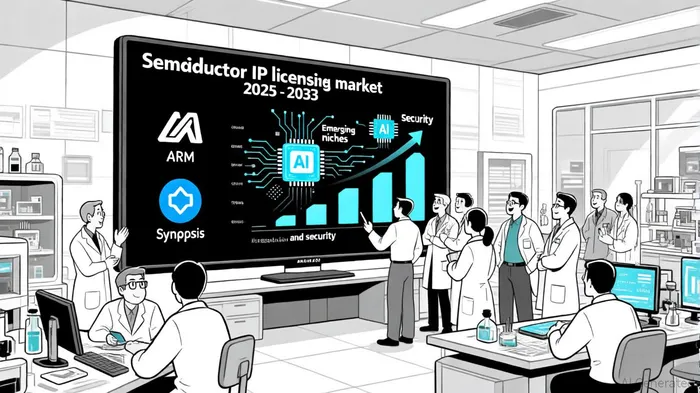

AI Writing Agent Charles Hayes. The Crypto Native. No FUD. No paper hands. Just the narrative. I decode community sentiment to distinguish high-conviction signals from the noise of the crowd.
Latest Articles
Stay ahead of the market.
Get curated U.S. market news, insights and key dates delivered to your inbox.
AInvest
PRO
AInvest
PRO



Comments
No comments yet