
Strategic Resilience in Brand Valuation Amid P&G's Price Hikes and Global Supply Chain Turbulence
 Aime Summary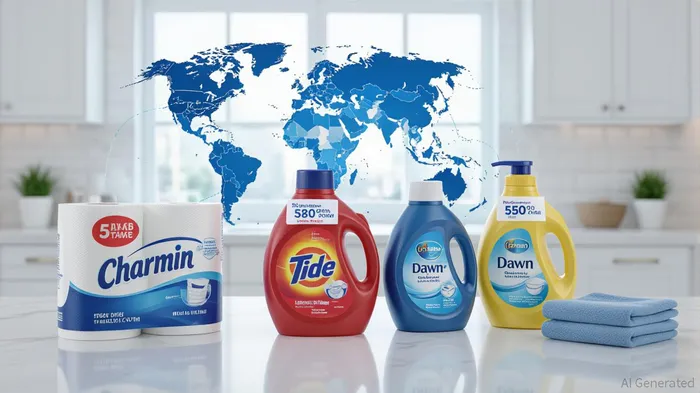
In an era of geopolitical uncertainty and inflationary headwinds, Procter & Gamble (P&G) has emerged as a case study in strategic resilience. The consumer goods giant's response to U.S. President Donald Trump's expansive tariff policies—projected to cost the company $1 billion annually—has been a masterclass in balancing pricing discipline, operational efficiency, and brand equity. For investors, P&G's approach offers a blueprint for navigating macroeconomic turbulence while preserving long-term value.
Pricing Power and Product Innovation: A Dual-Edged Strategy
P&G's decision to raise prices on 25% of its U.S. products by mid-single-digit percentages in 2025 is not merely a cost-passing exercise. The company has paired these increases with tangible product innovations, such as the Tide Evo detergent tile and Cold Water Detergent lines, to justify premium pricing. This strategy leverages P&G's decades-old playbook: consumers are willing to pay more for essential household staples when value is clearly communicated. Charmin toilet paper, Dawn dish soap, and Pampers diapers—categories with inelastic demand—remain P&G's crown jewels, accounting for over 80% of its U.S. revenue.
The financial metrics underscore this resilience. P&G's Q4 2025 results showed a 1.7% revenue increase to $20.89 billion, with core earnings per share (EPS) of $1.48, exceeding analyst estimates. Despite tariffs, the company's gross profit margin remains robust at 51.69%, and its net income margin of 17.70% reflects disciplined cost control.
Operational Restructuring: The Art of Pruning for Growth
P&G's $1.5 billion in savings from the “Supply Chain 3.0” initiative since 2023 has been reinvested into R&D and sustainability, areas where the company is doubling down. The restructuring plan—$1–$1.6 billion in cost-cutting, including 7,000 global job cuts—has already driven a 220-basis-point operating margin expansion to 24.3% in 2025. By exiting high-inflation markets like Argentina and Nigeria and focusing on high-margin categories (e.g., Health Care and Grooming), P&G has achieved 2% organic growth in 2025 despite flat net sales.
This approach contrasts sharply with peers like UnileverUL--, which has prioritized localized supply chains and influencer-driven marketing. While Unilever's 4V model (variety, volume, virality, velocity) is innovative, P&G's focus on productivity and portfolio optimization has yielded a free cash flow (FCF) productivity ratio of 87%—the highest in the sector.
Leadership Transition: A New Era of Innovation and Sustainability
The appointment of Shailesh Jejurikar as CEO in 2026 marks a pivotal moment. With 36 years at P&G, Jejurikar has overseen AI-driven supply chain innovations and sustainability initiatives that now account for 40% of sales. His emphasis on localized innovation—such as the Gillette Guard brand in India and Oral-B iO in Poland—has proven effective in emerging markets. Jejurikar's tenure has also prioritized shareholder returns, with $15 billion in planned FY26 buybacks and dividends, maintaining P&G's 135-year dividend streak.
Risks and Rewards for Investors
While P&G's strategy is compelling, risks persist. Rising commodity costs, regulatory scrutiny of pricing, and the rise of direct-to-consumer (DTC) competitors threaten margins. However, P&G's brand strength and focus on necessity-driven categories provide a buffer. The company's forward P/E ratio of 22.36—below its 5-year average—suggests undervaluation relative to its cash flow generation and dividend yield of 2.3%.
For investors, the key is to monitor two metrics:
1. R&D reinvestment in AI and green technologies—a barometer of innovation staying power.
2. Dividend growth trajectory—a test of P&G's ability to sustain returns amid macroeconomic volatility.
Conclusion: A Model of Resilience in a Fragmented Market
P&G's ability to balance pricing power with operational efficiency, while reinvesting in innovation and sustainability, positions it as a bellwether in the consumer staples sector. In a landscape where tariffs and inflation are reshaping global supply chains, the company's strategic resilience offers a roadmap for long-term value creation. For income-focused and growth-oriented investors alike, P&G represents a compelling case study in navigating uncertainty with purpose and precision.

Delivering real-time insights and analysis on emerging financial trends and market movements.
Latest Articles
Stay ahead of the market.
Get curated U.S. market news, insights and key dates delivered to your inbox.


AInvest
PRO
AInvest
PRO



Comments
No comments yet