
The Strategic Relevance of Singapore Airlines' A350 Fleet Upgrades and Route Changes


 Aime Summary
In the post-pandemic aviation sector, airlines are racing to redefine operational agility and premium service to capture market share in a landscape marked by shifting demand, rising costs, and evolving passenger expectations. Singapore Airlines (SIA) has emerged as a standout player, leveraging its A350 fleet upgrades and strategic route adjustments to position itself as a leader in long-haul premium travel. For investors, the airline's $1.1 billion retrofit program and dynamic network planning offer a compelling case study in how innovation and flexibility can drive long-term shareholder value.
Operational Agility: A350 as a Strategic Workhorse
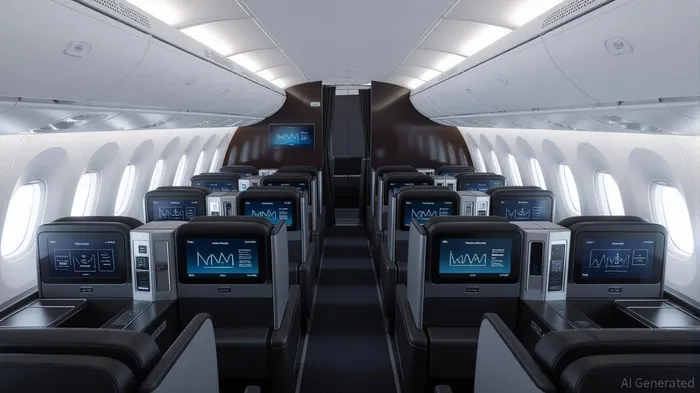
Singapore Airlines' decision to deploy the A350-900 Long Haul on high-demand routes like London Heathrow (LHR) from July 2026 underscores its operational agility. While the A350 replaces the larger BoeingBA-- 777-300ER on this route, reducing total capacity and eliminating First Class seats, the move is not a concession but a calculated pivot. The A350 will debut SIA's redesigned Business Class cabin, featuring privacy doors, alternating seat orientations, and “honeymoon pairs” for couples—a layout inspired by Qantas' Safran Unity design. This cabin, paired with a 2% increase in Economy Class capacity (from 187 to 192 seats), balances premium differentiation with operational efficiency.
The A350's versatility extends beyond Heathrow. SIASLGN-- is using the aircraft to optimize seasonal demand, such as deploying it on the Singapore–Auckland route with an A380 and temporarily suspending services to Barcelona via a SIA Engineering Company retrofit. These adjustments highlight SIA's ability to reallocate assets dynamically, ensuring fleet utilization aligns with peak travel periods and market fluctuations. For investors, this agility is critical in an industry where fixed costs and volatile demand can erode margins.
Premium Innovation: A Catalyst for Premium Pricing
The A350 retrofit program is more than a cosmetic overhaul—it's a strategic investment in premium cabin innovation. The new Business Class seats, with 4K-resolution screens, USB-C and wireless charging, and Bluetooth connectivity, align with global trends toward tech-enhanced luxury. SIA's decision to introduce First Class cabins on the A350-900ULR variant by 2027 further cements its position as a premium leader. These upgrades are not just about comfort; they're about commanding higher yields.
Historically, SIA has used London Heathrow as a launchpad for premium innovations, such as the 2002 “SpaceBed” and 2017 A380 Business Class. The A350's new cabin, set to debut on this route, is likely to attract high-value travelers willing to pay a premium for privacy and modernity. In an era where Middle Eastern carriers dominate the “kangaroo route” (London–Australia), SIA's A350 upgrades could reassert its competitive edge by offering a differentiated product.
Financial Resilience and Investor Confidence
SIA's financials reinforce the rationale for its strategic bets. For FY2024/25, the airline reported record group revenue of S$19.5 billion, with a net profit of S$2.78 billion despite margin compression from fuel and staff costs. Its robust cash reserves (S$8.3 billion) and conservative debt-to-equity ratio (0.82) provide a buffer for capital-intensive projects like the A350 retrofit. Investors are also incentivized by SIA's digital transformation, including AI-driven tools like Jarvis (an internal knowledge assistant) and the Flight Recommender (a GenAI-powered booking tool), which enhance operational efficiency and customer satisfaction.
Route Optimization: Balancing Capacity and Demand
SIA's Winter 2025–2026 schedule adjustments exemplify its route optimization strategy. For instance, the airline is increasing frequencies on the Singapore–Frankfurt route to 13 weekly flights using the A350-900, while temporarily suspending services to Seoul Incheon during off-peak months. These moves reflect a data-driven approach to capacity management, ensuring that resources are allocated to routes with the highest demand and profitability.
The A350's role in regional operations—replacing 787-10s on routes to Denpasar and Kuala Lumpur—also highlights its versatility. By using the A350 for both long-haul and regional missions, SIA reduces fleet complexity and capital expenditures, a critical advantage in an industry where asset utilization directly impacts profitability.
Investment Implications
For long-term investors, SIA's A350 strategy represents a dual opportunity: 1. Premium Yield Capture: The new Business and First Class cabins are designed to attract high-margin travelers, a demographic that drives profitability in the premium travel segment. 2. Operational Efficiency: The A350's fuel efficiency and flexible deployment options reduce costs and enhance resilience against demand volatility.
However, risks remain. The retrofit program's $1.1 billion price tag is a significant investment, and delays in Boeing 777-9 deliveries could strain short-term liquidity. That said, SIA's strong balance sheet and history of prudent capital management mitigate these concerns.
Conclusion
Singapore Airlines' A350 fleet upgrades and route changes are not isolated initiatives but part of a broader strategy to redefine premium air travel in the post-pandemic era. By combining operational agility with cutting-edge cabin innovation, SIA is positioning itself to outperform peers in both customer satisfaction and financial returns. For investors, the airline's ability to balance innovation with fiscal discipline makes it a compelling long-term bet in a sector still navigating uncertainty. As the first retrofitted A350s enter service in 2026, the market will be watching closely to see how these strategic moves translate into sustained shareholder value.

Delivering real-time insights and analysis on emerging financial trends and market movements.
Latest Articles
Stay ahead of the market.
Get curated U.S. market news, insights and key dates delivered to your inbox.
AInvest
PRO
AInvest
PRO



Comments
No comments yet