
Strategic Reinvention in Legacy Media: How Digital Agility and Content Diversification Can Reshape the Industry
 Aime Summary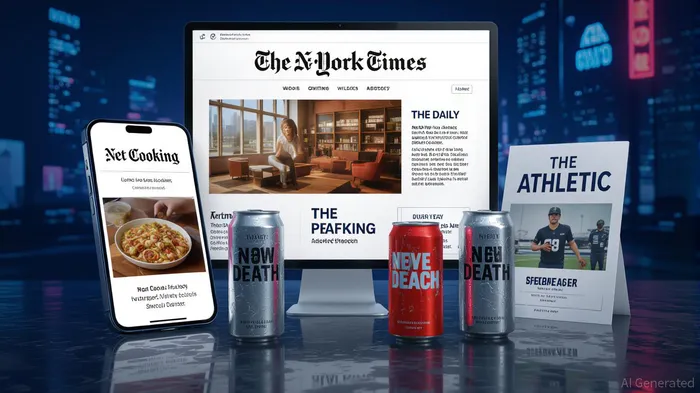
The media landscape is at a crossroads. For decades, legacy publishers like The New York Times (NYT) relied on print-centric models, but the digital age has forced a reckoning. Audiences now demand immediacy, personalization, and engagement—qualities that traditional media often struggle to deliver. Yet, as the NYT's recent transformation and Liquid Death's meteoric rise demonstrate, reinvention is not only possible but profitable. By adopting agile, content-driven strategies and prioritizing audience-centric innovation, legacy media can pivot from obsolescence to relevance.
The NYT's Digital Reinvention: Bundling, Diversification, and AI-Driven Engagement
Since 2020, The New York Times has redefined its business model through a digital-first strategy centered on three pillars: subscription bundling, content diversification, and audience personalization. By 2025, the NYTNYT-- had 11.88 million digital subscribers, with 50% of users opting for multi-product bundles that include Cooking, Games, Wirecutter, and The Athletic. This approach has boosted average revenue per user (ARPU) to $9.64 in Q2 2025, a 15.5% operating margin, and a subscriber base on track to hit 15 million by 2027.
The NYT's success lies in its ability to create “sticky” content ecosystems. Acquisitions like Wordle (2022) and The Athletic (2020) have anchored its digital offerings in lifestyle and niche interests, while AI tools like Brand Match and GoogleGOOGL-- BigQuery enable hyper-targeted advertising. The licensing deal with AmazonAMZN-- for generative AI content further underscores its pivot toward monetizing intellectual property in the AI era.
Liquid Death's Disruptive Blueprint: Branding as a Billboard
While the NYT's strategy is rooted in content and data, Liquid Death's approach is a masterclass in unconventional branding and cultural virality. From 2020 to 2025, the brand transformed bottled water into a cultural phenomenon by leveraging absurd humor, guerrilla marketing, and sustainability. Its “Sell Your Soul” campaign, Super Bowl parody ads, and partnerships with Live NationLYV-- festivals generated $263 million in revenue by 2023—a 139% increase from 2021.
Liquid Death's secret sauce? Juxtaposition. By packaging water in beer-style aluminum cans and pairing it with heavy metal aesthetics, the brand created a paradox that demanded attention. Its social media strategy—centered on TikTok and Instagram—prioritized entertainment over sales pitches, amassing 6 million followers and 400,000 monthly search queries. Crucially, the brand's sustainability angle (“Death to Plastic”) aligned with Gen Z's values, turning eco-consciousness into a revenue driver.
Parallels for Legacy Media: Agility, Creativity, and Audience-Centricity
The NYT and Liquid Death share a common thread: audience-first innovation. Both brands have moved beyond traditional product offerings to create ecosystems that engage users emotionally and functionally. For legacy media, this means:
1. Bundling for Value: The NYT's multi-product subscriptions mirror Liquid Death's product line extensions (e.g., iced tea, Death Dust). By diversifying revenue streams, media companies reduce reliance on single content formats.
2. Cultural Relevance: Liquid Death's viral campaigns and the NYT's AI-driven content both prioritize cultural agility. Legacy media must embrace humor, pop cultureCPOP--, and meme-driven storytelling to resonate with younger audiences.
3. Sustainability as a Selling Point: Just as Liquid Death leveraged eco-conscious packaging, media companies can highlight ethical practices (e.g., carbon-neutral publishing) to attract socially responsible consumers.
Investment Implications: The Case for Digital-First Media
For investors, the NYT's $1.4 billion valuation and Liquid Death's $1.4 billion market cap illustrate the financial potential of digital reinvention. The NYT's disciplined cost management—despite 5.8% year-over-year operating cost increases—proves that profitability is achievable in a digital-first model. Meanwhile, Liquid Death's 12% marketing spend (vs. 20–30% industry average) highlights the efficiency of creativity-driven growth.
Legacy media companies that fail to adapt risk obsolescence. However, those that emulate the NYT and Liquid Death—by prioritizing agility, diversification, and audience engagement—can unlock long-term value. For example, the NYT's Amazon licensing deal and Liquid Death's Death Dust expansion demonstrate how adjacent revenue streams can mitigate risks in saturated markets.
Conclusion: The Future of Media is Digital, Diversified, and Disruptive
The digital age demands more than incremental change—it requires strategic reinvention. The New York Times and Liquid Death exemplify how legacy brands can thrive by embracing bold branding, data-driven personalization, and cultural relevance. For investors, the lesson is clear: media companies that pivot to digital-first ecosystems, diversify revenue streams, and prioritize audience-centric innovation will outperform peers in the post-print era.
As the NYT's stock price and Liquid Death's valuation suggest, the future belongs to those who dare to disrupt.

Delivering real-time insights and analysis on emerging financial trends and market movements.
Latest Articles
Stay ahead of the market.
Get curated U.S. market news, insights and key dates delivered to your inbox.
AInvest
PRO
AInvest
PRO



Comments
No comments yet