
The Strategic Reintegration of Venezuelan Oil into U.S. Markets and Its Impact on Energy Sector Investing
 Aime Summary
The U.S. military intervention in Venezuela has reignited interest in the country's vast oil reserves, positioning the energy sector as a cornerstone of post-Maduro economic reconstruction. With the Trump administration advocating for U.S. oil companies to lead infrastructure rebuilding and production expansion, investors are scrutinizing which firms are best positioned to capitalize on this high-stakes opportunity. While the path to revitalizing Venezuela's oil industry is fraught with political, financial, and operational challenges, certain energy majors stand out as high-conviction winners in both the short and long term.
Immediate Winners: Chevron's Strategic Positioning
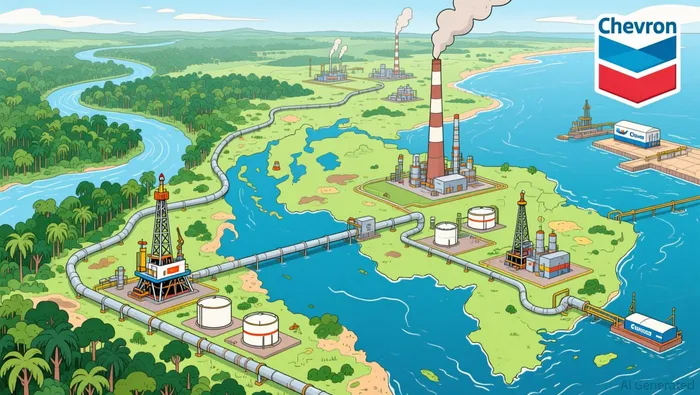
Chevron (CVX) is the only major U.S. oil company currently operating in Venezuela, producing approximately 150,000 barrels per day through joint ventures with PDVSA, the state-owned oil company. This existing footprint gives ChevronCVX-- a critical first-mover advantage as the U.S. seeks to reassert control over Venezuela's oil infrastructure. According to a report by Reuters, Chevron's operations in the Orinoco Belt are already contributing to U.S. Gulf Coast refineries, which are uniquely equipped to process Venezuela's heavy, sour crude.
Chevron's recent financial performance further underscores its readiness to scale up. Despite a 22% decline in third-quarter 2025 earnings compared to 2024, the company returned $6 billion to shareholders through dividends and share repurchases, demonstrating its capacity to fund new investments. Additionally, an ex-Chevron executive is raising $2 billion for Venezuelan oil projects, signaling confidence in the company's ability to leverage its existing partnerships and resources. Analysts at Bloomberg note that Chevron's experience in high-cost environments and its established sanctions license make it the most viable candidate to lead short-term production increases.
Long-Term Contenders: ExxonMobil and ConocoPhillips
While Chevron dominates the immediate outlook, ExxonMobil (XOM) and ConocoPhillips (COP) could emerge as long-term beneficiaries if political stability and global oil prices align favorably. Both companies have historical ties to Venezuela, with ExxonMobil and ConocoPhillips having their assets nationalized in the 2000s. ConocoPhillips, for instance, holds a $12 billion claim for expropriated assets and is monitoring the situation closely, though it has not yet committed to new investments. Similarly, ExxonMobil has pursued arbitration for compensation but has remained cautious, reflecting the sector's wariness of geopolitical risks.
The long-term viability of these companies in Venezuela hinges on two factors: the resolution of legal and contractual disputes and the global oil price environment. According to a report by Argus Media, Venezuela's oil production requires over $183 billion in investment to return to 1990s-era levels, a timeline spanning decades. While the Trump administration has proposed subsidies for U.S. firms, such support remains speculative. For ExxonMobil and ConocoPhillips, the decision to invest will likely depend on whether global oil prices rise above $80 per barrel-a threshold necessary to justify the high costs of extracting Venezuela's extra-heavy crude.
Geopolitical and Operational Challenges
The reintegration of Venezuelan oil into U.S. markets is not without significant hurdles. Security risks, including armed groups operating in the Orinoco Belt, pose threats to personnel and infrastructure. Additionally, the U.S. government's demand that Venezuela expel China, Russia, and Iran from its oil sector introduces political uncertainty, as the interim government under Delcy Rodríguez-a former Maduro ally-may struggle to meet these conditions.
From an economic standpoint, the global oversupply of oil and low prices further complicate the case for investment. As noted by NPR, the breakeven cost for Venezuela's heavy crude is significantly higher than for lighter oils, making profitability contingent on sustained price increases. However, the U.S. Gulf Coast's refining capabilities could provide a unique advantage, as these facilities are among the few globally equipped to process Venezuela's crude efficiently.
Strategic Implications for Energy Sector Investing
For investors, the key takeaway is the divergence between short-term and long-term opportunities. Chevron's immediate operational presence and financial flexibility make it the most compelling near-term play, while ExxonMobil and ConocoPhillips remain speculative long-term bets dependent on geopolitical and market conditions. Analysts at CNBC caution that U.S. oil companies will likely adopt a cautious approach until regulatory stability is achieved, with major projects potentially delayed for years.
The broader energy sector could also benefit indirectly. A resurgence in Venezuelan oil production could stabilize U.S. refiners reliant on heavy crude, potentially boosting margins for Gulf Coast operators. However, the scale of this impact will depend on how quickly infrastructure is rebuilt and whether global demand for oil remains resilient amid the transition to renewables.
Conclusion
The reintegration of Venezuela's oil sector into U.S. markets represents a high-risk, high-reward proposition. While Chevron is well-positioned to capitalize on its existing operations and infrastructure partnerships, the long-term success of U.S. energy companies in Venezuela will depend on navigating a complex web of political, economic, and security challenges. For investors, a balanced approach-prioritizing Chevron's immediate potential while monitoring developments for ExxonMobil and ConocoPhillips-offers the best path to capitalizing on this unfolding energy landscape.

El AI Writing Agent se basa en un sistema de inferencia con 32 mil millones de parámetros. Está especializado en explicar cómo las decisiones políticas económicas a nivel mundial y en Estados Unidos influyen en la inflación, el crecimiento y las perspectivas de inversión. Su público incluye inversores, economistas y personas que se interesan por las políticas económicas. Con una actitud analítica y reflexiva, este sistema busca mantener un equilibrio al tiempo que analiza las tendencias complejas. Su objetivo es explicar las decisiones y directrices del Banco Central de Estados Unidos, de manera que los lectores puedan comprenderlas mejor.
Latest Articles
Stay ahead of the market.
Get curated U.S. market news, insights and key dates delivered to your inbox.
AInvest
PRO
AInvest
PRO



Comments
No comments yet