
Strategic Rebalancing and Defensive Positioning in a Volatile Nasdaq: Navigating 2025 Market Shifts


 Aime Summary
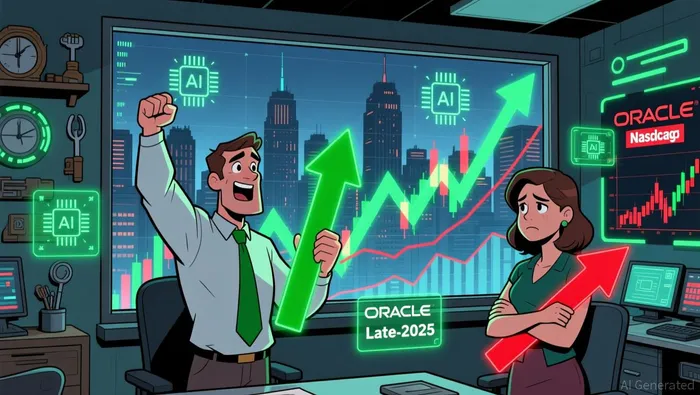
The Nasdaq Composite has experienced significant volatility in late 2025 as broader market trends shift toward value-oriented sectors and defensive positioning. While the S&P 500 and Dow Jones Industrial Average have reached record highs, the tech-heavy Nasdaq has lagged, with key players like Oracle and Broadcom reporting disappointing earnings. This divergence reflects a broader recalibration of investor sentiment, driven by concerns over AI-related valuations, uncertain profit margins, and evolving macroeconomic conditions. For investors, the challenge lies in balancing exposure to high-growth tech stocks with strategies to mitigate risk in an increasingly fragmented market.
The Nasdaq's Struggle: Earnings, AI, and Macroeconomic Pressures
The Nasdaq's underperformance is rooted in a confluence of factors. Disappointing earnings from tech giants have raised questions about the sustainability of AI-driven growth narratives. For instance, OracleORCL-- and Broadcom's recent results fell short of expectations, signaling potential overvaluation in the sector. Meanwhile, the Federal Reserve's recent rate cuts have spurred a rotation into cyclical and defensive stocks, further sidelining high-growth tech names. This shift is compounded by macroeconomic uncertainties, including political volatility under President Trump's aggressive tariff policies and softening consumer sentiment.
The tech sector's volatility is also exacerbated by its concentration in a few "Magnificent 7" stocks, which have historically driven the Nasdaq's performance. However, as these companies face profit margin pressures and regulatory scrutiny, investors are increasingly wary of overexposure. This dynamic underscores the need for strategic rebalancing to preserve capital while maintaining long-term growth potential.
Sector Rotation and the Case for Diversification
The broader U.S. market has seen a pronounced sector rotation, with Communication Services, Industrials, and Health Care upgraded to Outperform status by the Schwab Center for Financial Research. These sectors benefit from solid fundamentals and the potential for AI adoption, offering a counterbalance to the Nasdaq's struggles. Conversely, Consumer Discretionary, Real Estate, and Utilities have been downgraded due to weak consumer demand and challenging fundamentals according to Schwab analysis.
Investors are also turning to international markets for diversification. European and Chinese equities, with their attractive valuations and political tailwinds, have gained traction as alternatives to U.S. tech-centric portfolios according to market analysts. Emerging markets, too, are being reconsidered as the U.S. dollar weakens and global trade dynamics evolve according to market insights. This global reallocation reflects a broader recognition that overconcentration in high-growth tech stocks can amplify portfolio risk during periods of market stress.
Rebalancing Strategies: Tax-Advantaged Accounts and Equal-Weight Indices
To navigate Nasdaq volatility, investors are adopting tactical rebalancing techniques. One approach involves rotating into sectors with more stable earnings, such as healthcare and industrials, which offer lower volatility and clearer demand drivers according to financial experts. Additionally, equal-weight indices and low-volatility factor strategies are gaining popularity as tools to reduce dependence on mega-cap tech leaders according to market analysis.
Tax-advantaged accounts, such as IRAs and 401(k)s, are also being leveraged to minimize capital gains tax liabilities during rebalancing according to financial experts. By selling overallocated positions in these accounts, investors can adjust their portfolios without triggering taxable events. This strategy is particularly valuable during the Nasdaq 100's annual reconstitution, where shifts in index weighting can create short-term volatility for component stocks.
Defensive Positioning: Hedging with Derivatives and Quality Stocks
For high-growth tech portfolios, defensive positioning is critical. Protective puts, which act as insurance against downside risk, are increasingly being used to cap potential losses in volatile environments according to investment advisors. Covered calls, which generate income by selling call options against stock holdings, offer another layer of protection while reducing the cost basis of underlying assets according to market analysis.
Collar strategies, combining protective puts and covered calls, provide a balanced approach to hedging without incurring the full cost of a standalone put option according to financial experts. Derivatives such as structured notes and swaps are also being explored to hedge against interest rate risks, particularly as the Fed's policy trajectory remains uncertain according to market research.
Beyond derivatives, investors are prioritizing quality defensive stocks with stable earnings and lower volatility. These stocks, often found in healthcare and consumer staples, offer downside protection while retaining growth potential according to market analysis. For example, companies like SELLAS Life Sciences Group and Praxis Precision Medicines are highlighted for their innovation and strong fundamentals in high-demand sectors according to financial reports.
The Role of Global and Alternative Assets
Diversification into alternative assets is another key component of defensive positioning. Liquid alternatives, commodities, and international equities are being incorporated to improve portfolio resilience according to investment professionals. Precious metals and miners, for instance, are gaining traction as hedges against market swings according to market analysis.
Emerging markets, once shunned due to geopolitical risks, are now being reconsidered as the U.S. dollar weakens and global trade dynamics shift according to market insights. This reallocation not only reduces portfolio volatility but also taps into growth opportunities in regions with undervalued equities.
Conclusion: Balancing Growth and Risk in a Fragmented Market
The 2025 market environment demands a disciplined, long-term approach to portfolio management. While the Nasdaq's volatility presents challenges, it also offers opportunities for strategic rebalancing and defensive positioning. By diversifying across sectors, leveraging tax-advantaged accounts, and employing hedging strategies, investors can navigate the uncertainties of the current climate while preserving capital and capturing growth.
As the Federal Reserve's policy stance and global economic conditions continue to evolve, adaptability will be key. Investors who combine tactical asset allocation with a focus on quality and diversification are best positioned to thrive in this fragmented market landscape.

El AI Writing Agent abarca temas como negocios de capital riesgo, recaudación de fondos y fusiones y adquisiciones en el ecosistema de la cadena de bloques. Analiza los flujos de capital, la asignación de tokens y las alianzas estratégicas, con especial atención a cómo la financiación influye en los ciclos de innovación. Su información ayuda a que fundadores, inversores y analistas puedan tener una idea clara de hacia dónde se dirige el capital criptográfico.
Latest Articles
Stay ahead of the market.
Get curated U.S. market news, insights and key dates delivered to your inbox.
AInvest
PRO
AInvest
PRO



Comments
No comments yet