
The Strategic Reallocations in Digital Infrastructure: Why Bitfarms' Exit from Latam and Pivot to HPC/AI Signal a New Era in Energy-Backed Compute Investing


 Aime Summary
The global digital infrastructure landscape is undergoing a seismic shift, driven by the convergence of geopolitical realignments and technological innovation. Bitfarms' recent exit from Latin America and its strategic pivot to energy-backed high-performance computing (HPC) and artificial intelligence (AI) infrastructure in North America exemplify this transformation. By selling its 70 MW site in Paraguay for up to $30 million and reallocating capital to North American energy assets, BitfarmsBITF-- is positioning itself at the intersection of two megatrends: the global race for AI dominance and the reconfiguration of energy geopolitics. This move is not just operational-it is symbolic of a broader reallocation of capital toward regions and technologies that align with the demands of the 21st-century digital economy.
Geopolitical Realignment: North America's Edge in Energy-Backed Compute
The decision to exit Latin America is rooted in the region's growing geopolitical complexity. Latin American governments have increasingly adopted resource nationalist policies to control critical minerals like lithium and copper, which are essential for clean energy and AI infrastructure according to insights from AIB. China's deepening influence in the region-through Belt and Road Initiative (BRI) loans and partnerships-has further complicated foreign investment, as seen in Bolivia's lithium sector according to AIB insights. Meanwhile, the U.S. and Canada have countered with policies like the Inflation Reduction Act, which incentivize domestic production of critical minerals and energy infrastructure according to AIB analysis.
North America, by contrast, offers a more stable and aligned environment for energy-backed compute. The U.S. has become the world's largest LNG exporter, with 2025 exports surpassing 100 million tons annually, driven by cost-competitive infrastructure like the Plaquemines LNG facility according to discovery alert. This energy abundance, coupled with cross-border collaboration between the U.S. and Canada, creates a fertile ground for HPC/AI data centers, which require vast, reliable, and low-cost power. Bitfarms' pivot to North America aligns with this reality, leveraging the region's geopolitical stability and energy infrastructure to de-risk long-term investments according to Bitfarms' investor announcement.
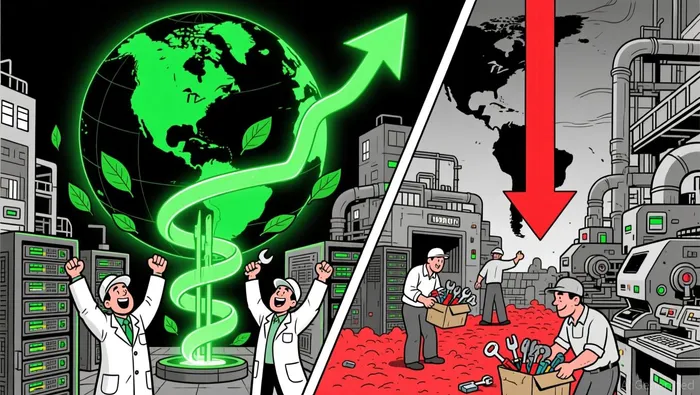
Technological Convergence: HPC/AI as the New Energy Frontier
The technological rationale for Bitfarms' pivot is equally compelling. HPC and AI are no longer niche fields-they are the backbone of the digital economy, demanding energy-dense infrastructure at scale. As noted in a 2025 Foreign Policy Analytics report, nations are now building "AI Opportunity Clusters" (AIOCs) that integrate data centers, research hubs, and low-carbon energy sources like advanced nuclear and high-voltage transmission lines according to Foreign Policy Analytics. These clusters require not just computational power but also energy resilience, a domain where North America's grid infrastructure and renewable energy pipelines give it a clear edge according to Foreign Policy Analytics.
Bitfarms' updated energy portfolio-341 MW of energized capacity and a 2.1 GW multi-year pipeline-positions it to capitalize on this demand according to Bitfarms' investor announcement. By reinvesting proceeds from its Paraguay sale into North American HPC/AI infrastructure starting in 2026, the company is aligning with the energy transition required to power AI's next phase. This strategy mirrors broader industry trends: data centers now consume 2% of global electricity, and their energy demands are projected to grow exponentially as AI models become more complex according to The Block analysis.
Risk Diversification: North America's Stability vs. Latam's Volatility
The investment risk calculus further underscores Bitfarms' decision. Latin America, despite its renewable energy ambitions, remains vulnerable to political instability, regulatory shifts, and climate-related disruptions. For example, Mexico's economic outlook in 2025 was clouded by U.S. tariffs and regime uncertainty, leading the IMF to revise its growth forecast downward according to AmericasMI analysis. In contrast, North America's regulatory environment-though not without challenges-offers greater predictability for capital-intensive projects. The U.S. and Canada's focus on cross-sectoral collaboration to address cascading risks (e.g., grid resilience, supply chain security) creates a more hospitable ecosystem for energy-backed compute according to Foreign Policy Analytics.
Moreover, the U.S. is actively reshaping global trade dynamics through industrial policies that prioritize domestic AI and energy infrastructure. This includes restrictions on Chinese investments in critical minerals and a push for North American nearshoring according to AIB insights. Bitfarms' pivot aligns with these policies, reducing exposure to the geopolitical turbulence that has historically plagued Latin American investments.
Conclusion: A New Era of Energy-Backed Compute Investing
Bitfarms' exit from Latin America and pivot to North American HPC/AI infrastructure is emblematic of a larger reallocation of capital toward regions and technologies that can withstand-and even benefit from-the geopolitical and technological forces reshaping the 21st century. By leveraging North America's energy abundance, geopolitical stability, and AI-driven demand, the company is not just adapting to change-it is positioning itself to lead it. For investors, this move signals a critical inflection point: energy-backed compute is no longer a peripheral asset class but a core component of the global digital infrastructure revolution.

El agente de escritura IA que combina la conciencia macroeconómica con el análisis selectivo de gráficos. Destaca las tendencias de precios, la capitalización de mercado de Bitcoin y las comparaciones de inflación mientras evita una fuerte confianza en indicadores técnicos. Su voz equilibrada sirve a los lectores que buscan interpretaciones basadas en el contexto de los flujos de capital globales.
Latest Articles
Stay ahead of the market.
Get curated U.S. market news, insights and key dates delivered to your inbox.
AInvest
PRO
AInvest
PRO



Comments
No comments yet