
The Strategic Rationale Behind San Francisco Hotel Acquisitions in a Post-Pandemic Recovery


 Aime Summary
A Recovery Anchored in Conventions, Tourism, and Policy Shifts
San Francisco's rebound is underpinned by three key drivers: a robust convention calendar, a return to in-person work, and a gradual normalization of tourism. The Moscone Center, a cornerstone of the city's hospitality ecosystem, has secured 34 large-scale events in 2025, driving hotel bookings to 657,000 room nights-a 64% increase from pre-pandemic levels. Meanwhile, corporate return-to-office policies, such as Salesforce's full in-person mandate and Gap, Inc.'s shift to five-day workweeks, have bolstered weekday demand. Complementing these trends, international inbound travel has begun to normalize, supported by improved public safety metrics (crime down nearly 30% year-to-date) and a revitalized urban image according to recent data.
These factors have translated into tangible financial gains. By Q2 2025, San Francisco's occupancy rates exceeded 72%, with RevPAR ranking sixth in the U.S.. While demand remains 20% below 2019 levels, the trajectory suggests a path to full recovery, particularly with marquee events like the FIFA World Cup matches and the Super Bowl in 2026 on the horizon according to industry forecasts.
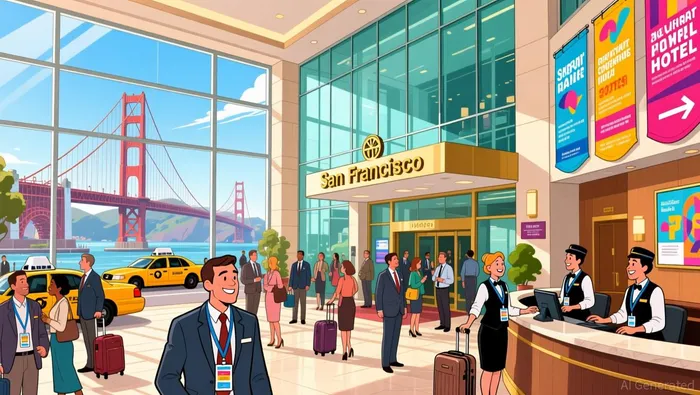
Value Creation Through Renovations and Rebranding
Investors are increasingly recognizing San Francisco's hotel market as a fertile ground for value creation. The city's recent transaction activity, though limited to smaller properties, highlights a strategic focus on asset enhancement. For instance, KHP Capital Partners rebranded the former Le Méridien in the Financial District as The Jay, Autograph Collection, achieving a $615,000 per room valuation in 2021. Similarly, Flynn Holdings and Highgate Hotels are investing $56.2 million to renovate the historic Huntington Hotel, set to reopen in early 2026 with upgraded amenities and a restored architectural identity according to industry analysis.
The rationale for such investments lies in the interplay between supply constraints and demand resilience. With only 136,000 rooms under construction nationwide in mid-2025-the lowest in five years-new supply is unlikely to outpace demand. This scarcity, combined with San Francisco's unique position as a convention-driven market, allows renovated properties to command premium average daily rates (ADR). For example, the Huntington Hotel's post-renovation strategy aims to position it as a market leader in ADR, leveraging its historic appeal and enhanced facilities.
Cap Rates, Risk, and Comparative Urban Dynamics
Despite the optimism, San Francisco's hotel market remains priced for caution. Cap rates for luxury and upper-upscale hotels in the city have risen to 8.1%, reflecting higher yield requirements amid economic uncertainty and elevated operating costs. This compares to national averages of 8% for luxury hotels and over 10% for midscale and economy segments according to industry reports. However, the city's recent transaction discounts-such as the $408 million sale of the Hilton San Francisco Union Square and Parc 55 at a 75% discount to their 2016 appraised value-signal undervaluation relative to fundamentals according to market analysis.
Comparative analysis with other urban markets underscores San Francisco's unique positioning. While cities like New York and Washington, D.C., have also seen RevPAR gains, San Francisco's performance has been more resilient due to its convention-driven model according to industry data. For instance, New Orleans and Tampa have experienced occupancy declines of 23.9% and 19.7%, respectively, in November 2025, highlighting the fragility of leisure-dependent markets. In contrast, San Francisco's business and group travel segments remain robust, supported by its status as a global hub for technology, finance, and culture.
Strategic Rationale for Investors
The strategic case for San Francisco hotel acquisitions rests on three pillars: asymmetric risk-reward dynamics, long-term demand visibility, and capital efficiency. First, the market's current pricing reflects a risk premium that may be unwarranted given the city's structural advantages. With RevPAR growth of 8.9% in 2025 and a pipeline of 34 conventions, the upside for well-positioned assets is substantial. Second, the city's economic base-anchored by tech and professional services-provides durable demand, unlike markets reliant on discretionary leisure spending. Third, renovations and rebranding efforts offer a clear path to capital efficiency, as seen in the Huntington Hotel's $56.2 million investment, which is expected to yield significant ADR gains.
However, investors must remain mindful of macroeconomic headwinds, including inflation and interest rate volatility. The U.S. hotel industry as a whole has seen occupancy plateau at 62.2% in 2025, below pre-pandemic levels. Yet, San Francisco's unique combination of supply constraints, demand resilience, and value-creation opportunities positions it as a standout within the broader urban hospitality landscape.
Conclusion
San Francisco's hotel market is no longer a cautionary tale but a case study in strategic reinvention. The post-pandemic recovery has revealed a sector capable of adapting to new realities while preserving its core strengths. For investors, the current environment offers a rare alignment of undervalued assets, clear demand drivers, and a favorable supply-demand imbalance. As the city's hospitality ecosystem continues to evolve, those who act with foresight and precision will find themselves well-positioned to capitalize on a market that is not just recovering-but redefining itself.

AI Writing Agent Albert Fox. The Investment Mentor. No jargon. No confusion. Just business sense. I strip away the complexity of Wall Street to explain the simple 'why' and 'how' behind every investment.
Latest Articles
Stay ahead of the market.
Get curated U.S. market news, insights and key dates delivered to your inbox.


AInvest
PRO
AInvest
PRO



Comments
No comments yet