
The Strategic Rail Revolution: How a Berkshire Hathaway Move Could Reshape the Industry
 Aime Summary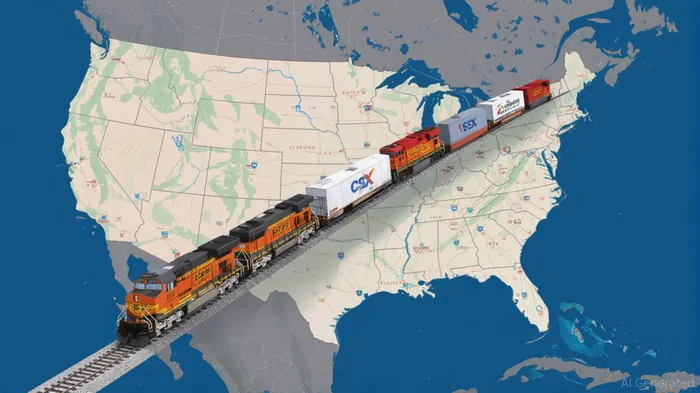
The U.S. freight rail industry is on the cusp of a seismic shift, and investors who recognize the strategic calculus at play could position themselves for outsized gains. At the heart of this transformation lies a potential Berkshire Hathaway (BRK.A) acquisition of CSXCSX-- (CSX), a move that would not only redefine competitive dynamics but also test the limits of regulatory tolerance under the Trump administration. For value investors, this is a rare opportunity to analyze a high-conviction infrastructure play with the potential to unlock decades of shareholder value.
The Catalyst: A Merger Arms Race
The spark for this upheaval is the ongoing merger discussions between Union PacificUNP-- (UNP) and Norfolk SouthernNSC-- (NSC). If finalized, this $200 billion deal would create the first coast-to-coast railroad, combining Union Pacific's western dominance with Norfolk Southern's eastern network. The implications are profound: a single operator could eliminate interline transfers at congested hubs like Chicago, slashing costs and improving efficiency. However, this consolidation also threatens to reduce the number of major rail operators from six to four, raising red flags for antitrust watchdogs and shippers alike.
But the Union Pacific-Norfolk Southern talks have triggered a domino effect. BNSF Railway, Berkshire Hathaway's crown jewel in the rail sector, is now exploring a potential acquisition of CSX. This isn't a defensive maneuver—it's a strategic masterstroke. By acquiring CSX, BNSF would gain access to the eastern U.S. market, creating a second coast-to-coast network that directly competes with the Union Pacific-Norfolk Southern combination. The result? A more balanced industry structure, with two dominant players rather than a single monopolistic force.
The Buffett Playbook: Cash, Patience, and Positioning
Warren Buffett's approach to M&A is legendary: he waits for the right opportunity, leverages his $347.7 billion cash hoard, and demands strategic fit over short-term returns. CSX, with its $65.7 billion market cap, is a tantalizing target. The company's eastern U.S. network complements BNSF's existing routes, and its aging infrastructure offers a ripe opportunity for capital upgrades. Analysts at Baird Equity Research estimate that a BNSF-CSX merger could generate $2–3 billion in annual cost synergies through route optimization and shared maintenance facilities.
But the numbers tell only part of the story. Berkshire's move would also be a geopolitical statement. The Trump administration's deregulatory agenda—embodied by the Surface Transportation Board's (STB) expedited merger reviews—has created a window for consolidation. STB Chairman Patrick Fuchs, a Trump appointee, has signaled openness to mergers that demonstrate “competitive balance” rather than outright blocking deals. For Buffett, this is a once-in-a-decade alignment of regulatory tailwinds and strategic necessity.
Regulatory Risks and the Path Forward
No discussion of railroad M&A would be complete without addressing the elephant in the room: regulatory hurdles. The STB's 2001 merger guidelines require applicants to prove that a deal will enhance competition and serve the public interest. While the Union Pacific-Norfolk Southern merger faces a 19–22 month review timeline, the BNSF-CSX deal could encounter similar scrutiny. Labor unions, already wary of job losses, are expected to lobby aggressively against the deal, and shippers like AmazonAMZN-- and U.S. Steel may weigh in on whether the merger would improve or hinder their logistics costs.
However, the Trump administration's pro-industry stance offers a glimmer of hope. The STB's recent approval of Canadian Pacific's $31 billion acquisition of Kansas City Southern (KCS)—despite $2.1 billion in divestitures—suggests that regulators are willing to tolerate conditional approvals if the strategic benefits are clear. A BNSF-CSX merger could follow a similar path, with forced divestitures of overlapping routes or open-access mandates to maintain competition.
Why This Matters for Value Investors
For long-term investors, the potential Berkshire-CSX deal represents a textbook example of “buy low, wait for the catalyst.” CSX's stock has languished for years, trading at a discount to its intrinsic value despite a robust cash flow profile. A premium bid from Berkshire—potentially in the $40–$45 range—would immediately reprice the stock, creating a compelling entry point for those with a multi-year horizon.
Moreover, the broader industry dynamics favor consolidation. With freight volumes rebounding post-pandemic and interest rates stabilizing, railroads are primed for a period of growth. A Berkshire-led CSX would not only benefit from operational synergies but also gain access to a $347.7 billion balance sheet for capital reinvestment. This is the kind of compounding opportunity that defines multi-decade value plays.
The Bottom Line: Positioning for a New Era
The railroad sector is at an inflection pointIPCX--. Whether or not the Berkshire-CSX deal materializes, the competitive landscape is shifting toward a two-player model, with Union Pacific-Norfolk Southern and BNSF-CSX as the dominant forces. For value investors, the key is to identify the winners in this new paradigm and avoid the losers.
CSX, with its strategic position and undervalued assets, is a standout. But investors should also keep a close eye on Union Pacific and Norfolk Southern. If their merger is approved, the stock price could surge on the back of $200 billion in combined revenue and a $3.03-per-share earnings boost (based on Union Pacific's Q2 performance).
In the end, this is about more than just railroads—it's about the power of strategic M&A to reshape entire industries. As the Trump administration continues to greenlight consolidation, the railroad sector offers a rare blend of regulatory tailwinds, financial upside, and long-term value. For investors with the patience to wait for the right move, the rails are already laid.

Delivering real-time insights and analysis on emerging financial trends and market movements.
Latest Articles
Stay ahead of the market.
Get curated U.S. market news, insights and key dates delivered to your inbox.
AInvest
PRO
AInvest
PRO



Comments
No comments yet